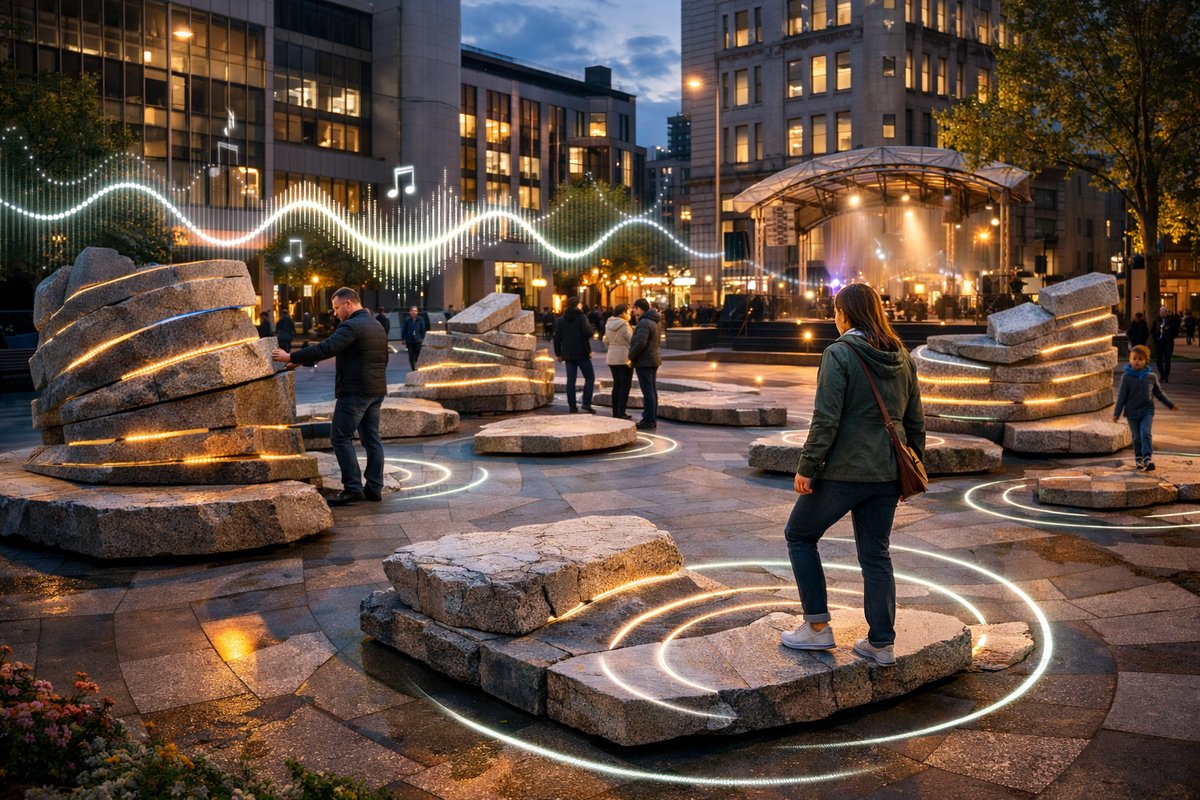

In a bustling city square once dominated by car horns and chatter, a new form of public art has begun to rewrite the urban soundtrack. Symphonic Stone is a series of sonically reactive sculptures installed at the heart of Rotterdam’s ArtSplash Festival. Each installation consists of reclaimed granite benches embedded with discreet piezoelectric sensors that detect footsteps, shifts in weight, and vibrations from passing bicycles. These signals are sent to microcontroller units housed beneath the stone, where custom generative audio software transforms them into evolving musical textures.
Developed by a collaboration of sound designers and sculptors at the MIT Media Lab, Symphonic Stone stands as a model for how technology and materials can converge to celebrate both heritage and innovation. The granite itself comes from decommissioned building façades, salvaged to reduce waste and honor the city’s architectural history. When pedestrians pause on the benches, faint notes ripple outward from directional speaker nodes concealed around the base, encouraging quiet reflection rather than intrusive noise. As more people converge, the soundscape becomes a layered tapestry of ambient chords, percussive clicks, and gentle tonal swells.
Unlike static monuments, these sculptures learn from their environment. Over the course of each weeklong festival, data logs track the average intensity and frequency of interactions. The system adapts its generative parameters to favor slower ambient drones during peak hours, then shifts toward shimmering, high-frequency motifs late at night when fewer visitors wander through. Programmers drew on principles from biomimicry and collective behavior, studying how bird flocks and fish schools adjust patterns in response to group size.
By embedding emotional intelligence into the code, the art collective aimed to craft a subtle conversation between human behavior and machine creativity. Early visitors described feeling acknowledged by the benches, as if their footsteps triggered a musical bow or a whispered greeting. One resident spoke of goosebumps upon hearing new harmonies rise and fall with the ebb and flow of the crowd. City planners are now in talks to expand Symphonic Stone to additional neighborhoods, hoping the installations will foster a sense of shared authorship over public space.
Technical workshops held alongside the festival gave curious makers access to the open source software behind the sound engine, along with step-by-step guides on soldering piezo sensors and deploying lightweight single-board computers. Dozens of attendees built miniaturized prototypes for school playgrounds, local parks, and even neighborhood plazas. Many walked away with a deeper understanding of sustainability in design-how upcycling materials can coexist with cutting-edge electronics to create experiences that are both tactile and ephemeral.
Beyond the festival grounds, Symphonic Stone has sparked conversations about the future of civic art. Can interactive installations foster genuine community engagement, or do they risk becoming tech gimmicks? Advocates point to the sculptures’ reliance on communal input as proof that participants become co-creators rather than passive spectators. The more a neighborhood embraces the benches-dancing on them, pausing to chat-the richer the sonic output becomes. It’s a feedback loop that rewards collective imagination.
Symphonic Stone also addresses ethical considerations around data collection and privacy. While sensors log interaction metrics to fine-tune the audio algorithms, they do not record personal identifiers or capture images. All data is anonymized and shared on a public repository for anyone to study. This transparent approach aligns with the project’s guiding principles: respect for individual autonomy, environmental responsibility, and open collaboration.
Critics have raised concerns about sound pollution and maintenance costs. To mitigate noise spill into adjacent residential blocks, the team designed highly directional audio modules that focus soundwaves downward toward the plaza floor. Maintenance crews received training on replacing sensor nodes and updating firmware remotely over secure wireless links, ensuring that each bench remains as responsive on day 100 as it was on unveiling day.
The intersection of sculpture, architecture, and sound design in Symphonic Stone has also drawn academic interest. Researchers from urban studies programs are conducting ethnographic studies on visitor behavior, while musicologists analyze how generative patterns reflect cultural rhythms unique to Rotterdam. Preliminary findings suggest that daytime interactions featuring commuters in a hurry yield sparse, staccato sequences, whereas evening gatherings of tourists and locals produce lush, melodic sections.
Looking ahead, the creators envision expanding the concept to include seasonal variations. Winter installations might incorporate wind sensors that trigger crystalline bell tones when gusts sweep through alleyways. Summer versions could capture humidity data to infuse new timbral elements. In each case, the sculptures become living organisms-sensitive to environmental shifts and human presence alike.
Symphonic Stone points toward a future where urban landscapes are not defined solely by static monuments or digital billboards, but by dynamic installations that blur the line between audience and artist. It invites passersby to listen closely to the hidden harmonies of the city, to recognize that every footstep, every pause, contributes to an ever-unfolding sonic tapestry. For a moment, the plaza becomes a collective instrument, inviting wonder, curiosity, and shared authorship in the art of place.
As other metropolises consider similar projects, the success of the Rotterdam installation offers a blueprint for balancing creativity, sustainability, and social connection. By welcoming sound into the heart of public sculpture, it challenges us to reimagine how design shapes experience and how our own movements can resonate-literally-as part of a greater, living composition.