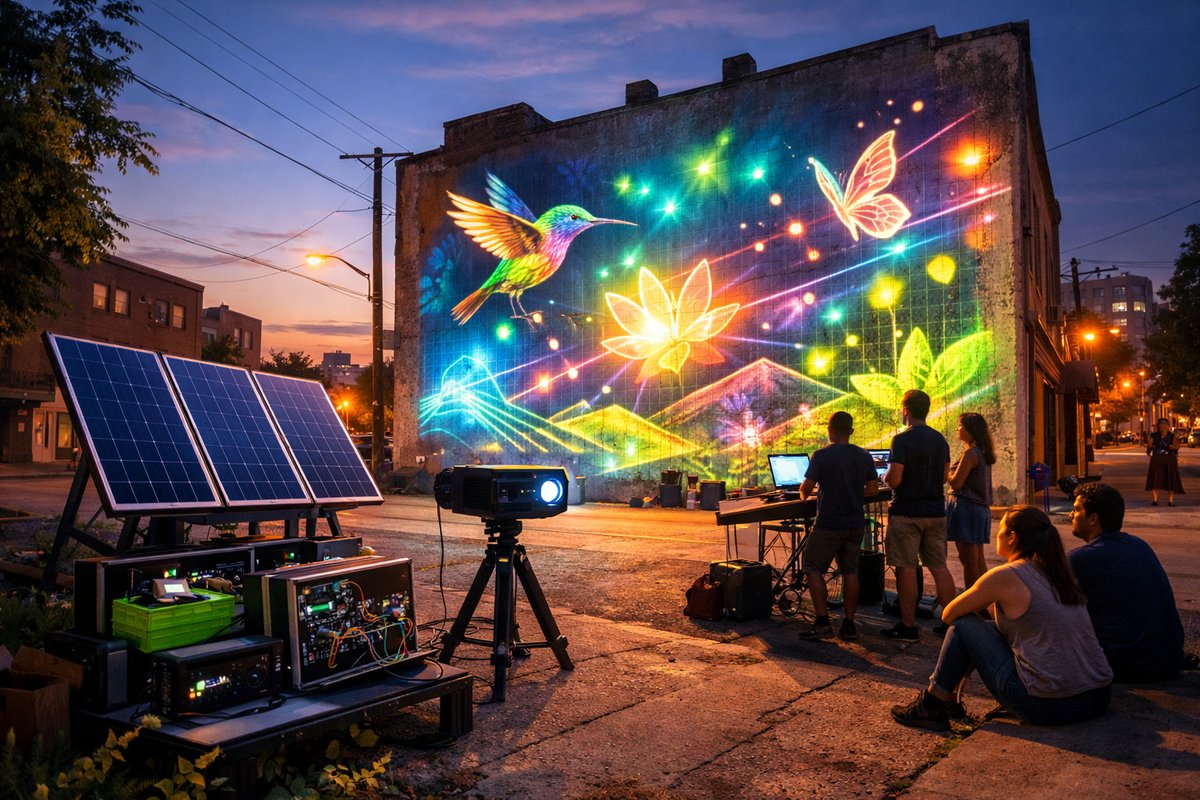

In a quiet alley off a major thoroughfare, pedestrians pause as a rusted industrial door flickers to life. Colorful shapes ripple across its weathered surface-tendrils of light respond in real time to footsteps, phones, and passing cars. This isn’t a gallery opening or a corporate event; it’s the work of a small collective of urban experimenters who have harnessed solar-powered projection mapping to breathe new energy into forgotten spaces.
Dubbed “Sunlight Signals,” the initiative began as an experiment in off-grid creativity. Its founders outfitted a standard LED projector with a portable battery bank charged by a compact foldable solar panel kit. A microcontroller board running open-source software syncs motion sensors, light detectors, and a custom media server. When night falls, the system projects generative art loops that shift based on ambient conditions-cloud cover changes the color palette, while nearby vibrations alter animation speed.
What was once a late-night prototype has grown into a series of pop-up installations across four neighborhoods in the city’s industrial district. Local camera crews document crowds gathering beneath bridges where the projection art dances across concrete pillars. Social media posts under the hashtag #SunlightSignals show families, cyclists, and late-shift workers stopping by for an unexpected moment of wonder.
“We wanted to prove that monumental art installations don’t have to rely on diesel generators or expensive wiring,” says one of the collective’s core members. “By combining biodegradable PLA filament sculptures with solar-charged projection loops, we can set up in minutes, leave no trace, and invite people to reimagine their surroundings.”
The team’s guerrilla-style deployments reflect a growing trend in both digital and sustainable art. In recent years, public art festivals have begun to mandate low-energy operations, incentivizing projects that run on wind, hydro, or solar. Even well-established light festivals now feature programs dedicated to micro-scale, carbon-neutral works. Event organizers report that audiences increasingly value installations that blend cutting-edge technology with environmental responsibility.
But Sunlight Signals isn’t just about power sources. At the heart of each installation is a suite of interactive sensors that let viewers influence the art itself. Passive infrared detectors can trigger entire animation cycles, while pressure-sensitive mats generate soundscapes tuned to each projection. When a group of pedestrians steps across a designated zone, 3D-printed sculptures embedded with LED strips react in sync, creating a multi-sensory dialogue between people and place.
The sculptures are printed onsite using portable 3D printing pens and biodegradable PLA filament. Each piece doubles as a light diffuser, scattering projector output into organic patterns that never exactly repeat. “We like the idea that these forms are temporary,” another collective member explains. “They’ll eventually break down, but in the meantime they guide the light and give it shape.”
Projects like Sunlight Signals are part of a broader shift toward ‘soft infrastructure’-artworks designed to be mobile, adaptable, and tech-enabled rather than fixed and monumental. City planners have started to welcome these ephemeral exhibits, zoning vacant lots for rotating art pods and offering permits that prioritize low-impact installations. A handful of municipalities are even piloting public charging stations at strategic intersections where artists can top up battery packs during the day.
In Midtown, a steel sculpture mounted on a parking garage facade now hosts nightly projection performances. The sculpture’s open lattice allows light to filter through, casting lattice-like shadows onto the sidewalk. Residents who once passed the garage without a second glance now linger, snapping photos and sharing them with local history groups. The piece pays homage to the building’s industrial past while pointing to a future where technology and ecology intersect.
Critics have praised these installations for their versatility. Unlike traditional murals or bronze statues, projection-based works can evolve over time. Artists can upload new content remotely, ensuring that the artwork stays fresh and responsive. One community center commissioned a weeklong series that celebrated local heritage-animating archive photos onto exterior walls. After closing hours, the projection became a silent street-level museum, open to anyone with curiosity and an internet connection.
Skeptics of high-tech public art often worry about accessibility: Are these installations welcoming to those without smartphones or tech skills? Sunlight Signals addresses this by integrating built-in physical controls-simple push buttons and color wheels-that let anyone alter the visuals without a mobile app. The goal is to spark hands-on discovery, not require a digital tutorial.
The economic case for off-grid projection art is also compelling. Compared to erecting a steel sculpture or commissioning a painted mural, a portable projector and solar kit can cost one-fifth as much. For community groups with limited budgets, the ability to self-install without renting heavy equipment or hiring electricians is a game-changer. Several neighborhood associations have already formed DIY teams, hosting workshops where volunteers learn basic projection-mapping techniques and sensor programming.
One resident-led group recently staged an event on a pedestrian bridge slated for demolition. Over three nights, they projected a time-lapse of the structure’s history, overlaid with interviews from older residents. Attendees sent postcards to city council members, advocating to preserve the bridge as a pedestrian art walkway. While the final decision remains in limbo, the campaign demonstrated how art, technology, and community advocacy can intertwine.
As the Sunlight Signals collective prepares for its next series in the waterfront district, they’re experimenting with new materials-transparent solar films applied to glass facades, and color-changing inks that respond to UV levels. They’re also refining their power management software to support clusters of synchronized projectors, enabling large-scale immersive experiences without drawing from the grid.
Beyond the technical innovations, the project’s greatest impact may be its invitation to look at the city with fresh eyes. The glow of a solar-charged projection invites passersby to pause, reflect, and interact. It reminds everyone that even the most utilitarian structures-parking garages, loading docks, or old factory walls-can become canvases for collective imagination.
In a world racing toward urban expansion and digital overload, these pop-up projection gardens offer a moment of pause. They show that art need not wait for galleries or government grants; it can emerge anywhere the sun shines and someone dares to play with light.
And as solar-powered projectors become more affordable and easier to program, cities around the globe are poised to light up in new, unexpected ways. From narrow alleys in aging industrial zones to brand-new waterfront promenades, the future of public art may very well be written in beams of sunlight and pools of color dancing on concrete.
Whether you stumble upon one of these projections by accident or seek it out deliberately, you’re bound to walk away with a reminder: creativity can thrive off the grid, and with the right tools, anyone can help shape the next urban masterpiece.