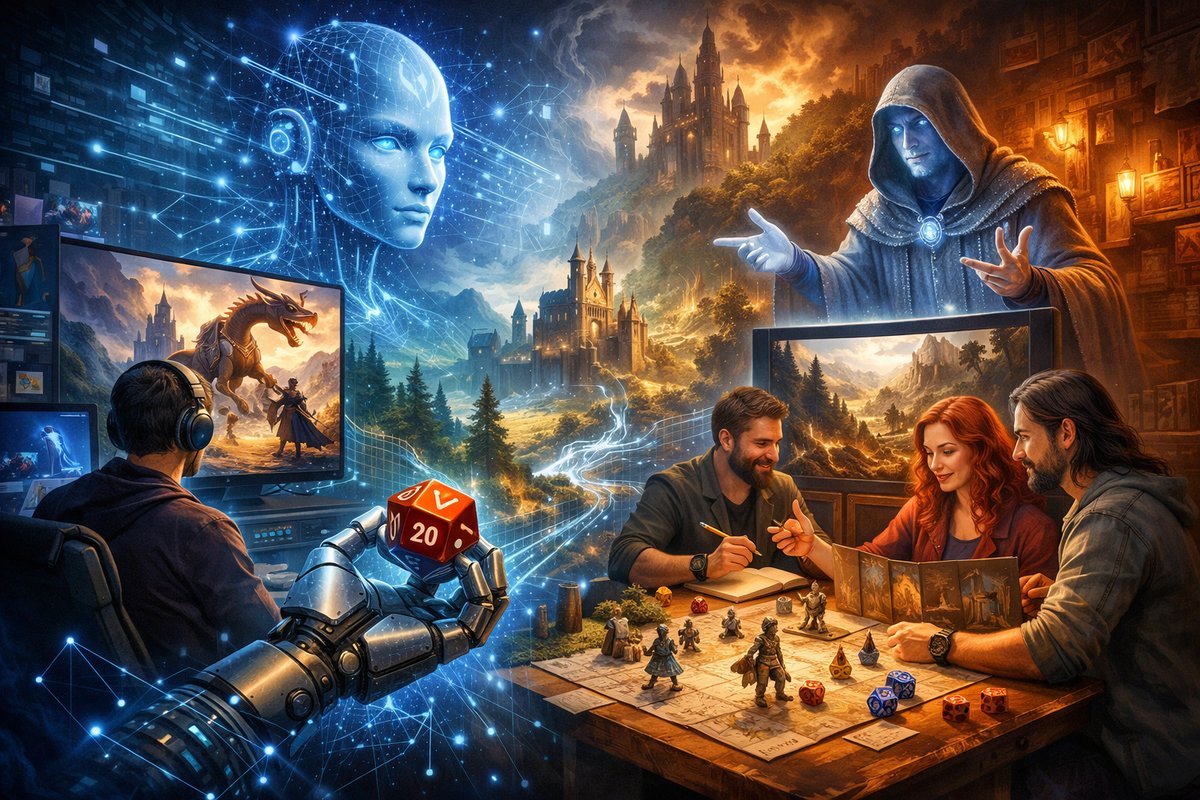

The gaming landscape is shifting beneath our feet as artificial intelligence moves from a supporting role into the spotlight of game design and play facilitation. Once confined to NPC behavior scripting and matchmaking algorithms, AI tools are now stepping into creative domains: generating entire quest lines, managing campaign pacing, and even weaving together unscripted story arcs in real time. Players who once relied on human game masters for endless campaigns are now turning to intelligent systems that can adapt on the fly, voice-act characters, and respond to player choices with surprising nuance.
At major showcases earlier this year, developers unveiled prototypes of AI dungeon masters built on large language models tuned specifically for gaming. These tools can track dozens of plot threads simultaneously, remember player backstories across multiple sessions, and adjust difficulty curves based on both in-game and real-world performance metrics. Instead of prewritten adventures, these AI engines synthesize lore from multiple settings, craft evocative environments on demand, and react to players in ways that mirror human spontaneity. The result is a gaming experience that feels both personalized and endlessly replayable.
Video game studios have been quick to explore similar dynamics. In certain live-service titles, AI narrators deliver mission updates in conversational tones, hint at hidden objectives when players stall, and even offer branching dialogue that reflects evolving global events within the game world. This tight integration of procedural generation and AI-driven storycraft has led to emergent moments that players share on social media: discovering secret shrines that reference their past choices, foiling AI-spawned ambushes orchestrated to test their tactics, or stumbling across NPCs who recall off-hand remarks from hours-long play sessions.
But perhaps the most compelling frontier lies in hybrid table-top/virtual setups. Enthusiasts are building play spaces that combine physical minis, printed maps, and tokens with motion-tracked cameras, smart speakers, and AI engines running in the background. One recent experiment had a camera track a toy castle while projecting weather effects and ambient sounds in real time. Players could move a wooden dragon token across the board, triggering the AI to narrate its roar and cast digital fire breath across a nearby wall. The blend of tactile pieces and digital augmentation draws on both nostalgia for analog role-play and the promise of cutting-edge immersion.
Communities have sprung up around these hybrid experiences. Online forums teem with advice on setting up inexpensive motion-tracking rigs, calibrating smart lights to respond to in-game events, and writing custom scripts that feed player actions into AI prompts. Weekend workshops now teach hobbyists how to retrofit a Bluetooth speaker into a “voice-activated quartermaster” or build gesture-sensitive props that unlock secret AI monologues. For many, the creativity lies not just in the stories themselves but in the tools and materials that bring them to life.
This surge in DIY innovation speaks to a broader shift in how players define fun and focus. Games are no longer just software or a stack of rulebooks-they’re ecosystems of physical gear, digital services, and collaborative imagination. A home theater-style projection system, synchronized LED lighting, and spatial audio aren’t mere aesthetic upgrades; they become co-creative partners that heighten emotional stakes, reinforce narrative twists, and anchor players more deeply in the fantasy.
Publishers are taking notice. Several tabletop game companies have announced partnerships with AI research labs to co-develop “living” adventure modules that evolve according to aggregated player feedback. These adventures won’t ship on cardboard and paper alone; they’ll arrive as cloud-connected packages with modular content updates delivered weekly. One pilot promised themed expansions tied to seasonal events, delivered automatically to home servers and voice assistants. Gamers subscribing to these services get fresh story content as if they were tuning into episodic audio dramas-but with the freedom to choose their own path.
Critics caution that AI-mediated play raises questions about authorship, data privacy, and the potential loss of human spontaneity. What happens when the algorithm that generates your next twist also collects data on your gaming habits? Will small-town game stores survive if players can summon high-quality AI narrators at home? And is there a risk that communities built around bespoke human storytelling will fracture when every group can access a perfect digital game master?
Industry insiders argue that human and AI game masters each bring unique strengths. A well-trained dungeon master weaves in personal anecdotes, adjusts the mood with carefully chosen props, and reads microexpressions to change the story’s tone. AI, in contrast, can manage a massive archive of mythic archetypes, chime in at the precise moment to inject drama, and never tire of tracking complex branching narratives. In practice, many groups are experimenting with hybrid sessions where an AI engine handles bookkeeping, ambient effects, and side quests, while a human host focuses on role-playing key characters and sculpting the emotional arc.
Educational applications are also gaining traction. Teachers have begun using AI-driven RPG sessions to engage students in history, language arts, and social-emotional learning. Imagine a classroom campaign set in a reconstructed ancient city, where students negotiate treaties, solve engineering puzzles, or debate philosophical dilemmas-all under the guidance of an AI facilitator that ensures pacing aligns with curricular goals. Early pilot programs report higher engagement levels, improved collaborative skills, and a deeper sense of agency among participants.
Looking ahead, the convergence of augmented reality glasses, haptic feedback gloves, and AI storytelling could redefine “immersive” entirely. No longer will players stare at screens; instead, they’ll inhabit fully realized worlds overlaid on their living rooms, complete with dynamic weather, interactive NPCs, and physical props summoned through lightweight projectors. AI will handle narrative moderation, ensuring that every participant has a voice and that the story adapts when someone veers off script.
Such an environment could also accelerate inclusivity in gaming. AI moderators can detect and mitigate harassing behavior, adjust content warnings in real time, and customize scenarios to accommodate neurodiverse players. Tools already exist to transcribe verbal cues for hearing-impaired participants or simplify rules on demand. As these capabilities mature, group managers will have powerful levers to shape safe, equitable play spaces for a broader range of enthusiasts.
Of course, these innovations hinge on responsible design and open collaboration. Many advocates call for open-source AI modules that allow hobbyists to audit and customize narrative logic. They argue that proprietary “black box” dungeon masters risk locking in communities and fragmenting shared story franchises. Campaigners for privacy are pushing for on-device AI processing so that player data never leaves the home network. Meanwhile, educators and community leaders are drafting best-practice guidelines for ethical AI usage in mixed-reality settings.
Rich new frontiers beckon. As AI penetrates every layer of game creation-from conceptual art to procedural worldbuilding, from voice-driven sidekick companions to the architects of complex social simulations-players must ask how they want to shape the future of play. Will they embrace hybrid experiences that elevate immersion and personalization, or will they champion analog craftsmanship and human spontaneity? Perhaps the answer lies in balance: using AI to handle the mundane and amplify creativity while holding fast to the shared rituals that make gaming a uniquely human venture.
Whatever path emerges, one thing is clear: play has never been more serious. As lines blur between digital and physical, algorithm and storyteller, the next generation of players will need not just dice and character sheets, but worlds infused with data, powered by code, and enlivened by collaborative imagination. In that realm, everyone can be both player and designer, and every session becomes an adventure waiting to be written.