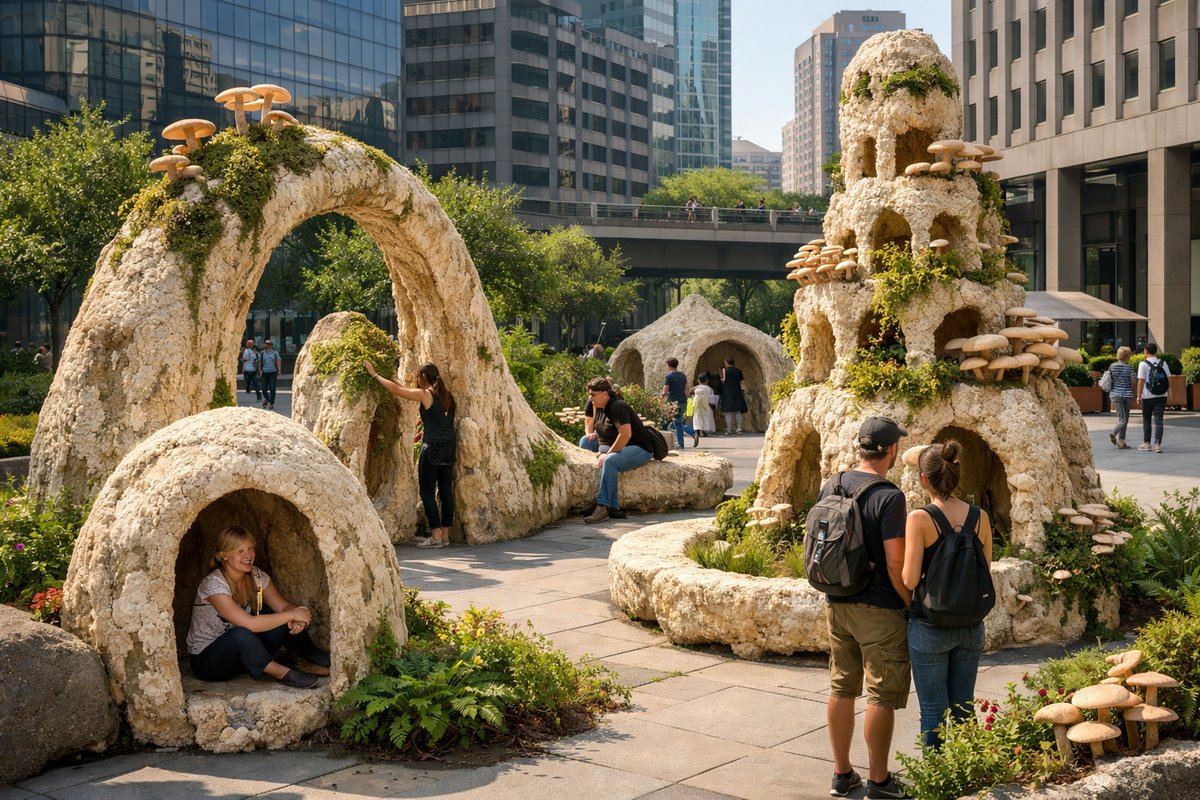

Cities around the world are beginning to embrace a new form of public art that challenges long-standing conventions of permanence and materiality. At the heart of this movement lie mycelium sculptures-biologically grown structures made from fungal networks that sprout, expand, and ultimately return to the soil. Far from the traditional bronze statues or marble obelisks that dominate urban squares, these living installations occupy a space where art meets ecology, inviting passersby to rethink their relationship with the built environment.
In Rotterdam last spring, a collective of Dutch designers unveiled a series of towering mycelium columns in a waterfront park. Each column, roughly twenty feet tall at the time of unveiling, was grown off-site over several weeks in custom biodegradable molds. Viewers watched as delicate white filaments wove themselves into elaborate patterns, forming arches, loops, and lattices reminiscent of Gothic cathedrals. Installed just steps from the city’s port, the sculptures became living landmarks that shifted shape over time. Rainwater darkened the surfaces, mosses colonized crevices, and stray spores drifted onto exposed soil, literally seeding new fungal growth around the base.
Designing with mycelium poses both creative opportunities and practical challenges. Mycelium networks bind organic waste-like shredded cardboard or hemp hurds-into firm, lightweight blocks. When dried, these blocks can hold form for months. But if moisture levels rise, the fungal culture can reanimate, softening and even sprouting mushrooms. To manage this dynamic behavior, designers have begun integrating moisture sensors and simple irrigation controls into the core of each work. Tiny hygrometer probes embedded in the sculptures relay humidity readings to a mobile dashboard. On dry days, an automated micro-spray system activates, preventing the mycelium from becoming brittle. During wetter spells, vents built into the molds open to release excess moisture and guard against unwanted overgrowth.
Beyond technical tweaks, the aesthetic language of mycelium sculptures challenges audiences to engage with impermanence. Visitors to the Rotterdam site were encouraged to touch the rough, wood-like surfaces, feeling the subtle warmth and pulsing life beneath the dry exterior. Guided tours highlighted the fungi’s ability to break down pollutants, filter heavy metals from soil, and even sequester carbon. In workshops adjacent to the park, children learned to grow their own mini-sculptures in small foam molds. After two weeks, they harvested solid mushroom-fiber cubes to take home, accompanied by instructions on turning them into compost when the time came.
This blend of hands-on engagement and ecological education has sparked collaborations across disciplines. Urban planners are exploring fungus-based barrier walls that could neutralize toxins around industrial zones. Architects are experimenting with modular mycelium panels for interior partitions. And performance artists are choreographing light and sound pieces that respond to the fungi’s metabolic cycles, turning microscopic biochemical shifts into luminous projections visible to the naked eye.
Yet perhaps the most compelling aspect of mycelium art lies in its storytelling power. In Seoul, a recent installation dedicated to climate refugees took the form of a sprawling fungal canopy over an abandoned lot. Each branch was grown from local wood chips, but the network stretched across the site like a web of shared experiences. As evening fell, subtle LED clusters embedded within the mycelium glowed softly, representing individual narratives of displacement and resilience. Viewers moved beneath the arches as recorded testimonies played through hidden speakers, creating an immersive journey that blurred the lines between personal memory and collective hope.
Artists and environmentalists are quick to point out that the life cycle of these sculptures underscores a critical message: nothing in nature is truly permanent, and every end gives rise to new beginnings. Once a public exhibit concludes, the forms are dismantled-or simply left to decompose in situ, nourishing soils and local plant life. Some city councils have adopted policies to allow unclaimed mycelium works to remain, seeing value in their gradual reintegration into green spaces. Others require artists to submit a reclamation plan that details how each piece will feed urban gardens or rehabilitate brownfields once its public display ends.
Of course, rapid fungal growth can also introduce risks. Local plant species may be overshadowed by aggressive fungal mats, or spores might spread beyond intended boundaries. To mitigate these concerns, many projects partner with mycologists who study native fungal strains and develop containment strategies. By selecting species with limited spore dispersal or engineering genetic “off-switches” that halt growth after a set period, designers strike a balance between vibrant displays and ecological responsibility.
Across the globe, small towns and megacities alike are piloting pilot programs inspired by these early experiments. In Vancouver, a downtown alleyway exhibit invites local businesses to sponsor segments of a living wall engineered from mycelium-infused bricks. Shoppers and diners can trace the art piece’s expansion on an interactive map, learning about the fungi’s role in breaking down petroleum residues from nearby traffic corridors. In Bangalore, a group of engineering students developed a solar-powered humidity control system for mycelium pods, adapting low-cost components to tropical climates.
These modular approaches reveal why mycelium art is more than a fleeting design trend-it’s a platform for community learning, environmental action, and cross-disciplinary innovation. By decentralizing the production and display processes, artists empower neighborhoods to host their own “living galleries,” using local waste streams and volunteer networks. The result is an organic tapestry of micro-exhibits that reflect each locale’s culture, climate, and environmental priorities.
Philosophically, the rise of fungal sculpture raises probing questions about our notions of art and authorship. Who truly “creates” a mycelium piece-the artist who sculpts the mold, the fungus that breathes life into it, or the collective of visitors whose footsteps and whispers shape its ecological context? In a sense, each installation becomes a collaboration between human intention and fungal agency, a co-authored work where boundaries between maker and material dissolve.
Looking ahead, designers are eyeing the frontier of biofabrication-where mycelium might be combined with bacteria, living pigments, or even microalgae to produce dynamic color and texture shifts. Imagine a sculpture that transitions from pale white to deep green as neighboring algae colonies photosynthesize, or walls that softly throb with bioluminescent displays at dusk. Such visions invoke echoes of science fiction, yet they rest on existing research into living composites and synthetic ecology.
While the idea of art as a process rather than a product may unsettle purists, it resonates with growing calls for sustainability and lifecycle thinking. As cities grapple with overheating, pollution, and dwindling green spaces, the prospect of artworks that sequester carbon, filter water, and enhance biodiversity offers a compelling alternative to static monuments. In a world craving fresh narratives and deeper connections to nature, mycelium sculptures stand as living testaments to what can happen when biology and design converge.
Whether sprouting in abandoned lots, gracing museum courtyards, or forming part of guerrilla art interventions, these fungal futures remind us that creativity need not be bound by inert materials. By giving voice to the silent webs beneath our feet, designers and artists invite us to witness processes of growth, decay, and renewal. In doing so, they cultivate not only striking visual experiences, but also a renewed sense of wonder at the intricate networks that sustain life in every corner of our planet.