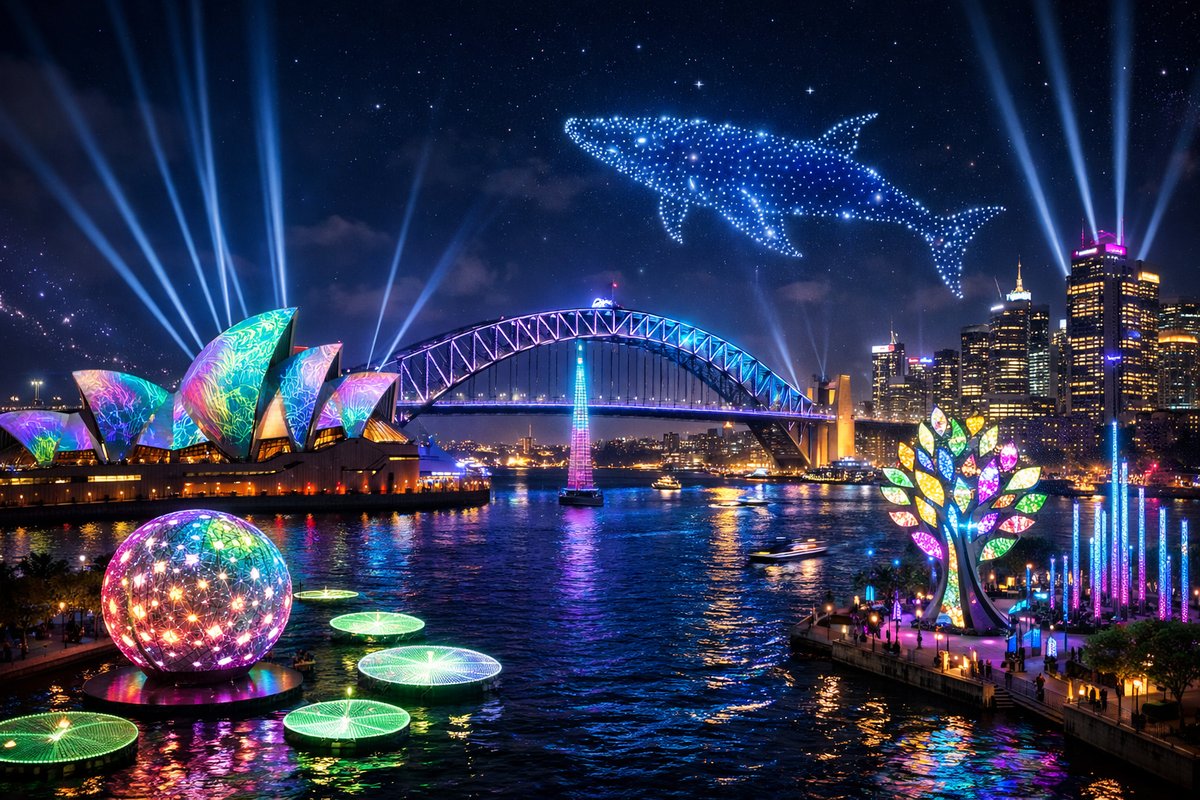

When dusk falls and the skyline of Sydney dissolves into a spectrum of color, the city becomes more than a backdrop-it turns into a dynamic stage where art, technology, and sustainability converge. The latest edition of the annual light festival has arrived, inviting hundreds of thousands of visitors to wander through illuminated corridors, navigate data-driven installations, and witness how urban environments can reimagine themselves after dark. Organizers are pushing the boundaries of public art with a lineup that balances spectacle with subtle commentary on climate, community, and digital culture.
Each year, the festival draws on the city’s iconic harbor, historic buildings, and hidden alleyways to stage dozens of installations that blend physical form and digital projection. Last year’s event welcomed nearly two million attendees, and this season’s roster promises to surpass that figure by introducing four major new works, plus a refreshed series of returning favorites. More than seventy artists and collectives from five continents have contributed pieces that range from solar-powered sculptures to augmented reality overlays, ensuring that every wanderer will find something unexpected around the next corner.
The centerpiece of this year’s festival is “Harbor Pulse,” an expansive projection mapping experience covering seven hundred meters of waterfront. High-resolution projectors trace the curves of footbridges and whisper across waterfront pavilions, synchronizing light patterns with real-time traffic and pedestrian flows. Sensors embedded in the boardwalk feed anonymized movement data into the installation’s algorithm, creating rippling waves of color that speed up as crowds grow and slow to gentle swells when foot traffic thins. Organizers report that the installation’s LED elements consume eighty percent less energy than traditional projection rigs, thanks to new low-power laser modules.
A short stroll away, “Data Gardens” transforms a historic courtyard into a living, breathing network of interactive sculptures. Each towering form is outfitted with environmental sensors that monitor temperature, humidity, and air quality. Visitors are invited to scan QR codes at the bases of the works, unlocking a companion app that visualizes the sensed data in real time. As air temperatures dip, petals on the digital display close inward; when humidity spikes, a faint mist drifts across the ground. The result is a poetic reminder of urban microclimates and the subtle forces that shape our daily comfort.
Elsewhere in the city, an international collective has introduced “Light Tapestry,” a sprawling installation of fiber-optic threads suspended above a pedestrian laneway. The strands detect sound, so every step, laugh, or conversation sets off gentle pulses of color that travel along the threads like photons dancing through a rain shower. Festival veterans will recognize similar kinetic works from previous years, but this edition incorporates new thermochromic coatings that cause the fibers to shift hue in response to body heat-turning a quiet whisper into a warm golden glow.
Beyond the physical works, the festival has expanded its digital arm with a free augmented reality app. Point your smartphone camera at marked festival sites, and an additional layer of graphics animates in sync with the physical art. One AR overlay animates birds made of shifting polygons that flock across the facade of an old power station, while another projects virtual lanterns that float skyward when you tap your screen. Artists collaborated closely with software engineers to optimize the app for everyday devices, ensuring minimal lag even on midrange smartphones.
Sustainability has been woven into every choice this year. More than half of the installations rely on solar panels for at least part of their power budget, and organizers have partnered with a local environmental nonprofit to offset the remaining energy draw through offshore wind credits. Materials for temporary structures are either locally sourced or designed for full recycling once the festival concludes. Signage throughout the event area highlights these efforts, inviting visitors to consider how art and design can move beyond mere spectacle toward genuine environmental stewardship.
Many festivalgoers arrive with their own creative gear in tow. Low-light photography workshops sprung up overnight on social media, guiding participants on how to capture long-exposure shots of projection mapping. DIY light-painting tents have popped up in alleyways, stocked with fiber-optic brushes, portable LED bars, and rechargeable battery packs. Seasoned street artists have set aside blank walls, encouraging passersby to add a line or shape, resulting in collaborative digital murals that evolve over the course of the evening.
Local galleries and performance spaces have also stepped into the fray. In a converted warehouse near the harbor, an immersive sound installation pulses in tandem with strobing lights, creating a sensory loop that responds to both ambient noise and the heart rates of visitors wearing pulse-ox wristbands. Next door, an experimental dance troupe stages a piece entirely lit by wearable micro-LED costumes, each garment rigged to sense movement patterns and switch colors accordingly. It’s a reminder that light art extends far beyond projections-encompassing textiles, wearables, and even the human body.
For administrators and novice curators, the festival offers a masterclass in logistical orchestration. Transit authorities have extended light-rail hours and launched a dedicated shuttle linking the most remote installations, while security teams use infrared cameras to manage crowd flow in real time. Free charging stations powered by rooftop solar arrays dot the precinct, ensuring that visitors can keep their devices-and their AR experiences-running through the night.
As the festival reaches its midpoint, feedback from social media underscores a sense of wonder tinged with curiosity about what comes next. Comments range from awe at the festival’s scale to probing questions about the environmental impact of such large-scale technology. In response, curators have begun hosting pop-up talks on topics like “Circular Design for Public Art” and “Data Ethics in Interactive Installations,” offering a space for dialogue rather than simply passive consumption.
Looking at the array of works on display, it’s clear that this festival isn’t content with simply beautifying the night. It seeks to challenge audiences to think about the systems-both natural and technological-that shape urban life. By harnessing data streams, renewable power, and modular materials, artists and designers are proving that large-scale public art can be spectacular without being wasteful, interactive without being invasive, and emotionally resonant without losing sight of environmental responsibility.
When the lights finally dim at season’s end, physical structures will be dismantled and digital overlays deactivated. But the ripple effect will endure: inspiring amateur photographers to explore long exposures, prompting tech firms to rethink energy-efficient display systems, and reminding city planners that urban spaces can act as canvases for experimentation. If this year’s light festival is any indication, the future of public art lies at the intersection of community data, ecological sensitivity, and a dash of digital magic-and that promise has never burned brighter.