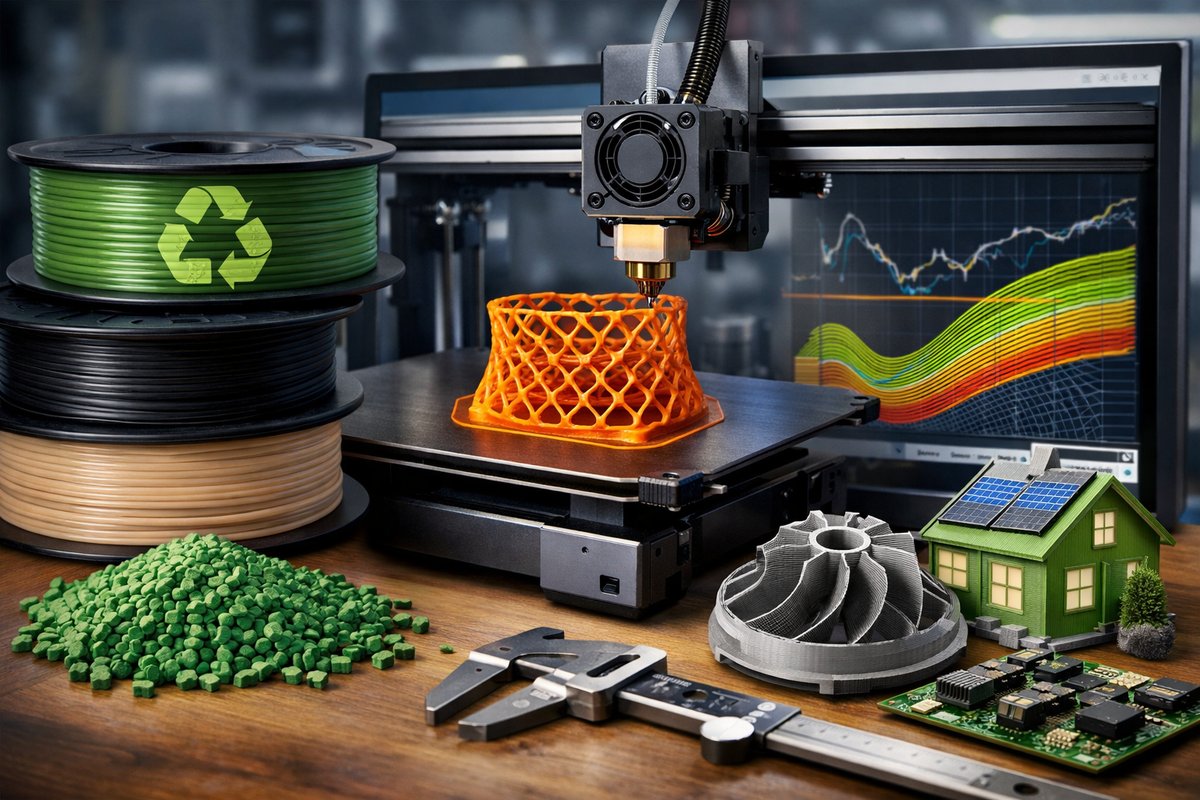

Three-dimensional printing has evolved from expensive prototyping labs into accessible workshops and home studios. At its core, additive manufacturing builds objects layer by layer, and every new innovation refines that process-reducing material waste, improving print success rates, and shrinking both the budget and the learning curve. Whether you’re a hobbyist crafting miniatures or an engineer fabricating functional tools, these emerging technologies and techniques help you get more for every dollar spent.
One of the most impactful developments has been the rise of recycled filament systems. Instead of buying pre-packaged spools, increasingly affordable filament recyclers shred and melt discarded prints, failed prototypes, and plastic scraps into fresh filament. By converting waste back into raw material, you slash ongoing supply costs and cut landfill contributions. Many desktop recyclers now integrate seamlessly with standard extruders, allowing smooth feeding of newly generated plastic. The result is a near-closed loop workflow where every test print becomes the seed for your next project.
Advances in pellet-fed extruders also promise significant savings. Commercial filament can cost three to five times more than bulk plastic pellets. Pellet extruders skip the spool stage entirely, melting raw polymer directly from bags or cartons. These add-ons fit onto popular open-source printer frames, turning them into cost-effective plastic processing lines. With the right temperature controls and screw design, pellet systems handle a broad range of thermoplastics, from standard PLA to more advanced TPU and engineering-grade nylons.
Beyond material savings, smarter slicing software has become a major ally in economical printing. Adaptive slicing algorithms adjust layer heights based on surface geometry-using fine layers only where detail demands it, and thicker layers on flat or gently curving faces. This dynamic approach slashes print times by up to 30 percent without sacrificing visual fidelity. Combine adaptive slicing with variable infill patterns that concentrate material around stress points and lighten non-structural areas, and you get high performance with lower material usage.
More recently, cloud-based and local hybrid slicers have emerged, offering on-demand processing power for complex models. These platforms analyze geometry with machine learning, recommend optimal support structures, and flag potential warping before the first layer even touches the heated bed. By predicting print failures early, they save both time and filament-fewer aborted attempts means more successful builds from the same supply.
Hardware tweaks play a huge role in boosting print success rates, too. Hardened steel nozzles with wear-resistant coatings handle abrasive composites-like wood-fill or metal-fill-far longer than standard brass tips. Upgrading to a quick-change hotend system minimizes downtime when swapping nozzle sizes or materials. Inexpensive quick-release couplings let you switch between high-flow nozzles for rapid prototyping and micro-diameter tips for intricate details in seconds.
Automatic bed leveling and mesh compensation are almost standard on modern machines, but add-on sensor kits bring that reliability to earlier models. Optical or capacitive probes map the build surface at hundreds of points, then the firmware compensates in real time-flattening out microscopic bumps that cause first-layer issues. A properly tuned first layer ensures parts stick perfectly without warping, which means no more wasted prints and far less cleanup between jobs.
On the resin-printing front, refillable vat adapters and bulk resin reservoirs have driven down cost per milliliter. Instead of single-use cartridges, refillable systems let you pour your own formulations-premium or budget-grade-into a reusable tank. Combined with low-cost, high-efficiency UV LED arrays and modular light engines, this approach matches cartridge-based reliability at a fraction of the price.
Post-processing is another area ripe for cost reduction. DIY resin washing stations use recycled isopropyl alcohol and activated charcoal filters to extend fluid life. Homebuilt UV curing chambers repurpose LED strips inside reflective boxes, delivering uniform exposure without the need for expensive turntables or enclosed commercial units. Paired with airtight, food-grade containers for IPA storage, these hacks keep consumable spending to a minimum and reduce environmental impact.
On the software side, open-source firmware forks and plugin ecosystems let you fine-tune every parameter-from acceleration settings to retraction algorithms. Community-driven repositories share proven profiles for specific filaments, nozzles, and printer models. Rather than reinventing the wheel on each machine, you download and adapt someone else’s calibration bench, cutting set-up time dramatically. Community calibration files often include temperature towers, retraction tests, and bridging trials-offering a ready-made testing suite that avoids print-and-fail cycles.
Design for Additive Manufacturing (DFAM) principles also play a critical role in cost management. Rather than importing complex geometry directly from CAD software, many designers now generate lattice structures, internal honeycomb patterns, and sacrificial supports natively within the slicing stage. This integrated approach produces parts that are lighter, stronger, and faster to print than solid models. When you optimize while designing, you reduce both filament consumption and print duration-a double win for budget and time.
Multi-material and color-changing prints have also become more accessible with low-cost mixing hotends. These devices blend two filaments on-the-fly, creating smooth color gradients or combining functional plastics-like mixing flexible TPU with rigid PLA to build shock-absorbing joints. By doing gradient transitions in hardware instead of post-processing, you save on paint, solvents, or assembly labor.
Emerging trends in robotic and gantry-based large-format printing tackle economies of scale. Bolt-on kits convert CNC mills or 3D printers into hybrid machines that can switch between additive and subtractive operations in the same job. This synergy reduces fixture costs and streamlines production of large or complex tooling. As the maker movement scales up, shared labs and makerspaces equipped with these hybrid systems allow small teams to access industrial capabilities without buying full-scale equipment.
The cumulative effect of these material, software, and hardware innovations is a 3D printing ecosystem that thrives on experimentation, community collaboration, and lean workflows. By tapping into recycled filament loops, adaptive slicing, open-source calibration profiles, and modular hardware upgrades, creators of every level can trim expenses while pushing the boundaries of form and function. With economies of scale now within reach of home workshops, the next generation of additive manufacturing breakthroughs may emerge not from massive R&D budgets, but from your basement or local makerspace-one layer at a time.
Whether you’re printing a custom tool handle, architectural scale model, or biomechanical implant prototype, the principles of sustainable design and cost efficiency hold true. Start small: add a filament recycler to your setup, tune your slicing profiles, and experiment with multi-material mixing. As each successful print feeds back into your material strategy-literally and figuratively-you’ll discover that the true magic of 3D printing lies not just in making objects, but in forging smarter, more sustainable workflows that benefit both creators and the planet.