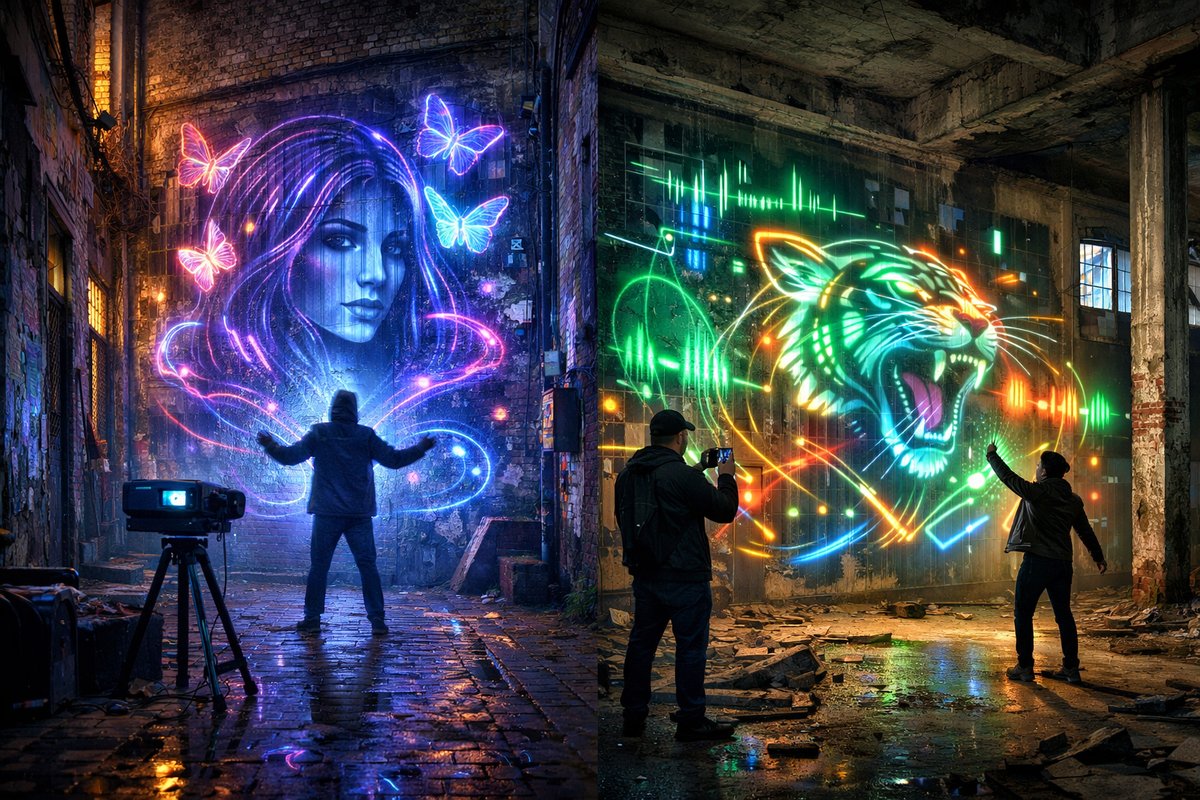

Stumbling down a narrow alley in central Berlin at dusk, passersby are greeted by floating shards of glowing color hovering inches above cracked concrete. The shapes shift with each footstep, scattering into fractal patterns before converging into a rippling wave of luminous graffiti. There is no paint on the walls-only light sculpted by high-powered laser projectors and driven by real-time motion tracking. What looks like magic is the latest frontier in urban art: holographic graffiti.
This new form of street expression replaces spray cans and brushes with code, lenses, and lasers. Artists harness projection mapping software and portable projectors to “draw” on surfaces without leaving a single drop of pigment. The result is ephemeral art that lives only as long as the equipment stays trained on its target, vanishing instantly when the power cuts or a handheld projector moves out of alignment.
At the recent Lumiere festival in northeastern England, one installation let festivalgoers tag a brick facade with ghostly calligraphy that faded away after a few seconds. In Detroit, a repurposed auto plant became the backdrop for a series of interactive murals that pulsed in sync with passing cars, their headlights triggering ripples of light. New collectives are organizing pop-up interventions, turning alleys and building sides into canvases for digital graffiti crews.
The technology behind these holograms is deceptively simple. A projector capable of high-lumen output aims at a wall or screen. A mapping program-often built on open-source frameworks or live visual performance tools-warps the projected image so it appears fixed on the three-dimensional surface. Motion-tracking cameras or infrared sensors feed the computer real-time data on pedestrian movement. Algorithms then alter shapes, colors, or patterns according to proximity, direction, or even sound levels picked up by on-site microphones.
Because there’s no paint, these installations leave no trace on buildings and skirt the legality issues that often plague traditional graffiti artists. Some view that intangible quality as inherently sustainable: no cleanup crews are needed, and the electrical load for a weekend installation is a fraction of what it takes to erect a permanent neon sculpture. Yet there’s still tactile satisfaction in watching a sculpted beam of light respond to your pulse or the thump of a passing car.
“People expect graffiti to be static,” says a member of a nomadic collective that stages midnight projections. “We wanted to bring it to life, to make it breathe with the city. You’re no longer just looking at art-you’re inside it.”
In many respects, holographic graffiti is a natural extension of projection mapping, a technique used in theater, concerts, and commercial advertisements for over a decade. But whereas projection mapping typically relies on massive rigs or pre-announced events, street artists favor lightweight equipment and guerrilla setups. A battery-powered laser projector and a small laptop can turn an abandoned parking garage into a kaleidoscopic dreamscape in under an hour.
One project transformed a row of shuttered storefronts into a series of mirror-like portals reflecting an alternate city skyline. Walk beneath one of these portals and your silhouette fragments into ribbons of colored light. Spectators were urged to record the illusion on their phones, turning their social feeds into living galleries.
Critics of this approach point out that digital interventions can feel less permanent and meaningful than paint on brick. But proponents counter that ephemeral art better reflects the speed of our digital lives-fleeting, boundaryless, and responsive. In a city where every surface can be monetized by advertisements, this form of guerilla projection denies corporate branding and democratizes the nighttime landscape.
It’s not just about aesthetics. A handful of artists are exploring how these holograms can serve as forms of social commentary. One piece projected rose petals onto a public fountain during a heat wave, the petals wilting and wilting again in fractal slow motion to reflect environmental stress. Another mapped the uneven pavement of a housing estate with fractal patterns that pulsed in harmony with community-recorded chants, weaving local voices into the visual tapestry.
The philosophy driving these installations draws on ideas from performance art, digital activism, and participatory design. The physical infrastructure of the city-the walls, corners, and stairwells-becomes a reactive interface. Passersby become collaborators, their movements and interactions shaping the work in unpredictable ways.
Technical challenges remain. Ambient lighting can wash out delicate designs, requiring laser projectors with greater brightness and contrast. Rain or fog can scatter light unpredictably. Wi-Fi signals used for coordination between multiple projectors often falter in dense urban cores. But these hurdles spur creative problem-solving. Some crews mount projectors inside weatherproof pods. Others deploy mesh network radios to maintain sync between devices. Architects are even beginning to experiment with intentionally textured surfaces that enhance projection fidelity.
As this medium gains popularity, larger festivals and city councils are taking notice. A handful of municipalities have begun issuing pop-up permits for laser art, commissioning one-night shows that animate otherwise forgotten corners. Organizers tout the low environmental impact-no heavy machinery, no toxic pigments, no permanent alterations-while embracing the traffic and tourism boost that comes with insta-worthy sights.
Looking ahead, the future may lie in blending holographic graffiti with personal devices. Imagine slipping on a pair of mixed-reality glasses to see additional layers of the same projected piece, or using a smartphone to direct its flow. By merging physical projection with wearable AR, artists could craft experiences that are both site-specific and individualized.
Some pioneers are already experimenting with miniature projectors embedded in backpacks, allowing walkers to leave invisible trails of motion-activated light as they roam. Others are developing gesture-controlled interfaces so that dancers can conduct entire visual symphonies on building facades.
For urban planners and cultural activists, holographic graffiti offers a blueprint for transient public art that adapts to evolving communities. In neighborhoods facing gentrification, it can give residents a voice without erasing the history etched in brick and mortar. In industrial zones awaiting redevelopment, it can turn abandoned warehouses into nocturnal wonderlands overnight.
There’s a poetic justice in using laser light-once the purview of high-end entertainment venues-to reclaim the overlooked edges of our cities. These installations remind us that art need not be permanent to leave a lasting impression, and that the spaces beneath our feet and above our heads are canvases waiting to be awakened.
Whether you call it holographic graffiti, laser tagging, or projection street art, the movement is transforming how we perceive urban nightscapes. It invites us to step beyond static murals and into immersive worlds where light and shadow dance at our fingertips. In the cross-hairs of technology and creativity, the walls of the city are no longer boundaries-they’re gateways to collective wonder.