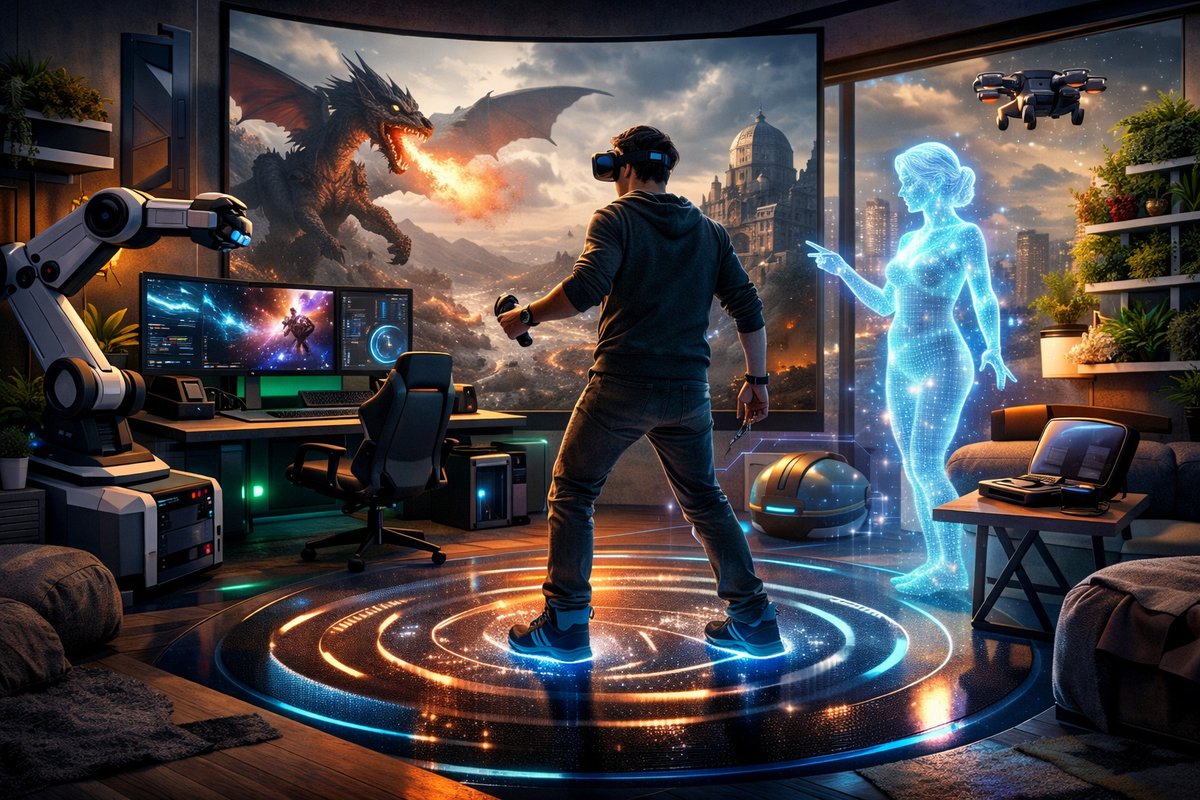

Imagine stepping onto a floor that vibrates in rhythm with on-screen explosions or donning a lightweight vest that delivers nuanced taps as your character navigates alien landscapes. No, this isn’t the Hollywood set of tomorrow-it’s the cutting edge of today’s gaming and entertainment scene. Across the globe, local arcades, coworking hubs, and even living rooms are transforming into hybrid playgrounds, where multi-sensory technology, AI-driven story engines, and sustainable design converge to blur the boundary between player and play.
At the heart of this evolution is a growing recognition that traditional screens can only deliver part of the experience. A new generation of immersive hardware is designed to engage more of our senses-touch, spatial audio, ambient lighting, even subtle scents. Take the rise of haptic immersion trends: specialized floors equipped with pressure sensors and actuators now ripple or pulse in sync with in-game events. When a dragon’s roar shakes the ground on screen, you feel it underfoot. Nearby, wireless vests calibrated to translate directional impacts deliver corresponding sensations across the torso-enough to make you instinctively duck when a virtual arrow whistles past.
These systems aren’t confined to high-budget conventions. Independent studios are launching plugin-style expansions that work with existing gaming PCs and consoles. One grassroots collective recently hosted a weekend festival in a converted warehouse, installing a grid of haptic pads and mapping them to popular battle-royale titles. Players rotated through sessions, trading tactics and reacting to tactile feedback that elevated the thrill. Organizers noted that newcomers who typically avoided competitive shooters found themselves drawn in once they realized the sensory hooks were less about precision aiming and more about feeling the pulse of play.
Yet no immersive setup is complete without sound. Spatial audio engines, long a staple of VR headsets, are shedding their tether to full-face devices. Compact speaker arrays with head-tracking capabilities now provide 360-degree soundscapes from desktop rigs. As you swivel your chair, the whir of spaceship engines or the rustle of footsteps follows you, creating a sense of presence that a single soundbar can’t match. Developers are experimenting with dynamic footstep layers-soft carpets for indoor levels, crunching gravel for outdoor treks-amplified by subwoofer modules embedded beneath floor mats.
Even lighting has become an active participant. Addressable LED strips, once a purely cosmetic addition, are now integrated via open-source APIs to reflect in-game actions. Land your final blow and watch your desk glow a triumphant gold. Enter a shadowy alley and the same strip dims to inky blues and purples. Some setups even extend to smart bulbs in overhead fixtures, enveloping an entire room in a synchronized light show.
This ambient choreography extends beyond pixels. Fragrance diffusers timed to game checkpoints are in R&D phases at several indie labs. Imagine the smell of charred wood seeping into the air after a virtual campfire scene, or a faint pine aroma as you trek through snowy forests. The goal isn’t realistic scent reproduction-it’s emotional anchoring, a subtle cue that deepens immersion.
What makes many of these trendsetters particularly compelling is their modular ethos. Instead of monolithic, expensive setups, they’re designed as building blocks. A haptic floor panel here, a wearable actuator there, a lighting module over there. Users can customize systems based on room size, budget, or desired intensity. Open data standards ensure that modules from different makers can interoperate. One community-driven project even published an API specification that lets floor systems, vests, and lighting units share a single timeline for feedback events. Hobbyist hardware hackers quickly adopted the spec, printing 3D cases and wiring it to off-the-shelf microcontrollers.
At the software layer, AI is becoming the ultimate play partner. Procedural narrative engines powered by large language models can react to player inputs in real time, adjusting plot arcs, dialogue, and world states. Writers and designers tune these engines with “emotion maps” that define tonal shifts-surprise, dread, exhilaration-triggered by in-game achievements or failures. The result is a dynamic story that feels handcrafted, with each playthrough branching in unique directions.
Some forward-thinking lounges are integrating voice-activated assistants that serve as on-the-fly dungeon masters. Speak a phrase-“summon the ice titan”-and the system calls up pre-trained AI routines that generate instant boss mechanics and stage designs. Haptic floors amplify the titan’s footsteps, spatial audio cues snow-crashing effects, and lighting modules cast frosty hues. The entire room becomes an ad hoc adventure table, without a single rulebook or dice roll required.
Sustainability is also playing a starring role. Reclaimed wood is now a popular material for gaming desks built by local artisans. Solar-assisted charging stations, complete with battery banks, reduce reliance on grid power for energy-hungry rigs. Even packaging has shrunk: modular kits arrive in recyclable cardboard sleeves, and users are encouraged to share or sell off old components on community marketplaces. Several indie studios have pledged to offset carbon footprints by planting trees for every new hardware unit sold.
Accessibility has come a long way, too. Open-source hardware designs for adaptive controllers enable players with limited mobility to join the fun. Haptic modules can be calibrated for light taps suitable for sensitive users or cranked up for a more visceral thrill. Audio descriptions and haptic cues work in tandem to serve visually impaired gamers. Room layouts with wireless power mats eliminate tripping hazards from cables, making setups safer for all.
The remote-friendly promise of cloud-streamed arcade cabinets has also matured. Virtual lounges replicate classic game rooms, populated with digital avatars and remote voice chat. Haptic plugins for controllers bring back the tactile joy of clacking joysticks and arcade buttons, transmitted over the internet. Esports tournaments have adopted this model to accommodate global audiences, letting competitors feel the same precise feedback whether they’re next door or across the ocean.
For living-room enthusiasts, turnkey bundles are emerging that package haptic seat cushions, audio pods, and USB-powered lighting strips into a single box. While purists still mix and match individual modules, casual gamers appreciate the plug-and-play simplicity. Retailers even offer subscription plans that let users swap in new modules every season-next month’s package might include an air-blaster that puffs gusts of wind during flight sequences, or a thermal unit that warms the area around your console when virtual lava flows nearby.
This era of sensory-rich play is not without its challenges. Early adopters warn of lag and calibration headaches when combining multiple hardware brands. Some players report motion-sickness if haptic feedback isn’t finely tuned. Developers are racing to refine middleware that can standardize timing and intensity across devices. Still, as the open-source community thrives, hardware vendors are more willing to collaborate on universal drivers, reducing the compatibility friction.
Looking forward, the most exciting innovations may emerge at the intersection of XR, AI, and full-room immersion. Picture projection-mapped floors that reshape themselves underfoot, or machine vision cameras that track body movements without requiring wearables. Gesture-driven interfaces could let you grab virtual objects in midair, while dynamic haptics reinforce the sensation. These breakthroughs promise to democratize immersive play, allowing anyone to tailor an environment that resonates both emotionally and physically.
Whether you’re a competitive strategist, a narrative seeker, or someone who just craves a more engaging way to unwind, today’s hybrid play spaces are leveling up what it means to game. The future is one where you don’t just see and hear your adventures-you feel them, breathe them, and become part of them. And as technology continues to shrink the gap between the digital and the physical, you may never look at a screen the same way again.