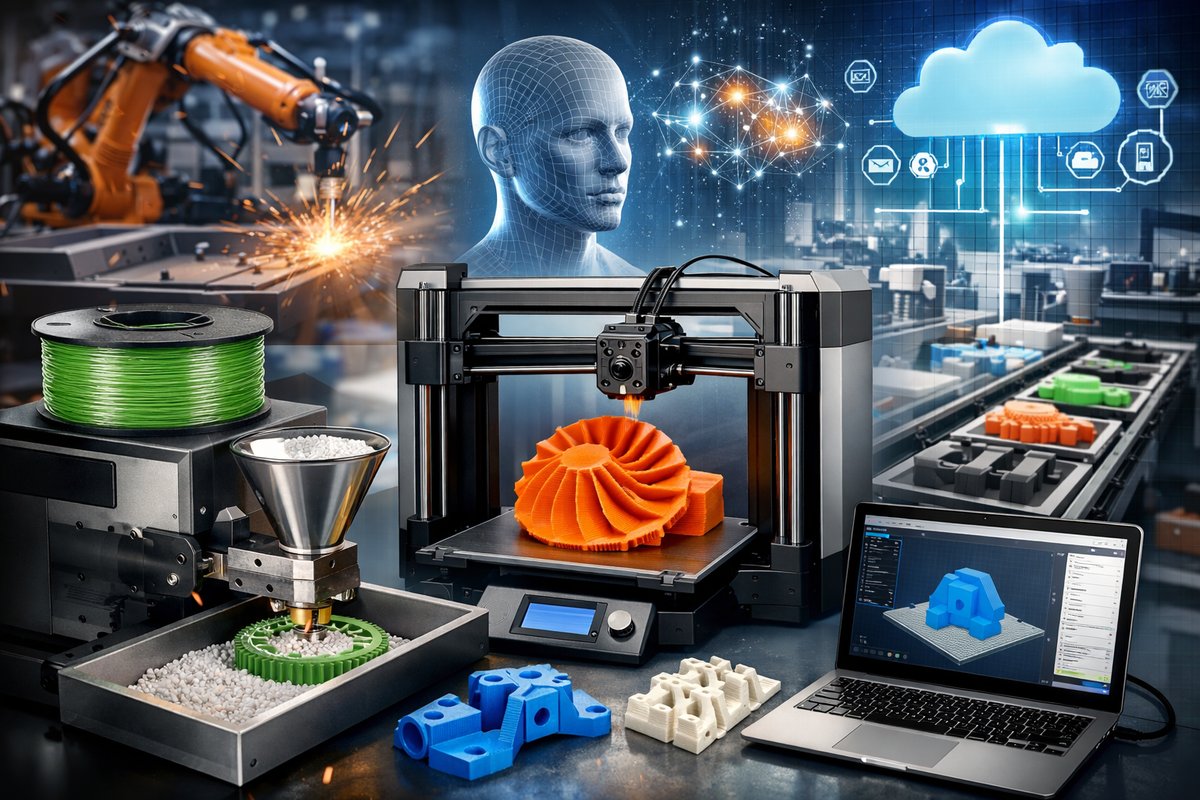

Three decades into its rise, 3D printing has moved beyond early novelty into a realm where precision, speed, and sustainability converge. Whether you’re shaping functional prototypes, custom jigs, or artistic sculptures, today’s toolkit spans low-cost desktop machines, industrial lasers, and open-source firmware that can be tuned for every layer. Yet for many users-hobbyists on a budget, educational labs, and small-batch manufacturers-the real challenge remains the same: how to tame material costs, accelerate print cycles, and guarantee successful outcomes with minimal waste. A new wave of techniques and technologies is addressing these problems head-on.
Economies of scale have long favored large-format and industrial additive systems. But a string of innovations is narrowing the gap for desktop operators. Pellet-fed hot ends now accept bulk plastic granules at a fraction of the price per kilogram of filament, cutting material costs by up to 60 percent. Combined with modular extrusion heads that swap in nanocomposite and recycled-polymer feeds, these setups can churn out tens of kilos of parts before needing a refill. By contrast, standard spools often require user intervention every 500 grams. The shift from filament to pellets mirrors injection molding economics and makes small-batch runs far more viable.
Open-source firmware has kept pace with hardware breakthroughs. Advanced motion planning algorithms and thermal compensation routines ensure more consistent layer adhesion, even on budget machines. AI-driven slicers now analyze models for stress points, automatically generating variable-density infill patterns that preserve strength while slashing print time and filament use. These adaptive infill routines only add material where it’s structurally needed, trimming hours off prints of complex geometries and cutting filament use by up to 30 percent.
On the resin side, low-cost digital light processing (DLP) projectors paired with off-the‐shelf optics have driven down the price of high-resolution photopolymer printing. Some innovators have begun exploring gravity-fed resin vats with recirculation pumps that filter and replenish photoinitiators automatically. This keeps resin properties within spec for longer runs and reduces the need to discard partially used batches. Combined with adjustable pixel masks and dynamic layer heights, these systems can deliver both speed and fine detail without the usual resin waste.
Selective laser sintering (SLS) and multi-jet fusion (MJF) have traditionally been the domain of service bureaus, but desktop-scale powder systems are emerging. By deploying lower-power diode lasers and redesigned powder trays, small SLS rigs now fit on a tabletop and cost a fraction of their industrial cousins. Several pilot programs at universities have demonstrated the feasibility of modular powder recycling stations, where sieving and temperature-controlled drying bring leftover material back into the print cycle with minimal performance loss.
Material innovation plays a starring role in cost reduction. Blends of recycled PET and bioplastics are now widely available in spools, offering both strength and a reduced environmental footprint. Carbon-fiber-infused filaments incorporate short chopped strands that boost stiffness without requiring exotic hardware. Meanwhile, new copolymer resins resist cracking under load and cure faster under UV light, enabling quicker post-processing. Even metal powders have seen price softening, thanks to more efficient atomization techniques and closed-loop powder handling that recovers fines.
Post-processing often proves to be the hidden expense in any print workflow. Sanding, support removal, and surface finishing can demand hours of labor or specialized equipment. Automating cleaning with ultrasonic baths paired to rapid curing stations reduces manual time and ensures consistent part quality. Water-soluble support materials, once reserved for high-end stereolithography, now integrate with mainstream FFF machines via dual-extrusion heads, eliminating break-away fiddling for complex geometries.
Cloud-based management platforms contribute to reliability as well. Centralized slicers update in real time with new material profiles and anti-warp settings. Print farms can be orchestrated remotely, with dashboards tracking layer-by-layer progress and flagging anomalies like nozzle clogs or under-extrusion. For educational makerspaces, this translates into fewer failed prints and more time learning design principles rather than troubleshooting hardware.
Sustainability is woven through many of these advances. Recycled spools, pellet extrusion, and closed-loop resin systems all aim to cut waste. Some open-source initiatives are even repurposing household plastic-bottle caps, food containers-into feedstock. While these experimental workflows require careful cleaning and shredding, they showcase a path to near-zero-waste fabrication.
In industrial contexts, hybrid processes blur the line between additive and subtractive. Robotic arms equipped with high-flow extruders can deposit thermoplastic in shapes later milled to tight tolerances, combining the material efficiency of 3D printing with the precision of CNC. Laser-scan volumetric monitoring ensures that each layer meets exact thickness specifications, and any deviations are corrected in real time by adjusting extrusion rates.
The DIY community remains a hotbed of experimentation. Hot-end hacking, self-built multi-nozzle carriages, and even bed-leveling systems using inductive sensors have pushed mass-market printers into new performance envelopes. Sharing these modifications through online repositories has spurred rapid iteration-within weeks, a breakthrough idea can propagate across thousands of builds.
Ultimately, the future of a more economical and successful 3D printing ecosystem hinges on interoperability among machines, materials, and cloud services. Standardized APIs for slicing, material certification, and machine health monitoring promise plug-and-play compatibility that reduces setup overhead. As additive manufacturing hardware becomes more of a commodity, the real battleground shifts to software, materials science, and supply-chain integration.
Whether you’re a classroom instructor looking to print dozens of anatomical models on a budget, a small shop producing custom jigs, or an at-home hobbyist experimenting with mixed-media sculptures, these layered innovations unlock new possibilities. Materials that once cost tens of dollars per kilo now approach the price of commodity plastics, while software tools once locked behind industrial contracts are available under open licenses. By combining recycled feedstocks, AI-optimized slicing, and automated post-processing, the economics of additive manufacturing transform from niche boutique runs into scalable workflows.
For anyone delving into the craft of turning code into physical form, the message is clear: today’s 3D printing landscape is more accessible, more efficient, and more sustainable than ever. The quiet revolution of making has shifted from high-budget labs to everyday workshops-one economical layer at a time.