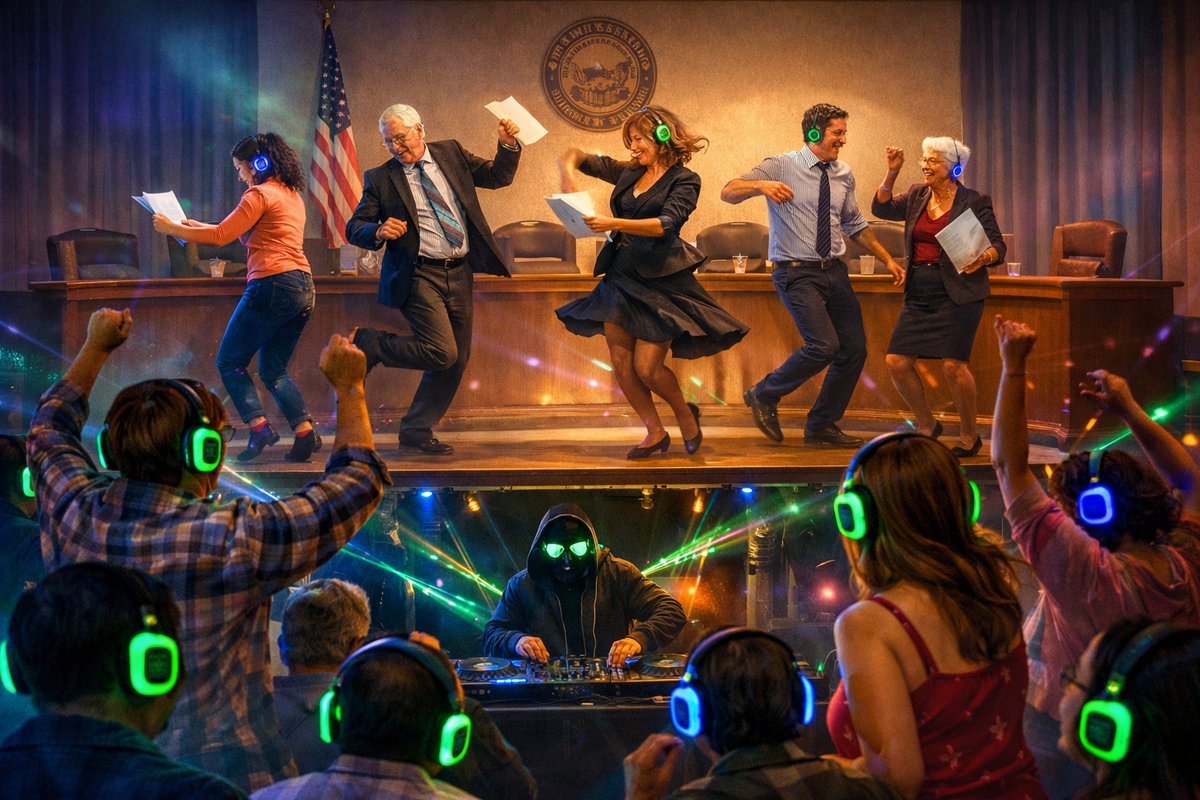

On a Tuesday evening that began like any other, Maplewood’s Town Council assembled to debate the annual budget-only to emerge hours later in neon attire, gyrating in solemn unison. What started as a goodwill gesture to curb shouting matches ended with the entire legislative process conducted through silent disco. Instead of raising hands or yelling “Point of order,” councilmembers bobbed heads to a beat only they could hear, while citizens in the gallery tapped insistent footwork whenever they wanted to speak.
The origins of this dance-driven democracy lie in a protracted lawsuit from last spring. After a neighbor filed a noise-complaint class action against the council for “excessive oratory intensity,” lawyers argued that the decibel levels routinely exceeded regulations. Faced with mounting legal fees and the risk of judicial intervention, the council’s newest member-a former community theatre director-proposed a radical solution: silent disco meetings. The idea drew chuckles at first, but within days the town’s finance committee had earmarked seed funding for custom headsets and glow-stick sashes.
At the inaugural session, participants arrived with an array of LED headphones, each pair color-coded by voting bloc. The public gallery wore yellow headsets for comments; councilmembers sported red for motions and green for amendments. As the clock struck seven, a local DJ-secreted in a soundproof booth-faded in an ambient track mixing civic chants with disco strings. Instantly, hands that once slapped desks now formed rhythmic patterns, and proposals glided from speaker to speaker in choreographed pirouettes.
Ladies and gentlemen, debates have never looked so smooth. When Councilperson Alvarez moved to allocate funds for road repairs, she conveyed her motion with an elegant spin, prompting an appreciative cheer from rhythmically aligned citizens. Even routine agenda items like “Approval of Previous Minutes” became interpretive dance numbers featuring jazz-hands and knee lifts. By the time Merchant Row’s sidewalk repair bill came up, every nod of agreement was synchronized to a four-beat count-providing the illusion of unanimity, even when dissenters tapped eccentric solo riffs.
But not every performer played by the beat. During a heated zoning discussion, a mid-meeting technical malfunction prompted two councilmembers’ headsets to shift into a polka remix. One attempted to continue a rebuttal mid-shuffle; the other obligingly responded with a spirited two-step. Citizens in the gallery started klanging glow sticks against the benches, uncertain whether to applaud or demand a return to parliamentary procedure. That moment of musical misalignment sparked the session’s first audible gasp-a noise so rare it sent the town clerk diving under her desk for cover.
Budget approvals soon ground to a staccato halt when the DJ-tasked with queuing “motion” tracks and “second” tracks-fell asleep at the console. The council sat in silence, headset lights glowing in the darkened chamber, until a toddler in the gallery finally pressed play on his older sister’s wireless remote. Twenty seconds of bubblegum pop later, debate resumed with unexpected chewiness: councilmembers snapped fingers, hummed along, and flirted with the idea of swapping justice reform for glitter cannons.
Amid the absurdity, emergency services found themselves on standby. Just last week, dispatchers received a frantic 911 call reporting “uncontrollable gyrations” inside town hall. Firefighters arrived to find only bass-powered silhouettes through frosted glass, and once assured that no actual infernos were present, chalked it up as another Maplewood anomaly. EMT crews, still in full gear, were dispatched to distribute spare batteries to elderly attendees whose headsets had died mid-debate.
Meanwhile, the town hall building seemed to join the revelry. Strange pulses of colored light began emanating through its stained-glass windows at precisely 8:13 PM, despite no wiring being installed in that wing. Local electricians concluded that the effect was caused by a reflective interplay between disco balls and the evening sun. Residents now whisper that the building itself has enrolled in the silent disco, sending Morse code-style illuminations to signal upcoming agenda shifts.
The council chair, who previously suffered from stage fright during televised addresses, has become the session’s star. Armed with a glow-in-the-dark baton, she choreographs each vote count in an elaborate dance sequence that resembles a hybrid of tap, vogue, and semaphore. When asked for comment, she shrugged off concerns about efficiency. “Sure, it takes longer to allocate grants when you have to nail a spin-kick transition into the budget line,” she admitted, “but people remember it. Democracy shouldn’t bore you to tears.”
Civic engagement is off the charts. The town’s livestream channel, once plagued by buffering problems during heated debates, now boasts record viewership as remote viewers drop in for the choreography. Fan-made GIFs of councilmembers moonwalking through town resolutions flood social feeds. Even the board of education is considering a similar approach for parent-teacher conferences-imagine kids approving field trips via coordinated floss dance.
Critics of the new system argue that policy decisions deserve clarity, not jazz-hands. A letter to the editor last week lambasted the council for “prioritizing performance art over plainspoken dialogue.” But proponents counter that the method encourages emotional intelligence: participants sense each other’s intent through movement and eye contact rather than aggressive interruptions. It’s hard to ignore someone mid-pirouette.
Some residents have formed support groups called “Silent Disco Divorcees,” sharing tales of how they miss the old process of shouting into microphones. Others host watch parties in their living rooms, complete with DIY headphone rental racks and glow-stick lemonade. One local bakery began selling “motion muffins,” stamped with icons representing motions and amendments-a treat for activists debating health codes who need quick fuel between breakbeats.
Despite occasional missteps-like the incident when a stray glitter cannon shuttered a routine tax vote-the council plans to institutionalize silent discos for at least the next fiscal year. Town staff are drafting a new ordinance titled “Groove Governance,” which will outline approved dance moves for common legislative procedures. The charter commission joked about adding a clause to permit air guitar solos during public comment periods.
As Maplewood heads into yet another moonlit session, the question on everyone’s lips is whether this experiment will outlast the novelty. Will zoning ordinances glide through unopposed, or will the silent boogie eventually lose its sparkle? For now, citizens seem content to express candid feedback via cha-cha-chalets and spin-finishes. After all, if democracy can’t keep you on your toes, what’s the point of governance?
Maplewood’s silent disco council has already inspired neighboring towns to ballot recreational versions of procedural decorum. If you catch a whiff of sage-infused fog from the city hall roof or spot fluorescent headsets in a planning commission, you might just be witnessing the future of participatory government-one dance floor at a time.