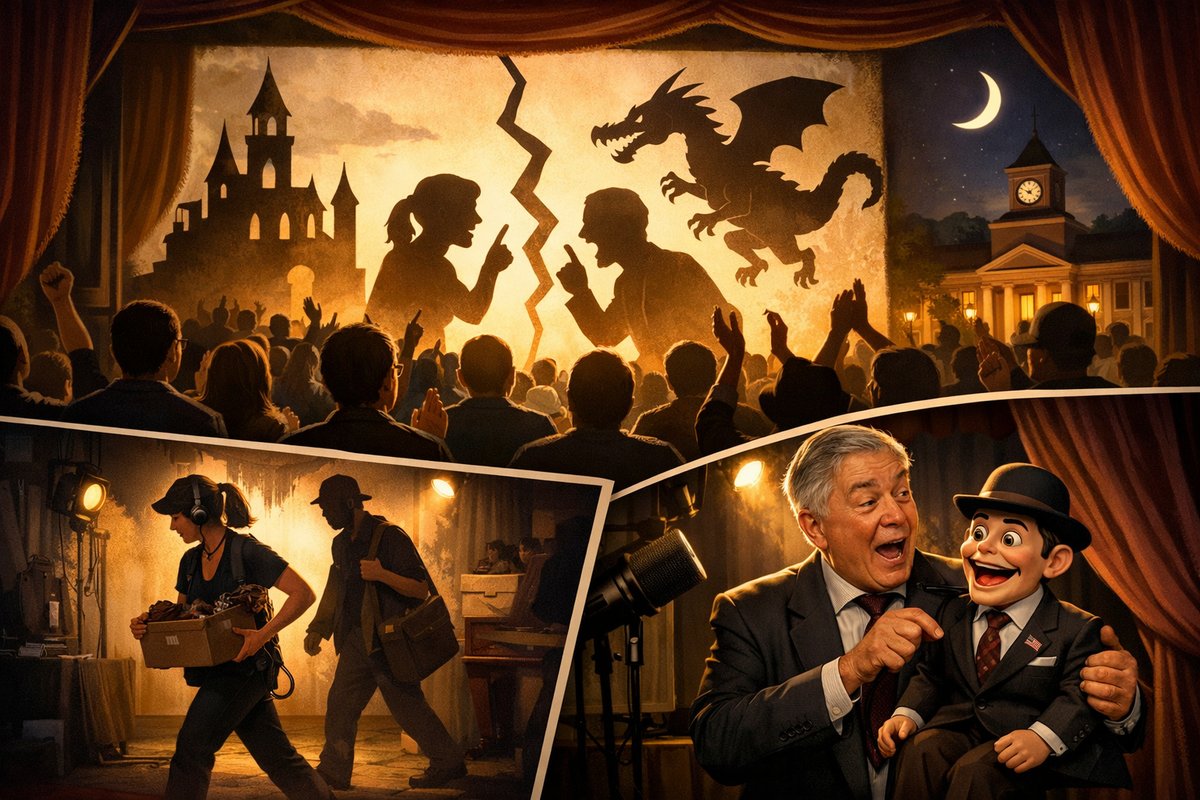

It began as an ambitious experiment in grassroots democracy: replace the usual roundtable budget debates with immersive shadow puppet performances. A unanimous vote at the last old-fashioned town hall session promised to transform the annual fiscal review into a community theater spectacle. Organizers believed silhouettes dancing on a backlit sheet would make line items feel more approachable, even exciting.
On opening night, curious citizens packed the modest auditorium, clutching homemade signs reading “More Road Repairs, Fewer Donations to Mascots” and brandishing tablet devices poised for livestreaming. Engineers hastily rigged LED stage lighting behind a stretched white canvas. Councilors handed off documents to a troupe of local puppeteers, each entrusted with shadow incarnations of revenue streams, salary lines, and emergency funds.
As the lights dimmed, a hush settled. The first puppet-designed to resemble the town’s treasurer-glided across the screen, arms thrust wide as a booming voiceover detailed next year’s projected surplus. A series of lurching shapes then enacted a debate over fire department funding. Children in the audience pointed at the bulbous silhouettes, convinced they were watching interstellar creatures negotiating a peace treaty.
Halfway through the performance, the town clerk rummaged under the stage to adjust a wireless microphone that had started crackling like a haunted radio. A stray beam of light pierced the canvas, exposing the tips of shadow puppeteers’ fingers. An audible gasp rippled through the crowd: this was democracy revealed in a new, slightly alarming form.
When the figures representing street maintenance collapsed mid-monologue, audience members reached for a portable digital audio recorder to capture the collective gasp. Several brass-band enthusiasts at the back began humming a fanfare in solidarity with the fallen puppet, while a trio of retired accountants huddled to debate whether the malfunction signaled a hidden overspend.
By intermission, rumors swirled that the puppet troupe had demanded hazard pay for “working in pitch-black conditions under intense scrutiny.” Backstage, black-clad technicians fussed over gaffer tape, smartphone tripods, and battery packs. A pamphlet circulated among townsfolk labeled the entire affair “the most entertaining budget blunder in local history.”
At curtain down, a disgruntled puppeteer slipped out from behind the canvas to deliver a terse statement: “We’ll accept the contract once you upgrade to higher-wattage LED stage lights and provide ergonomic gloves for extended silhouette positions.” Councilors exchanged glances and swiftly convened an emergency session to discuss the cost of creative labor.
The second performance promised improvements: fortified lighting rigs, reinforced canvas, and even a tablet mounted for streaming the show on social media. Yet as the lights rose, one shadowy shape began wobbling uncontrollably. The puppet representing the public works budget folded in half, triggering a low, mournful honk from a hidden sound effect machine. The audience erupted into confused applause, assuming it was part of the script.
Moments later, another technician announced through the crackling handheld microphone that the stage had officially entered a “stop-work protest.” An officious silhouette no larger than a child’s hand scurried across the canvas, waving an invisible picket sign. Gasps mixed with stifled laughter as everyone realized the puppets themselves had organized a union strike.
In a last-ditch effort to salvage the evening, the mayor introduced a homemade mediator puppet: a tiny, expressionless marionette equipped with googly eyes. The town’s official conflict resolution specialist attempted to broker peace, speaking into a nearby wireless headset. Meanwhile, some citizens brandished noise-canceling headphones, convinced that listening to too many phantom legislative jingles might cause irreversible brain fog.
Outside the auditorium, volunteers handed out “Free Bean Dip and Compassion” snacks to placate the growing crowd of puppet sympathizers. Children scurried behind concession stands, brandishing gaffer tape and makeshift lanterns in case the LED kit gave out again. Senior citizens lined up to offer knitting lessons “to mend the tears in municipal morale,” as one septuagenarian proudly proclaimed.
By the third act, puppeteers had vacated the stage entirely, leaving only an empty frame and a flickering glow. The audience, in a remarkable display of communal ingenuity, staged their own improvisational hearing. One resident pounded a wooden gavel carved in the shape of a sunflower, while another recited the entire budget in iambic pentameter-complete with dramatic flair and spotlit gestures captured on smartphone cameras.
Just as the impromptu legislature threatened to spiral into full-blown interpretive dance, a hush fell over the crowd. The back of the stage parted, and there emerged the mayor-no longer concealed behind puppet silhouettes but standing tall beside a vintage ventriloquist’s dummy. The dummy sported a tiny gavel, and its painted grin seemed to widen with every blink.
“Citizens of Harmony Hollow,” the mayor intoned, voice steady as a church bell, “I confess that I am the puppeteer behind every shadow. I taught you to engage, to speak up, to reclaim this process from monotony. And if I may add, I apologize for the lack of hazard pay-on my next campaign, I’ll include better stage conditions.”
A stunned silence reigned before the audience burst into applause. Some wept tears of relief that the mayor wasn’t actually an alien puppet overlord. Others cheered the revelation as a masterstroke of participatory theater, dubbing it “the most honest political confession since negotiations with the pizza committee.”
In the days that followed, enrollment in the town’s community theater soared by 82 percent. The local hardware store reported record sales of stage lights, gaffer tape, and portable audio recorders. Neighborhood potlucks turned into puppet workshops, and the public library reserved an entire shelf for silhouettes and scripts.
While traditional budget hearings have since resumed-complete with PowerPoint slides and lawful decorum-the shadow puppet phenomenon left an indelible mark. Citizens now rally every quarter to vote on whether council minutes should include a choreographed musical number. And deep in the attic of City Hall, a dusty canvas and a single LED spotlight wait patiently for the next act.
In the end, the town discovered that governance thrives not just on spreadsheets but on stories told in light and shadow-especially when the mayor’s right hand is literal, articulated through felt characters and unscripted confessions. The fiscal year closed with a balanced budget and a newfound sense of wonder, a reminder that sometimes the best way to illuminate numbers is by casting them in silhouette.