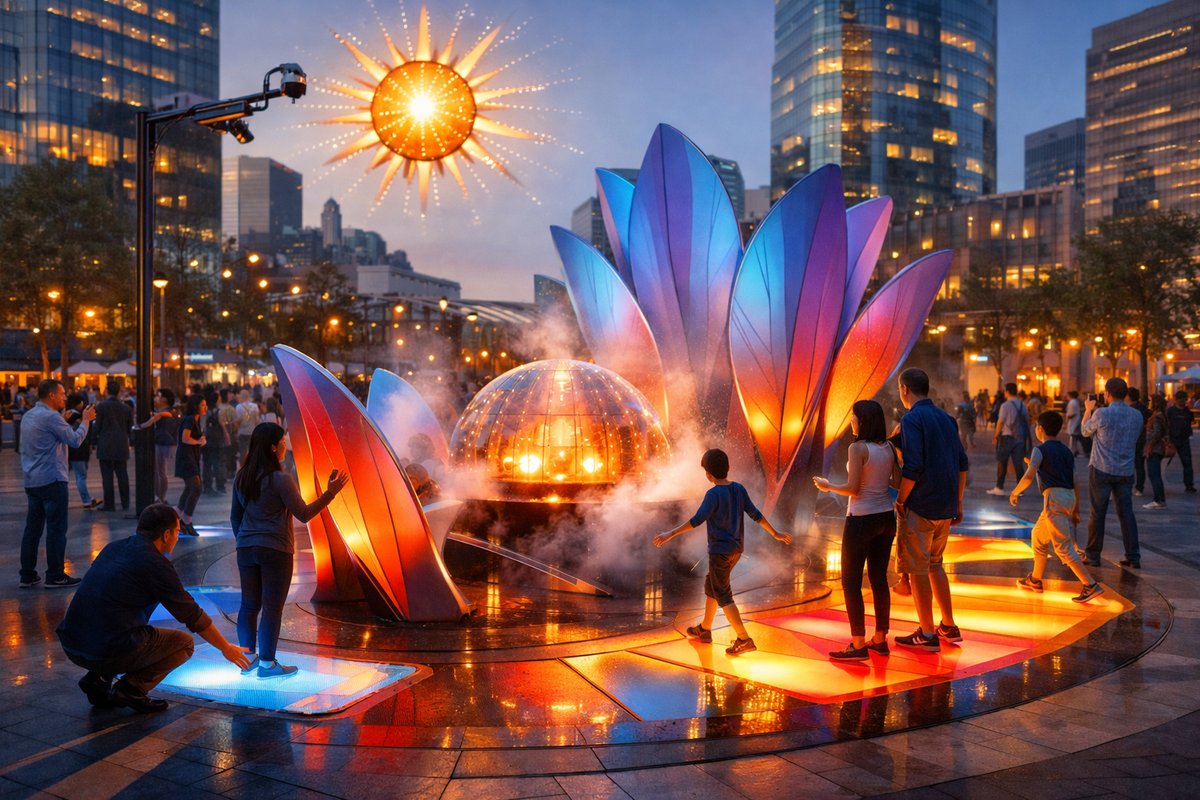

A bustling plaza in a mid-sized city recently welcomed its most dynamic artwork yet: a series of towering cylindrical columns coated in heat-sensitive pigments that shift from slate gray to vibrant orange as the sun’s rays warm their surface. Onlookers discovered that a midday stroll could literally leave a mark-our footsteps, conversations, and even a warm cup of coffee held near the metal apply enough heat to momentarily awaken fluorescent patterns. These reactive sculptures are part of a growing movement that seeks to collapse the boundary between viewer and artwork, turning cold, static surfaces into living canvases that breathe with the rhythms of daily life.
Artists and engineers have long flirted with interactive public art, but the latest generation relies on breakthroughs in smart materials and environmental sensing. Thermochromic pigments, once the novelty of mood rings, are now formulated for outdoor longevity, resisting UV degradation and repeated temperature swings. Photochromic inks, which darken under ultraviolet light, can be layered beneath these coatings and combined with embedded sensors to produce even richer visual responses. Some installations pair reactive paint with timed LED modules that glow at dusk, creating a day-to-night transformation in a single structure.
At the heart of this trend is a philosophy of co-creation. Passersby become inadvertent collaborators, their body heat, conversation volume, and mobile devices triggering subtle shifts in hue or revealing hidden graphics. A popular installation in a coastal town uses infrared detectors to measure humidity as well as heat-on misty mornings, soft blue streaks appear alongside the thermochromic orange, producing a painterly sense of weather on the wall. Families often arrive with frozen treats, placing them directly against panels to watch a cool teal blossom across a warm-red background.
In many cities, community workshops accompany these public launches. Volunteers mix custom pigment blends in portable booths, experimenting with ratios of thermochromic powder, acrylic binder, and UV-protective clear coat. Organizers distribute handheld heat guns so participants can fine-tune color-change thresholds, selecting a sensitivity that triggers at body-temperature contact or only under direct sunlight. These gatherings foster a deeper connection to material science and encourage dialogue on sustainability as artists source pigment components certified free of heavy metals and microplastics.
Behind each installation is often a team of specialists. Material scientists refine pigment particle sizes for consistent performance, software developers program Arduino-style microcontrollers to read temperature probes and drive color-tuning LEDs, and installation crews ensure weather seals prevent moisture from seeping beneath multiple paint layers. Many artists partner with local technical colleges and maker spaces, creating opportunities for students to gain hands-on experience in architectural scale art and environmental sensing.
The appeal extends beyond novelty. Urban planners see thermoresponsive art as a tool for placemaking, encouraging foot traffic in underused districts. Night markets report a 30 percent increase in visitors when heat-activated murals glow in twilight, lending a sense of discovery after dark. City councils allocate small grants to pilot these low-energy projects-relying on solar cell-powered control boxes rather than traditional wiring-and in return they reap increased civic pride and economic activity in overlooked neighborhoods.
One inventive project transformed a drab pedestrian bridge into a kaleidoscope of shifting patterns. Engineers installed long strips of thermochromic film on the handrails, accompanied by motion sensors that detect passing cyclists and foot traffic. As movement warms one section of railing, the adjacent panels register the change and release stored energy through hidden electroluminescent wires, producing a brief glow that follows each rider like a comet’s tail. The effect draws attention to pedestrian safety, subtly reminding cyclists to maintain a steady pace and stay within designated lanes.
Critics sometimes question the longevity of these installations. Early thermochromic formulas faded after repeated heat cycles, and painted surfaces dulled under pollution. Today’s advanced binders and ceramic-embedded pigments can endure thousands of color-change transitions, and periodic maintenance protocols-rinsing surfaces with mild soap and reapplying protective coatings-extend lifespans well beyond a decade. Artists design for modularity: replaceable panels or pigment cartridges slot into hidden frames, making refurbishment straightforward when performance declines.
Sustainability remains a core concern. Leading material suppliers now offer pigment blends free of volatile organic compounds and heavy metals. Some teams experiment with bio-based binders derived from algae or citrus peel, reducing reliance on petroleum chemicals. At a recent symposium on reactive art, researchers showcased a prototype paint made from recycled glass beads and non-toxic colorants harvested from botanical waste. While performance still lags behind conventional formulas, the ecological benefits hint at an emerging era of truly green interactive art.
Beyond thermochromic sculpture, related experiments explore sound-activated frescoes and moisture-sensitive murals. In one pilot, ceramic tiles embedded with tiny piezoelectric discs hum faintly when pedestrians step on them. The generated sound waves ripple through a network of speakers, causing suspended metal panels overhead to gently sway, creating a multisensory feedback loop of touch, sound, and movement. Another project sequesters rainwater in porous stone tiles, revealing hidden imagery only when the surface is wet, then gradually concealing it as the pavement dries.
A shared thread among these efforts is emotional engagement. People speak of delight and surprise when cold steel bursts into color, or when a quiet sidewalk hum awakens in tune with footsteps. These installations spark curiosity, encouraging deeper observation of everyday surroundings. In a world saturated with screens and digital stimuli, the tactility of heat-activated paint and the poetic interplay of light and motion reconnect individuals with material phenomena.
As responsive public art spreads, collectors and private clients are taking notice. Galleries commission smaller indoor versions for lobbies and atriums, using climate-controlled environments to fine-tune color-change thresholds. Designers install heat-sensitive wall panels in coworking spaces to signal occupancy: a soft gradient glows when someone is seated, fading once they leave. Hospitality groups adopt photochromic table surfaces that reveal menu options in bright sunlight and retract when indoors, blending novelty with practical communication.
Educational institutions see potential for informal science learning. Interactive art becomes a gateway to explaining thermodynamics and material chemistry. In science centers, exhibits allow visitors to mix pigment pastes and test temperature triggers, then vote on their favorite color transitions. Sculpture parks host weekend demos on microcontroller programming, helping teens link coding skills with tangible visual results.
Despite rapid adoption, these projects remain accessible. A small-scale heat-sensitive mural can be completed in days with a team of four, modest equipment, and a pigment budget that rivals a high-end commercial paint job. Artists leveraging crowdfunding often meet modest goals to cover materials and sensor hardware. Municipal arts commissions increasingly allocate five-figure sums to pilot public interventions that captivate both locals and tourists.
Looking ahead, the next frontier blends machine learning with responsive surfaces. Experimental panels equipped with thermal cameras and AI algorithms can recognize walking patterns, crowd density, or even simple gestures, and choose color palettes accordingly. Imagine a plaza that senses a gathering and shifts from calming blue tones to vibrant reds, or a fountain that pulses neon green when children gather around. Researchers are already testing prototypes under controlled conditions, envisioning urban canvases that learn from behavior and adapt to cultural events.
As these technologies mature, questions arise about privacy and autonomy. What data do sensor-driven walls collect? Who controls the color algorithms? Artists stress the importance of transparency-open-sourcing code, anonymizing sensor readings, and clearly communicating the installation’s behavior. In most cases, only temperature or motion vectors are recorded, with no personal identification. Community advisory panels review data-use policies, ensuring installations align with local values and protect individual rights.
For cities grappling with climate change, responsive art offers more than aesthetics. Surface temperature readings gathered by thermochromic installations can contribute to urban heat-island studies, mapping micro-climates in real time. When paired with public dashboards, passersby can see which streets cool faster at night or which plazas trap heat near sunlit façades. Such data informs tree-planting campaigns, solar canopy installations, and other resilience measures, turning art into actionable insight.
Ultimately, the surge of heat-activated public installations signals a broader shift in how society perceives art and design. No longer confined to museums or galleries, sculptures and murals become immersive, participatory experiences woven into daily routines. By celebrating material science, community engagement, and environmental awareness, these projects redefine the role of art in the civic realm. They remind us that every sidewalk, plaza, and wall holds untapped potential-waiting for a spark of curiosity and the warmth of human presence to bring it to life.
-
Renfio 6 Colors Thermochromic Pigment Powder,18g ... - Amazon.com
✓6 Thermochromic Pigment for 12 Color Changing Trip: Color changing pigment powder set ... thermochromic paint pigment. 3g/0.1oz per jar,18g/0.63oz total.The ... -
Enclosure for Resin 3D Printer with Ventilation kit and LED Lighting ...
Enclosure for Resin 3D Printer with Ventilation kit and LED Lighting Eliminate or Reduce 3D Printing Smell Constant Temperature Improve Printing Quality ...