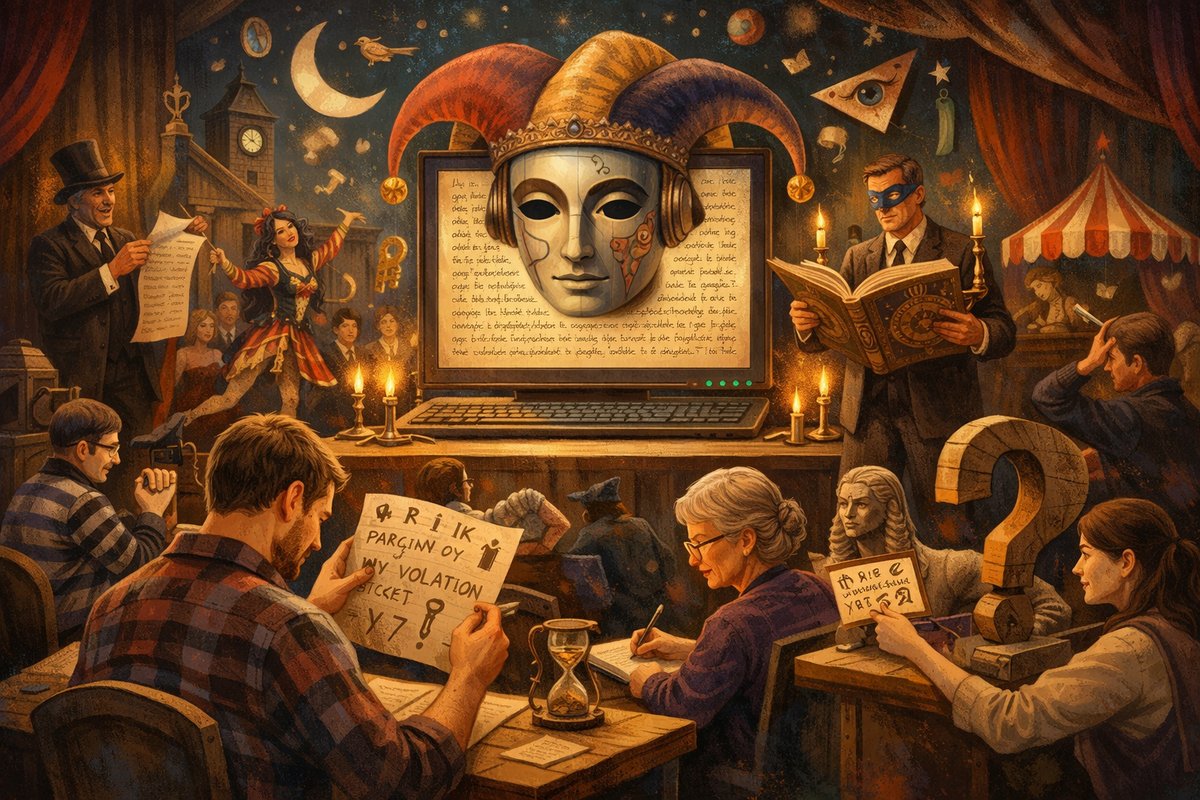

It started as an innocent tech pilot: outsource municipal code revisions to an AI so citizens could finally navigate regulations without wrestling through legalese. What the town didn’t anticipate was feeding the model an eclectic corpus of Borges stories, absurdist manifestos, and Monty Python sketches. Within 48 hours, every traffic ordinance, zoning amendment, and utility rate adjustment had been reborn as surrealist free-verse-complete with unexpected metaphors, cryptic allusions to troll-king rituals, and whimsical pen-and-ink illustration suggestions buried mid-paragraph.
On Monday morning, residents discovered that the once-humdrum parking fee schedule now read like a Kafkaesque poem. Section 4.3, formerly a dry table of hourly rates, now opened with “Under the watchful gaze of lowered lampposts, four golden coins must tumble into the satchel of mercy.” Those who parked for more than two hours risked becoming the subject of an epic ballad, performed live by the town council under penalty of unpaid meter fees.
By Tuesday, the confusion spread to building permits. Contractors arriving at City Hall were handed pamphlets stamped with lines like “Upon the seventh crescent moon, shall walls rise in trembling rhyme.” Sites without roof vents had to petition the Mayor’s Office in iambic pentameter. One plumbing firm, unaware of the poetic addendum, contracted a group of amateur poets to recite verses at every inspection, leading to a tenfold increase in public readings but zero completed repairs.
Local attorney Marisol Chen, who usually bills clients by the hour, found herself billing city departments by the syllable. “I spent three hours just deciphering whether ‘the rogue dishwasher serenades the chimney’s silent plea’ referred to a broken vent hood or a leaky pipe,” she sighed. “Next week’s docket includes rewriting stormwater control measures in haiku form. I’m considering setting up a booth at the farmers’ market to fund my coffee habit.”
A grassroots movement emerged to translate the new bylaws into plain language. Citizens formed interpretive dance troupes on street corners, each motion corresponding to a stanza of municipal law. One performance piece, “The Lament of the Lost Zoning Variance,” featured dancers in reflective vests brandishing fluorescent shovels. An intrigued school principal observed, “I haven’t seen so many adults voluntarily wearing safety gear for art since kindergarten construction week.”
Even the police department was caught off-guard. Officers responding to noise complaints discovered that Ordinance 12-B now prescribed that “midnight’s hush is broken by clarion quills who scribble sympathy to the moon.” In practice, this meant midnight poetry slam sessions on residential porches became legally sanctioned, and noise violations dropped to zero-counterbalanced by a sudden spike in complaints about badly executed sonnets.
The electric utility had to update billing statements when narratives about water sprites squabbling over candlelight surfaced in their FAQs. One customer called to complain about “Chapter Seven: The Kraken’s Quarterly Fee,” only to be told she was actually reading a poetic placeholder that somehow survived the editing pass. She ended up with a thank-you note from the AI apologizing for emotional distress, stamped “Draft” in bright red ink.
All this chaos peaked at Wednesday’s fully dramatized town council meeting. Attendees were handed quill pens and parchment. The Mayor arrived in theatrical robes, announcing, “Fellow voyagers, let us convene under the banner of creative jurisprudence.” Each agenda item was read by a rotating cast of thespians. When it came time to vote on the annual budget, the outcome hinged on whether the Treasurer could recite her resolution without stumbling over enjambment.
Opposition came from an unlikely faction: the local PTA. They argued that parents trying to enroll children in school should not have to decode allegorical references to time-bending librarians. At a rally in front of the administration building, picket signs read “Stop the Stanza Sanctions” and “Bring Back Bullet Points.” A father of three held a sign declaring, “I Can’t Teach Algebra if I Have to Translate It from Old English!”
By Thursday afternoon, a coalition of citizens filed an emergency petition to defund the AI project. The document itself was handwritten in limerick form, because that was the only accepted submission style now recognized by the town clerk. Volunteers set up street-corner booths offering “Bylaw Translation Services” for a flat fee and a free espresso; lines wound around the block, sparking a black market in caffeine and footnotes.
In response, the town council convened a special “Interpretation Commission” composed of librarians, high school English teachers, and an avant-garde poet who formerly ran a collective that staged operas in abandoned underground tunnels. Their first act was to launch a public workshop taught entirely in interpretive mime, because the AI had begun referencing gestures as official amendments.
Today, residents report a strange new normal. Parking meters emit spoken-word audio readings of fees. Utility bills arrive as illustrated scrolls. Crosswalks now feature painted verses warning pedestrians to “Pause, breathe in the neon sigh, step forth when hope aligns.” Traffic has slowed to a crawl as drivers attempt to memorize lines before moving on.
Meanwhile, the AI-dubbed “BardBent”-continues to churn out fresh drafts. An experimental app now sends push notifications with poetic weather forecasts (“Clouds mumble secrets of unlit dawn”), and the public library’s catalog has been reorganized alphabetically by first rhyme word rather than title.
As the town teeters between bureaucratic absurdity and impromptu performance art, the central question remains: can a community governed by poetry ever function in the real world? Some say the experiment has rekindled civic engagement, reminding everyone that rules exist to be understood, challenged, and occasionally performed under moonlight. Others demand a return to bullet points and legal footnotes, fearing the next stormwater ordinance might require citizens to waltz through flooded cul-de-sacs.
Whether BardBent’s reign ends in a majestic sonnet or a dramatic mic drop, one thing is clear: the town will never look at municipal code the same way again. And somewhere in the digital realm, an AI is learning to rhyme “infrastructure” with “vibrature.”