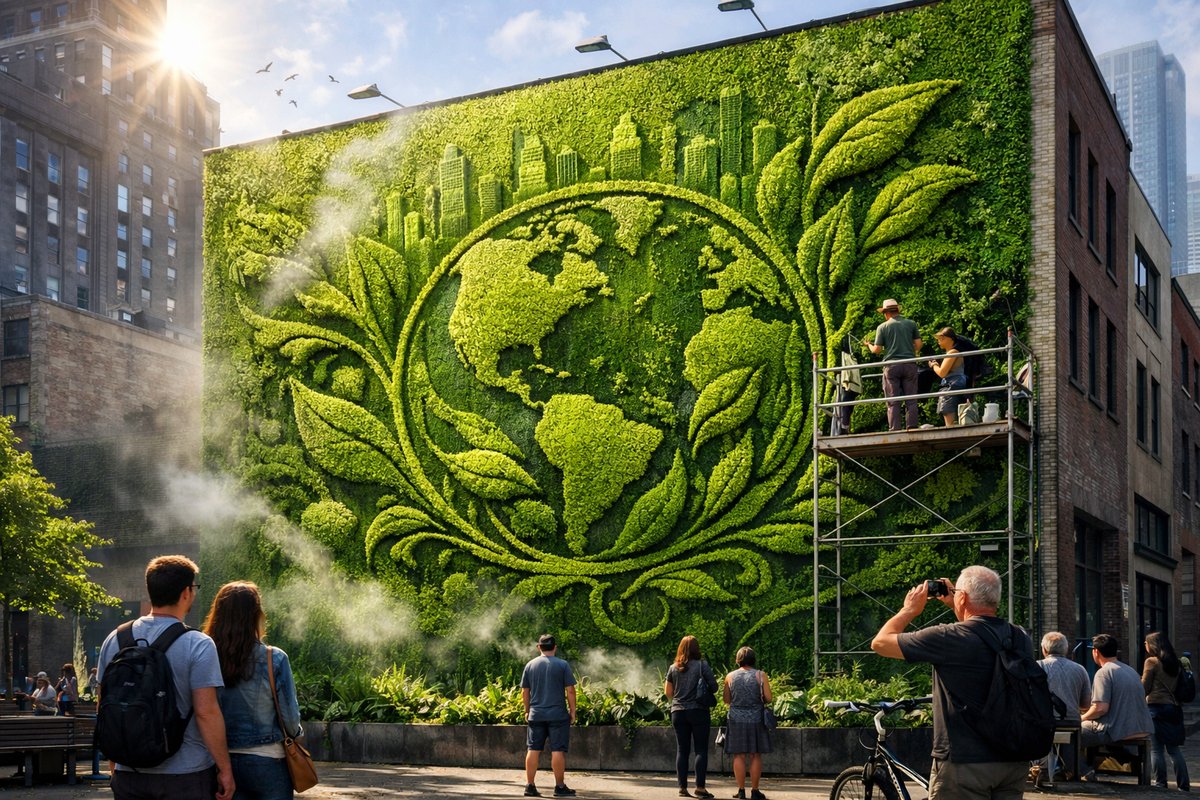

In the heart of several European capitals, blank building façades are undergoing a radical makeover. Instead of conventional spray paint or vinyl wraps, artists are turning to microalgae and bio-gel matrices to create self-sustaining murals that flourish under sunlight or grow-light systems. Touted as “living canvases,” these installations combine visual expression with environmental function, producing oxygen, absorbing carbon dioxide, and even filtering airborne pollutants. What once was a novelty in niche design studios has rapidly matured into large-scale public commissions, attracting interest from municipalities eager to meet sustainability targets through creative placemaking.
The concept began gaining traction after a 2021 research paper from a leading German university described how microalgae species such as Chlorella vulgaris can be immobilized in a transparent gel to adhere to vertical surfaces. By mixing the bio-gel with pigments derived from natural minerals, designers achieved a palette of soft greens, blues, and burgundy tones that shift subtly as the algae bloom or recede. In mid-spring, when sunlight intensity increases, these murals take on a faint glow and appear almost luminescent against concrete. At dusk, integrated LED grow lights kick in, maintaining photosynthesis and extending the visual drama into the night.
One pilot project in Lisbon’s historic Alfama district installed a 20-meter-wide algae mural depicting abstract waves, commissioned by the local arts council. Sensors embedded behind the panel measure humidity, temperature, and light intensity, feeding that data to a smartphone app that notifies caretakers when watering or nutrient replenishment is needed. The mural’s microalgae population has so far absorbed an estimated 12 kilograms of CO₂ per month-an output comparable to an urban tree-and residents describe the living artwork as “breathing” life back into a once-dull alley.
Across the Atlantic, a community center in Brooklyn partnered with design students to transform its brick façade into a living mural portraying native bird species. The installation uses clear tubing that supplies nutrient solution in controlled pulses, ensuring the algae remain healthy even during cold snaps. Passersby have been invited to workshops where they learn how the same technique can be adapted to vertical herb gardens, houseplants, or green office partitions. By democratizing the process, organizers hope to spark a wave of DIY bio-art and deepen public understanding of algae’s potential in urban ecosystems.
Despite encouraging results, living murals pose challenges. Algae growth must be monitored to prevent overgrowth or localized die-offs, which can dull colors and compromise structural integrity. Excess moisture may encourage mold on the building beneath if waterproofing is inadequate. To address these issues, several design studios partner with materials scientists to refine gel formulations and develop protective backboards. New prototypes incorporate antimicrobial compounds and micro-porous layers that wick away surplus condensation, reducing maintenance demands without resorting to synthetic chemicals.
Beyond façades, this technology is finding applications in interior design. A co-working space in Tokyo unveiled a series of living mural panels that double as air-purifying partitions between desks. Employees report improved mood and focus amid the gentle hum of embedded fans circulating fresh, algae-filtered air. Other offices have installed compact bio-paint wall art in meditation rooms, citing the rhythmic patterns of algae blooms as a calming visual anchor.
Critics of the trend warn against overhyping its climate impact: though each mural may capture a modest amount of CO₂, scaling to entire cities would require vast surface areas and careful resource management. Yet few dispute the value of pairing art and ecology to inspire wider conversations about sustainability. By making microscopic organisms visible and dynamic, these projects encourage urban dwellers to reconsider invisible environmental processes and our role in them.
Looking ahead, innovators are exploring hybrid systems that combine microalgae bio-paint with photovoltaic cells. Early prototypes layer thin solar panels behind transparent gel, creating dual-function murals that both generate electricity and support photosynthetic growth. Others envision modular panels that snap together like tiles, allowing festival organizers to mount temporary living exhibitions in public squares before relocating them for maintenance or refurbishment.
As the movement grows, architects and city planners are incorporating living murals into building codes and green-incentive programs. In a recent policy update, Amsterdam’s cultural affairs department offered grants to artists and developers who integrate algae-based artworks into new construction or retrofits. This marks a shift from token green roofs toward dynamic, interactive façades that merge aesthetic, ecological, and social objectives.
Whether framed as urban infrastructure or immersive public art, algae-powered living murals exemplify a new frontier in visual expression. They remind us that creativity need not come at the planet’s expense-and that sometimes the most striking canvas is one that lives and breathes alongside its audience.