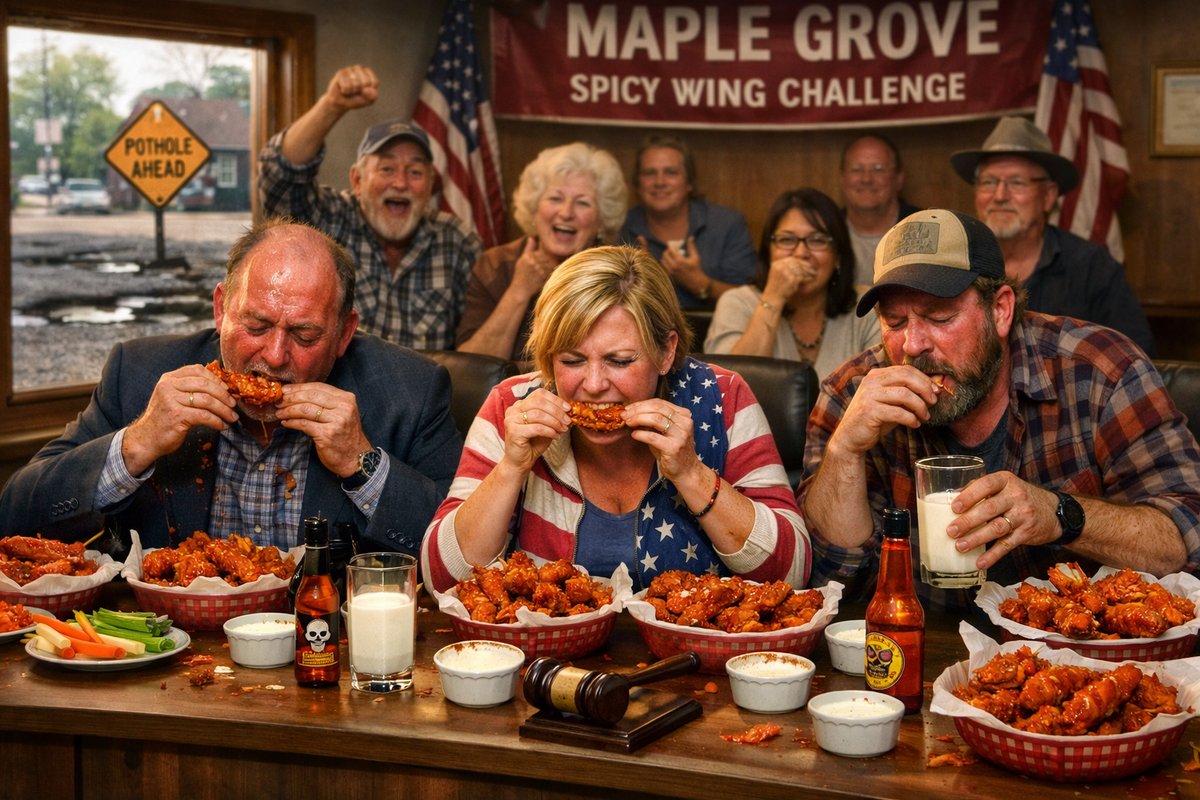

It started on a Tuesday afternoon, when Mayor Linda Granger strode into the council chambers carrying a tray of steaming hot wings instead of an agenda. “Ice breakers are boring,” she declared, brandishing a scorching drumette from Fiery Fox Sauces. “From now on, we vote with our mouths.” Confounded citizens and city staff watched as she downed the wing in one bite, eyebrows singed but spirit unbroken. Thus began Maple Grove’s transformation from sleepy municipal body to a caldron of culinary chaos.
The seeds of this revolution were sown earlier that week, during what everyone thought was a routine budget workshop. Councilor Javier Morales, worn thin by hours of pandemic-era Zoom deliberations, suggested that a dash of capsaicin might liven things up. Inspired by a dare at last summer’s charity barbecue, he proposed a pilot event: substitute a single council meeting with a timed wing-eating challenge. “If we can survive ghost peppers,” he reasoned, “we can handle any funding debate.” The motion passed unanimously-though several members whispered that unanimity was probably just the spicy sauce numbing their tongues.
Within days, the council chamber was retrofitted with concession stands and branded banners reading “Democracy on Fire!” The dais was lined with red plastic tablecloths and disposable napkins stamped with the municipal seal. Contestants-councilors, department heads, even the town clerk-lined up before platters of wings lacquered in varieties like “Volcano Voter,” “Lava Ballot,” and the dreaded “Supreme Scoville Standard.” At the buzzer, the mayor counted down: “Three… two… one…” and the first round began with carb-powered fury.
By all accounts, the inaugural contest was a hit. Councilor Marisol Kim, known for her temperate disposition, stunned everyone by dispatching eight wings in under two minutes before succumbing to fiery tears. Parks Director Theo Johnson declared the exercise “surprisingly therapeutic,” claiming he emerged with “a clearer vision for downtown revitalization.” Reporters scribbled notes as staff passed out milk and ice cream to stunned onlookers. A live camera feed showed the usually stoic finance director trading his ledger for a straw-stirred iced coffee-clearly prioritizing palate rehabilitation over spreadsheets.
Residents, meanwhile, were polarized. Some embraced the mayhem as an avant-garde approach to participatory democracy. High school civics teacher Dana Brooks staged a pep rally outside City Hall, complete with homemade posters reading “Pave the Potholes, Then Bring the Heat.” Others sputtered in outrage. “I moved here for community values and affordable sewer rates, not competitive gastronomy,” griped lifelong taxpaying resident Earl Meyers, who, despite never sampling a wing, vowed to start a recall petition. Within hours, an online support group called “Save Our Stomachs” amassed hundreds of members demanding a return to PowerPoint presentations.
The turning point came when the state ethics commission caught wind of the spectacle. A cease-and-desist letter arrived mid-contest, warning that official business could not be conducted under the influence of hot sauces. The council brushed it aside, dubbing their wing-off “performance art” and claiming First Amendment protection. To placate concerned parties, they introduced a “mild sauce alternative,” though few dared sample its bland, bureaucratic flavor.
Undeterred, Maple Grove officials escalated the concept. The next week, they hosted an open-to-the-public Wing Walk-In, inviting local restaurants to compete for the title of “Official Civic Caterer.” Food trucks lined the parking lot, offering everything from honey-chipotle diplomacy wings to ghost-pepper reconciliation bites. Citizens formed tasting panels, awarding micro-grants funded by the surplus wing-off “entry fees.” Meanwhile, the official council meeting agenda-the actual list of motions and votes-remained sealed in a plexiglass box, untouched beneath a mound of scorched napkins.
Word spread beyond town borders. National food blogs dubbed Maple Grove the “Hot Wing Capital of Small-Town America.” A late-night comedian quipped that the next logical step would be to replace jury duty with “courtroom hot sauce duels.” Local historical societies, worried that future generations would read minutes claiming that tax dollars had been “appropriated for wing procurement,” hastily archived old meeting records in attic vaults.
Back home, a group of frustrated citizens formed the Pothole Preservation Society. Armed with protest signs and spare pavement bricks, they staged a sit-in on Main Street, demanding that at least one thoroughfare receive a new coat of asphalt before the “Great Global Spiciness Referendum” could proceed. Curiously, councilors paused mid-wing, some wiping tears, others licking stray sauce flecks off their forearms, before unanimously passing a motion to schedule a wing-off at 3 a.m.-ostensibly so protesters wouldn’t be able to attend.
That predawn showdown was, predictably, a fiasco. The town clock had unceremoniously reset itself during daylight savings, leaving contestants half the town asleep and half the town wondering why the streetlights were still on. The mayor, wielding a torch lighter and a lukewarm wing, conceded that perhaps 3 a.m. was “too ambitious.” In a rare moment of clarity, she proposed a final compromise: hold one last council meeting conducted in the traditional sense, at a civil hour, no wings in sight.
On Wednesday afternoon, under the steady glow of fluorescent bulbs instead of neon sauce labels, the council reconvened. They moved to codify “Wing Wednesday” as an annual festival rather than a governing mechanism. They voted to direct leftover contest revenues toward repairing the most notorious potholes-although several councilors quipped that they might keep one wing for “research purposes.” A collective round of applause filled the chamber, though it lacked the fervent slurps and coughs of earlier sessions.
Maple Grove has since become a magnet for wing enthusiasts and political tourists alike. T-shirts proclaiming “I Survived the Municipal Wing-Off” hang in the visitor center. Yet at the end of the day, the potholes remain, yawning like unblinking mouths waiting for attention. To many residents, the spicy absurdity was a welcome distraction-a fleeting reminder that government need not always be dull. And as one local diner owner put it over a pint of milk: “At least our council finally spiced up town life, even if they forgot to pave the roads.”