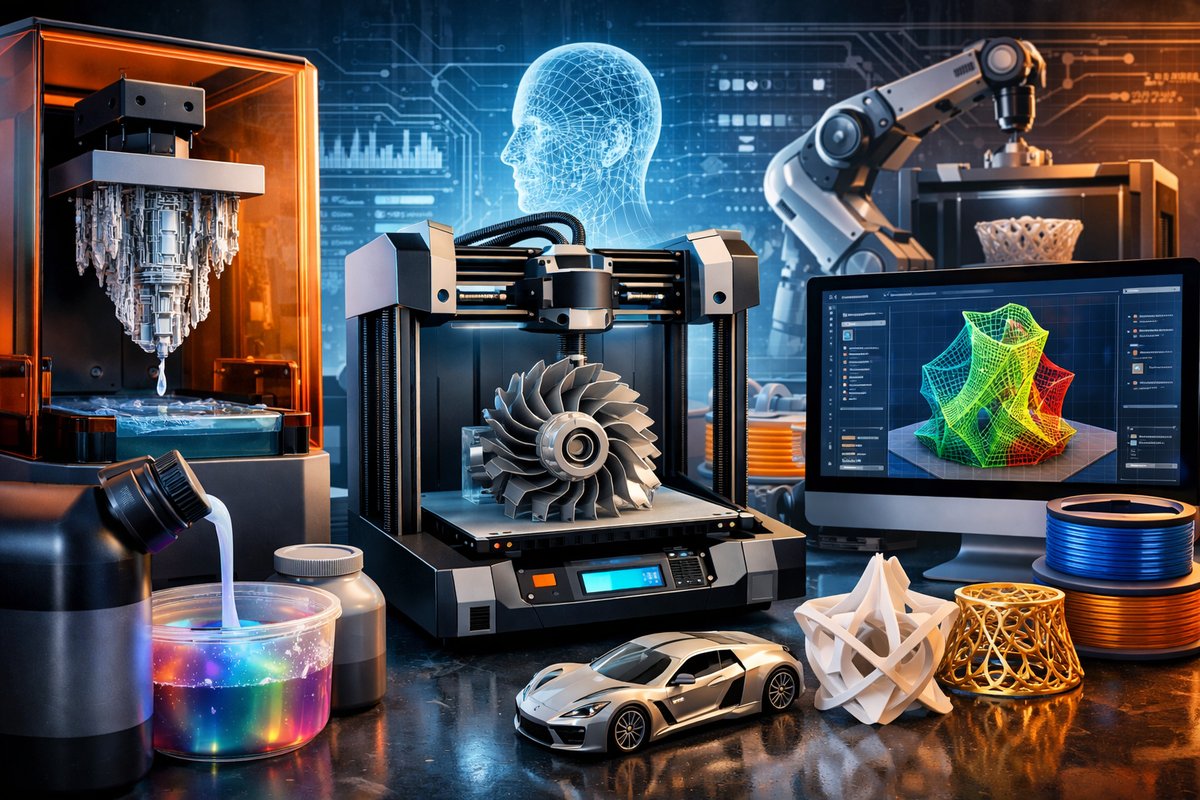

Three decades after the first commercial stereolithography machines appeared, 3D printing has evolved from a niche prototyping tool into a versatile platform reshaping industries. Today’s printers can fuse metals, cure composite resins, and extrude recycled polymers, all while guided by smarter software and real-time monitoring. What was once a laboratory experiment is now a desktop workshop essential for hobbyists, small businesses, and R&D teams. As costs fall and capabilities rise, the process of turning a digital design into a tangible object has become both more economical and more feasible for a wider range of creators.
At the heart of this shift are breakthroughs in hardware design. Traditional fused filament fabrication (FFF) printers now sport direct-drive extruders capable of handling flexible and fiber-reinforced filaments without jamming. Pellet-fed extruders bring raw plastic pellets-often 50 percent cheaper than spools-into the equation, driving material costs down. Meanwhile, resin-based technologies have diversified: low-force stereolithography (LFS) systems use elastic vats to reduce peel forces, boosting print success rates for delicate overhangs. Powder-bed fusion machines once reserved for aerospace components now appear in desktop form, using lasers or infrared heating to sinter nylon powders with remarkable speed.
Materials science has kept pace, introducing high-strength composites and bio-based resins that extend beyond decorative prototypes. Carbon-fiber-reinforced filaments offer tensile strengths rivaling machined parts, while glass-filled polymers improve thermal stability for functional fixtures. On the resin side, ceramic-loaded photopolymers promise printable molds that can be fired post-print, opening doors for jewelry casting and dental applications. Even conductive filaments, embedded with graphene or silver, bring circuitry to life within a single print run.
Software improvements are equally transformative. Open-source slicing engines now integrate machine-learning models to predict and prevent print failures before the first layer is laid down. By analyzing data from thousands of prints, these algorithms fine-tune print speeds, temperatures, and support structures for each geometry. Cloud-based platforms allow remote monitoring of multiple printers, alerting users to nozzle clogs or warping as soon as they occur. Some systems even pause mid-print to swap materials or embed electronics, all coordinated through a web interface.
To make 3D printing economically viable, many adopters turn to open-frame kits or recycled-plastic extruders. Open-source communities share designs for modular extruders that accept shredded PET bottles or agricultural plastic waste. By reclaiming local scrap, individuals reduce reliance on imported filament, championing a circular-economy mindset. Community-driven marketplaces host digital files under permissive licenses, fostering collaboration and continuous improvement of both hardware and materials.
Success in 3D printing starts with careful design for manufacturability. Features like chamfered overhangs, gentle bridging angles, and built-in print pauses can dramatically improve first-time print success. Designers often hollow out bulky models or use lattice infill patterns to cut material usage by up to 60 percent without compromising strength. Smart orientation tools in slicing software optimize part placement for minimal supports, reducing post-processing time and waste.
Speaking of post-processing, modern workflows no longer end when a print finishes. Automated resin-wash stations and UV ovens streamline the curing process, ensuring consistent mechanical properties across batches. Solvent recycling units capture and filter IPA or other cleaning agents for repeated use. For FFF parts, desktop sandblasters and precision polishing stations help achieve smooth finishes that rival injection-molded components. These steps, once labor-intensive, are now packaged in affordable benchtop units that even small makerspaces can adopt.
Quality assurance has emerged as a cornerstone of professional additive manufacturing. In-printer cameras and laser scanners scan each layer, comparing it to the digital model in real time. Discrepancies trigger corrective actions-like adjusting extrusion rates or recalibrating axes-before errors compound. Some advanced setups integrate thermal imaging to detect hotspots that could lead to warping, automatically tweaking cooling fans or bed temperatures to maintain uniform layer adhesion.
Even novice users benefit from these innovations. Starter printers now come pre-calibrated, with guided setup wizards that walk through bed leveling, filament loading, and test prints. Intuitive touchscreen interfaces replace cryptic g-code commands, while built-in safety features-such as enclosed build chambers and filament runout sensors-reduce user anxiety. The next generation of makers doesn’t need a degree in mechanical engineering to embrace additive technology.
Emerging techniques hint at tomorrow’s possibilities. Multi-jet fusion, once confined to industrial floors, is finding its way into compact footprints through lower-power infrared modules. Continuous liquid interface production (CLIP) speeds photopolymerization by orders of magnitude, eliminating visible layer lines. Hybrid machines that combine subtractive milling with additive layer deposition offer one-step part finishing, merging the strengths of CNC and 3D printing.
Economic feasibility also ties into sustainability. A growing ecosystem of biodegradable polymers-like PBAT and PHA-targets applications where end-of-life disposal matters. Closed-loop recycling initiatives collect failed prints and support structures, pelletize them, and reintroduce them into extruders. Circular supply chains reduce landfill waste and shrink the carbon footprint of manufacturing small batches or custom components.
This quiet revolution extends beyond object creation. Educational institutions embed 3D printers into STEAM curricula, encouraging students to iterate designs, test prototypes, and learn engineering fundamentals hands-on. Medical teams print patient-specific anatomical models for surgical planning, improving outcomes without the cost of outsourced molds. Artists explore generative design to produce organic sculptures that defy traditional carving methods. Across disciplines, the layer-by-layer approach embodies a new ethos: rapid experimentation, feedback-driven improvement, and a deep respect for material efficiency.
The promise of 3D printing lies not just in its ability to make objects, but to democratize innovation. By lowering barriers-cost, complexity, and lead time-it empowers anyone with an idea to prototype, test, and bring their visions to life. As the technology matures, economies of scale in materials and hardware will continue to drive prices down, even as capabilities expand. In this landscape, creativity becomes the only true limit.
Beyond the Next Layer
Looking ahead, the fusion of artificial intelligence, advanced materials, and tighter process controls will further transform additive manufacturing. Imagine self-optimizing printers that learn from each build, or composite resins that change color or conductivity on command. Even now, the seeds of that future lie in community drive, open innovation, and accessible tools that place precision fabrication within reach. Each new layer begins with a simple click-and with it, a chance to reshape the way we make things.