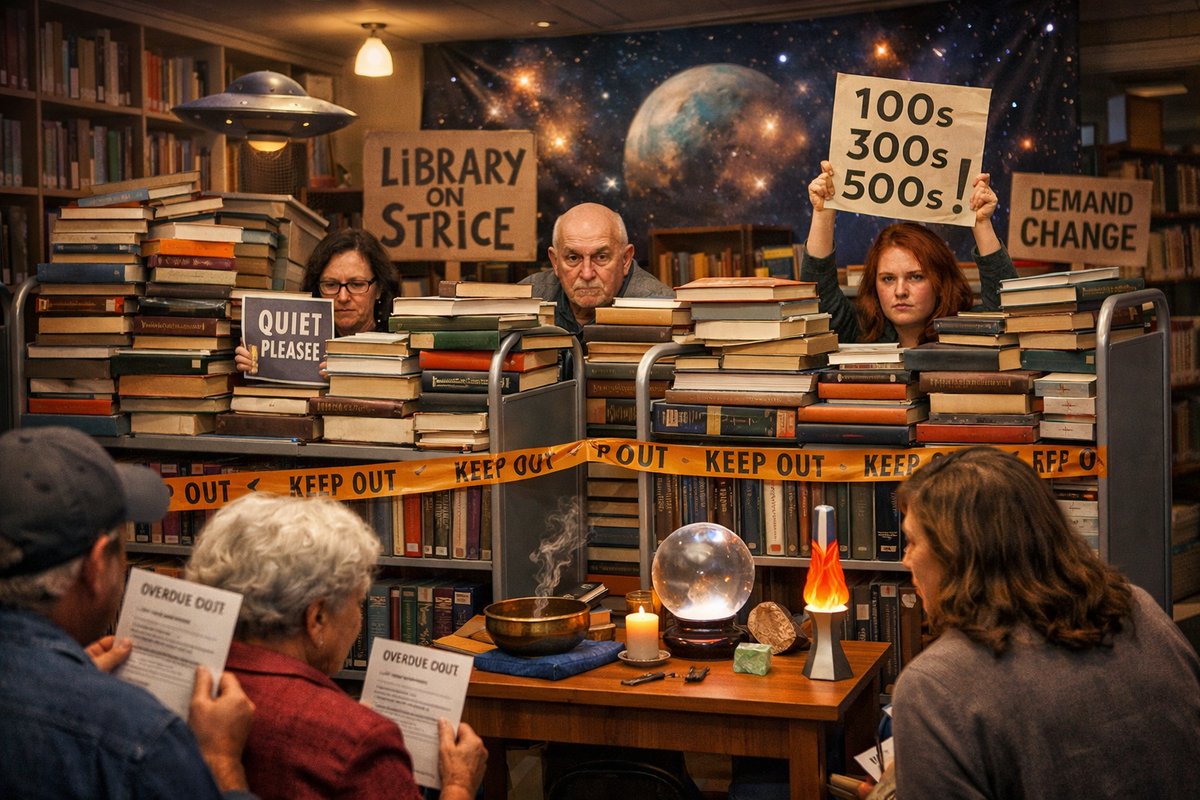

On a crisp Tuesday morning, the unsuspecting citizens of Brookhaven stepped into their beloved public library only to find the front doors chained with colorful satin ribbons and a handwritten sign that read, “Quiet Protest Zone: Do Not Disturb Our Dewey.” Behind the reinforced card catalog barricade, a cadre of librarians sat cross-legged on swivel chairs, eyes closed in silent meditation. Word quickly spread that these defenders of silent reading had embarked on an unprecedented work stoppage-no reshelving, no interlibrary loans, not even the faintest shush of disapproval.
Sources inside the hushed chambers report that the strike began at precisely 9:07 a.m., the exact moment a junior page was caught shelving a dog-eared copy of Cold War spy fiction in the biography section. “It was a bridge too far,” confided one bespectacled librarian who asked to remain anonymous. “We’ve been absorbing overdue fines, midnight cataloging marathons, even angry patrons demanding life-or-death assistance. But misplacing beloved Tom Clancy under Winston Churchill? That shattered our trust.” With that, the collective rubbed the spines of every copy of Moby Dick and sealed the circulation desk behind them.
By noon, the spectacle had drawn a small crowd of bewildered readers. Some attempted to negotiate. A father with three toddlers begged for Humpty Dumpty picture books. A college student pleaded for her thesis sources. Even the mayor showed up wearing white cotton gloves, offering free public Wi-Fi and a lifetime supply of sticky tabs. The librarians responded by passing around a three-page manifesto-single spaced-titled “On the Ethical Imperative of Shelf Accuracy and Emotional Well-Being.” It contained five amendments, including the right to weekly empathy circles and annual book cart maintenance days.
Rather than relish their newfound leverage, the librarians insisted on maintaining absolute silence. Volunteers distributed pre-written note cards labeled “Yes,” “No,” and “We Need More Bibliotherapy.” Anyone caught speaking was lightly shushed by a remote-controlled recording of the library’s most legendary hush. The community, ever adaptable, found creative ways to communicate: semaphore with bookmarks, interpretive dance routines inspired by Victorian literature, and a mime performing “The Trial of the Missing Library Card.”
Internally, tensions rose when the budget committee attempted to break the standoff by offering freshly sharpened pencils and a lifetime supply of sanitized paper clips. The librarians declined, citing a newly discovered clause in their employee handbook that granted them sovereign immunity from office supply bribes. The final straw came when the Gazette published a scathing editorial accusing them of book elitism. In response, the librarians unveiled their next move: a demand that every policy meeting be conducted in iambic pentameter and punctuated by at least one extended haiku.
Word of the protest made national headlines when a freelance journalist live-streamed a dramatic reading of the manifesto. Viewers witnessed librarians in pastel cardigans, sporting protest sashes embroidered with tiny book motifs. One tearfully recounted the trauma of reorganizing a misfiled romance novel under astrophysics while her supervisor looked on approvingly. The clip went viral, inspiring solidarity sit-ins at libraries from coast to coast-though most participants simply reclined in beanbag chairs clutching pulp fiction.
By day three, urgent negotiations were underway in the basement reference room, where librarians threatened to activate the legendary Cosmic Reference Desk. According to library lore, this unstaffed counter peers into an alternate dimension where knowledge transcends page numbers. If triggered, it would allow patrons to browse texts that haven’t yet been written-or texts that were never meant to exist. “Once we open that portal,” they warned in a collectively typed communiqué, “the library will never close, and we’ll be on call through every timeline.”
In response, the town council convened an emergency mixed-reality hearing in the local community center. Residents were asked to weigh in using VR headsets and interactive index cards. A passionate group of retirees demanded daily guided tours of rare first editions; a coalition of students insisted on 24-hour study zones complete with snack drones; and two gentlemen in trench coats repeatedly tried to melt down the index card system for unknown reasons. After four hours of heated debate, the council offered a compromise: a monthly “Library Wellness Day” where librarians could lead sound baths among the science fiction shelves.
Sensing momentum, the librarians upped the ante by enlisting the help of the children’s story hour puppets. Reporters arrived to find sock puppets delivering impassioned speeches on representation in fairy tales, followed by a solemn shadow-puppet reenactment of the time a toddler smeared chocolate on a rare manuscript. The sock puppet union leader then unfurled a tiny banner reading, “Books and Puppets United Against Emotional Exhaustion.” It was an absurd spectacle, yet it perfectly captured the librarians’ point: every facet of the library ecosystem deserved recognition and care.
As dusk fell on the fifth day, the community braced for the librarians’ final ultimatum. Instead of opening the Cosmic Reference Desk, the librarians quietly reclaimed their normal stations. Patrons cheered as the reshelving resumed with dramatic flourish. The final negotiator, a young librarian named June, addressed the assembled crowd: “We have agreed to lift our blockade in exchange for the establishment of an annual Date With Dewey festival-complete with story slams, silent disco reading rooms, and empathy-driven shelf relays.” With that, the satin chains were cut, and the library doors reopened to the applause of relieved but bewildered citizens.
In the aftermath, one elderly grandmother was overheard muttering, “I came here for War and Peace, but I got a revolution instead.” Meanwhile, the mayor declared an official holiday in honor of the librarians’ “courageous quest for cataloging justice.” Even the freight-train of overdue notices piled high on the circulation desk seemed to rest more gently. The last line of the librarians’ triumphant manifesto now hangs in the lobby, framed in oak: “May every book find its place, and every reader find their voice.”
Brookhaven’s library has reopened with new guidelines that include quarterly empathy training, a rotating puppet council, and designated cosmic-portal standby crews. Patrons have returned with a keener appreciation for the hidden labor behind their quiet sanctuary. And somewhere in the section marked “Local Folklore,” librarians are rumored to be assembling a new chapter-this time on the ethics of protesting in haiku. If there’s one lesson from this absurd uprising, it’s that even the quietest spaces can become stages for community theater, cosmic speculation, and the deeply sincere art of shelving books correctly.