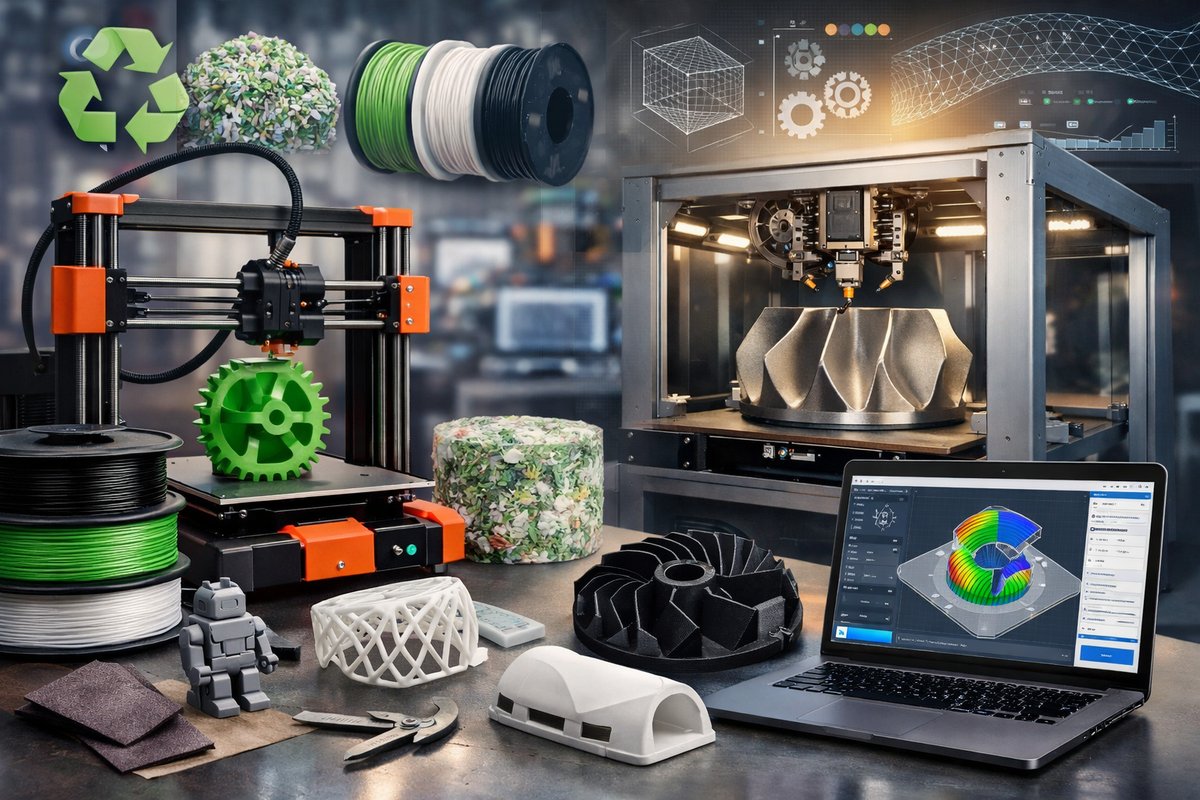

In the ever-evolving world of additive manufacturing, each new breakthrough ripples across communities of hobbyists, engineers, artists, and entrepreneurs. What began as a tinkerer’s dream-droplets of plastic stacking into blocky shapes-has matured into a precise, multi-material craft capable of producing functional tools, intricate jewelry, and medical models. Today’s challenge is not simply pushing resolution or exotic materials, but streamlining every stage of production to reduce cost, boost reliability, and unlock creativity for anyone with a USB cable and a spark of curiosity.
At the heart of this shift lies hardware innovation focused on affordability. A wave of compact resin printers now brings sub-50-micron detail to desktop workstations for a fraction of what professional stereolithography machines once cost. Thanks to lower-cost LEDs, standardized 2K monochrome screens, and simplified vat designs, resin rigs that once retailed for several thousands of dollars are now available for under a few hundred. Meanwhile, filament-based machines have embraced modular electronics and open-source firmware offerings that eliminate proprietary markup. Builders can now assemble or upgrade a polymer extruder using community-driven control boards, hot ends, and stepper drivers for less than half the price of an enclosed retail unit.
On the materials front, cost-cutting meets sustainability in a surprising convergence. Chemical recycling processes are yielding recycled PLA and PETG filaments that perform nearly on par with virgin polymers, while biodegradable resins derived from plant oils offer a greener alternative to petroleum-based formulas. Pilot programs in some maker spaces even convert local plastic waste into feedstock pellets via shredders and pellet extruders. By closing the loop on material usage, eco-conscious makers can slash both environmental impact and raw‐material expenses.
Software advances have multiplied these savings by optimizing how printers lay down each layer. Adaptive slicing algorithms evaluate geometric complexity and adjust layer thickness on the fly-applying ultra-thin slices to curves and details, while thickening layers on flat surfaces to accelerate print times. Coupled with smart infill patterns like gyroid or voronoi lattices, these strategies maintain part strength while minimizing material usage. And in multi-extruder setups, unified slicing engines negotiate temperature, flow rate, and retraction parameters seamlessly across polymer or resin channels-eliminating the trial-and-error that once choked small-batch production.
Post-processing, long the bane of resin enthusiasts and filament fans alike, has also seen a democratisation. Automated resin wash and cure stations now match the footprint of a desktop speaker and evacuate harsh solvents through enclosed cycles. Instead of manually dunking prints in alcohol baths, users rack up consistency and safety by loading parts into a sealed chamber that agitates, drains, and UV-cures with programmed intervals. For thermoplastic prints, simple heated cabinets remove moisture from filament spools on demand, slashing brittleness and preventing nozzle clogging. The result: fewer failed prints and less wasted material.
In parallel, the rise of 3D printing farms caters to small businesses and rapid prototyping groups. Rack-mounted FDM machines network together under centralized management software, assigning models to idle units based on bed size, nozzle diameter, or material loaded. Automated bed leveling and filament runout sensors guarantee that jobs jump to the next available rig if one fails, maintaining throughput without constant oversight. For labs and startups, this level of automation translates into real productivity-weeks of development time turn into days as dozens of identical parts emerge in parallel.
Cloud-based slicing platforms have further lowered entry barriers by offloading intensive path-planning to remote servers. Makers with modest laptops can upload designs and receive optimized G-code expressly tuned for their printer’s build volume, nozzle profile, and filament type. Some services even integrate real-time failure prediction using machine-learning models trained on millions of print logs, warning users if a particular overhang or unsupported span carries high risk of collapse. By catching mistakes before the first layer hits the bed, the cheapest filament becomes the most reliable partner in prototyping.
Layer adhesion and surface quality, once artifacts of guesswork, now benefit from sensor-driven calibration routines. Tiny cameras inside enclosed chambers monitor the first few layers, analyzing extrusion width, bead height, and bed adhesion. If deviations appear, the printer can automatically tweak flow rates, adjust Z-offsets, or pause to let a warped corner cool. Such real-time feedback loops, paired with filament drying chambers, guarantee that regardless of ambient humidity or temperature, every slice is consistent with the digital model.
For creatives skeptical of code and calibration menus, plug-and-play ecosystems are arriving in parallel. Complete printing suites bundle machine, materials, post-processing station, and companion app with one-click presets for jewelry casting, dental modeling, architectural mock-ups, or cosplay components. These turnkey solutions offset some cost savings by streamlining the user journey-eliminating the steep learning curve that once blocked non-technical users from additive manufacturing’s full potential.
Yet the real revolution occurs when these accessible tools empower small teams and solo makers to iterate faster than ever. A mechanical engineer can prototype tooling jigs in hours, test iterations overnight, and deliver production-ready molds to a local injection molding shop by morning. A jewelry designer can sculpt a complex lattice bracelet in CAD, print it in resin for castable wax patterns, and forge final pieces in precious metal-all from a home workbench. Medical researchers can scan anatomical models, slice them into patient-specific surgical guides, and sterilize them for clinical use without shipping samples across continents.
The cost curve continues to bend downward as new materials and methods arrive: pellet extruders that adapt plastic pellets directly from bulk bags, eliminating expensive filament; multi-jet fusion techniques once reserved for industrial floors filtering down to smaller footprints; and continuous liquid interface production that cures entire layers in moments, rather than point by point. Laboratory-scale carbon fiber composites promise high-strength, low-weight parts for drones and lightweight robotic arms, while electrically conductive filaments open up printed circuit boards and sensor embeds.
All of these advances-open-source electronics, material recycling, adaptive slicing, sensor-driven calibration, and farm automation-converge to make 3D printing more practical and affordable. The dream of a truly democratized manufacturing toolkit, once a distant echo in research papers, is now within reach of anyone with a desk, a modest budget, and a willingness to learn. As costs shrink and reliability soars, the real frontier becomes the imagination: what shapes, what tools, what meaningful innovations will tomorrow’s makers build?
Whether you’re an educator aiming to teach engineering principles, an entrepreneur developing a niche product, or a passionate hobbyist eager to push your printer to its limits, the latest technology and techniques offer unprecedented opportunity. By embracing community-driven hardware, recycled and biodegradable feedstocks, cloud-powered slicing, and automated post-processing, you can streamline every layer in the production chain. In doing so, each printed object becomes more than a shape-it becomes proof of what’s possible when creativity, precision, and accessibility unite.