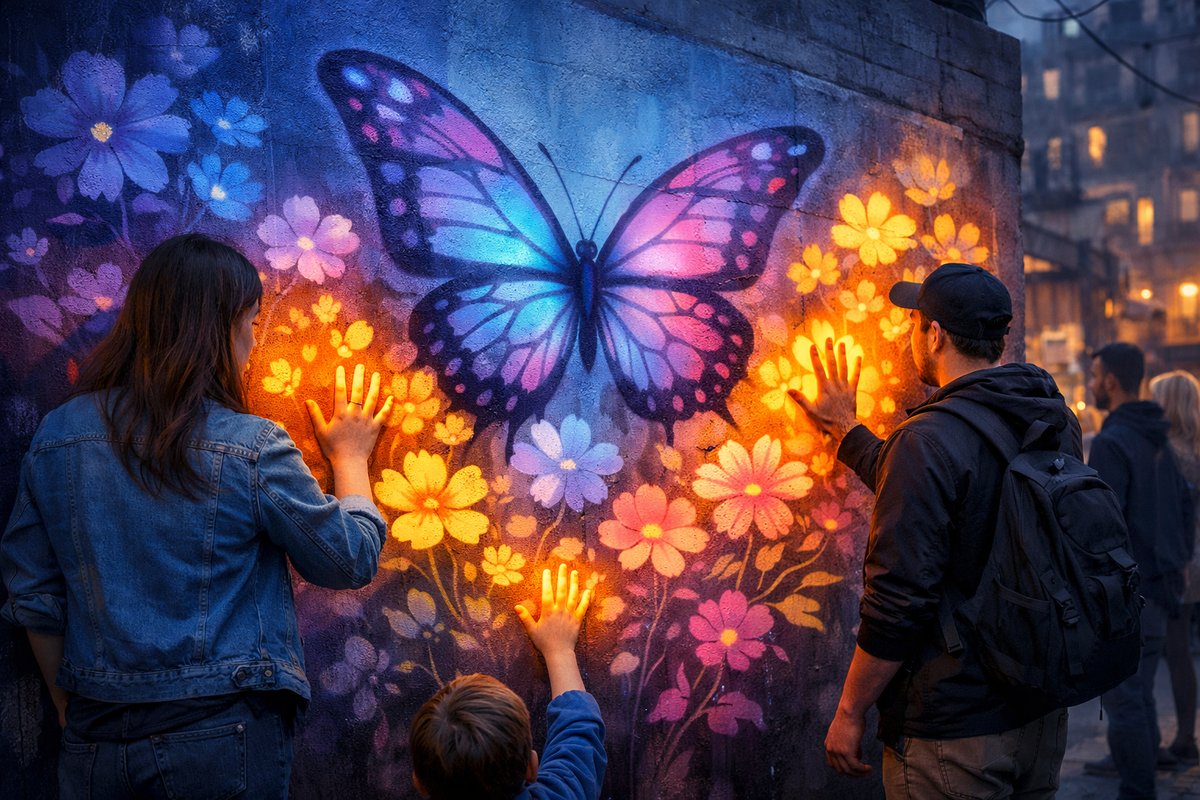

Under the glow of twilight, a once-dull underpass in the arts district has transformed into a living tapestry of shifting tones. As pedestrians lean against the wall, their palms leave warm imprints that blossom into vibrant hues. Moments later, as ambient temperatures drop, the pigments recede to their original muted palette, erasing traces of human interaction. This is the allure of the new wave of thermochromic murals sweeping urban centers: art that responds to touch and temperature, inviting viewers to become participants.
The science behind these mutable murals lies in thermochromic pigments-microscopic compounds that change color when exposed to different temperature thresholds. Originally developed for novelty items like mood rings and coffee mugs, artists have refined these materials by blending them with durable binders suited to outdoor environments. The result is a medium that combines mystery and interactivity: every shift in body heat, every passing breeze, and even the midday sun can elicit a subtle transformation.
Across several cities, local art collectives and design studios have begun adopting thermochromic technology to reimagine neglected walls and pedestrian corridors. In one coastal town, volunteers spent weekends painting a three-block stretch beneath a railway overpass. Geometric shapes and abstract motifs, rendered in panels of custom-blended thermochromic paint, invite cyclists and shoppers to slow down and engage. The installation team provided gloves and rollers, guiding volunteers through the precise mixing ratios needed to ensure durability under rain and UV exposure.
“We wanted to reclaim a space that many people rush through without noticing,” explains an artist involved in the project. “By making the mural reactive, it becomes alive in the moment someone leans in or brushes past. It feels personal without being permanent.” That ephemeral quality is central to the philosophy behind thermochromic street art: every interaction is fleeting, a reminder of the transient connections we share in public spaces.
Technical hurdles did arise. Early tests showed that some pigment formulations would fade too quickly under direct sunlight. To address this, artists blended UV-resistant sealants into their topcoat, balancing protective properties with the need for rapid color change. Moisture-repellent primers were applied first, ensuring the wall substrate remained stable through seasonal shifts. These engineering refinements have expanded the palette of thermochromic artists, now offering more than a dozen visible hues-ranging from deep indigos that brighten to soft pinks, to vivid lime greens that dim to charcoal gray.
Interactive street art has long embraced technology, whether through projection mapping or sensor-driven light displays. Thermochromic murals, however, offer a tactile, low-energy alternative. No electricity is required; human warmth and natural temperature fluctuations fuel the spectacle. This eco-friendly approach aligns with growing calls for sustainable public art that minimizes power consumption while maximizing emotional impact.
Community engagement has taken on a new dimension as well. Several installations have been designed as workshops, where residents of all skill levels mix their own paint batches under artist supervision. One workshop in an inner-city neighborhood invited young residents to contribute to a large-scale mural depicting local flora. As they experimented with paint rollers and brushes, they learned about pigment chemistry, color theory, and the practical challenges of outdoor installation. By the end of the day, each participant left with a small tester panel, ready to conduct their own at-home experiments on porch walls or recycled wood panels.
Early data from one pilot site revealed surprising results: over 1,500 unique interactions per week were recorded by nearby thermal cameras monitoring temperature shifts. Observers noted how families and strangers alike paused to leave their mark, turning an ordinary walkway into a social hub. Some visitors timed their visits to watch the heat-induced bloom of color under the fading sun, while others returned at dawn to see the palette return to neutrality. The mural became a living clock, marking the cycle of day into night through the language of color.
Philosophically, thermochromic murals explore notions of memory and absence. Like sand mandalas in certain cultural traditions, these works embrace impermanence, suggesting that the beauty of an experience may lie in its temporal fragility. Each warm fingerprint becomes a micro-moment, recorded in pigment and then surrendered back to the environment. In an era where digital screens compete for attention, the simple gesture of pressing a hand against cool enamel becomes profoundly human.
Critics and curators have begun cataloging these installations as part of a broader shift toward participatory public art. While previous decades favored monumental sculptures or static murals, the current moment prizes art that evolves and invites direct engagement. Thermochromic works open new avenues for audience interaction without requiring specialized devices or apps. They speak a universal language: the warmth of a hand is understood across cultures, and the resulting color change is immediate and visceral.
Some municipalities are exploring how to integrate thermochromic art into civic planning. One pilot program proposes dedicating certain crosswalk ramps and bus shelter walls to heat-sensitive paint, creating tactile wayfinding cues for visually impaired pedestrians. Another initiative envisions a series of park benches coated with thermochromic layers that shift hue as the day warms, offering visual signals of peak temperatures and helping parkgoers choose comfortable seating spots.
Despite the enthusiasm, long-term sustainability remains a concern. Continuous thermal cycling can eventually degrade pigment performance, and heavy foot traffic may abrade painted surfaces. To address this, some teams are experimenting with embedded protective films that can be replaced periodically, preserving the underlying pigment layer. Others are investigating self-healing polymer blends that close minor scratches when warmed, extending the mural’s lifespan without sacrificing interactivity.
As the movement grows, so do possibilities for hybrid forms. Imagine sculptural panels where heat-sensitive bas-reliefs reveal hidden textures only when touched, or pedestrian bridges whose railings illuminate patterns as hands traverse the length. Early prototypes of thermochromic installations in transit stations have already begun to enliven commuter routines, offering moments of delight during rush-hour crowds.
Educational institutions have also taken notice. Design schools are incorporating thermochromic modules into their curriculum, challenging students to conceive public art projects that balance aesthetic vision with material science. Workshops in polymer chemistry are paired with urban sketching sessions, fostering a new generation of artists fluent in both pigments and pixels, even as their final media remain analog.
Ultimately, heat-sensitive murals remind us that art need not be static. By inviting participation, acknowledging impermanence, and embracing sustainability, thermochromic installations offer a fresh template for urban creativity. They turn sidewalks into living canvases, where every step, every lean, and every breath leaves its mark-however fleeting, however beautiful.
In cities worldwide, walls are no longer silent monuments; they pulse with human warmth. As thermochromic paint blooms under our fingertips, it asks us to consider the value of touch, the poetry of color, and the power of art to transform the everyday into an interactive experience. And in those fleeting imprints, we find a subtle revolution: art that belongs not just to the artist, but to every passerby willing to press a hand against the wall and watch the city come alive.