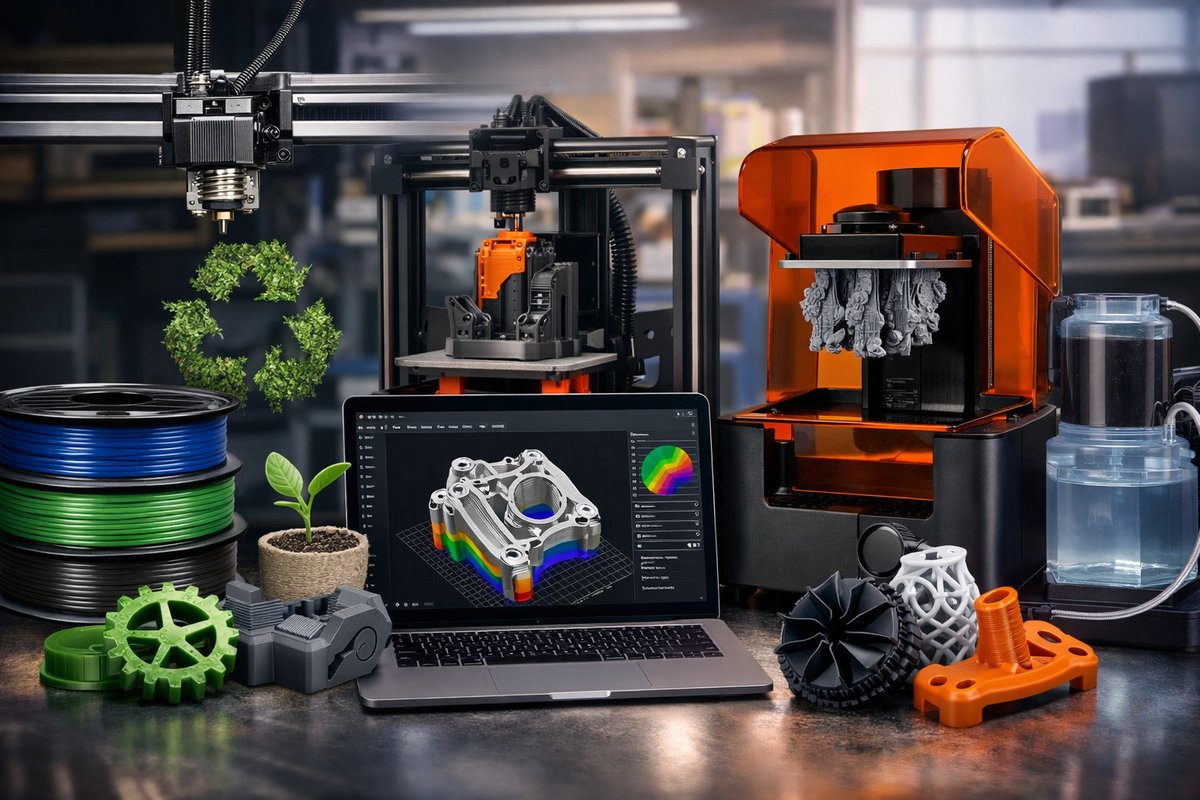

3D printing has progressed from niche prototyping to a mainstream tool for makers, engineers, artists, and educators. What once required industrial-scale machines and tight budgets can now be done on a desktop bench with affordable hardware, open-source designs, and clever software. At the heart of this shift lies a suite of innovations-new materials, streamlined processes, and data-driven slicing methods-that shrink expenses, raise success rates, and broaden creative horizons.
In this article, we’ll survey the latest advances in filament and resin systems, powder-based approaches, automated calibration and post-processing, and workflow optimizations. You’ll learn how recycled and blended materials keep costs down, how adaptive slicing slashes print times, and how modular upgrades can transform an entry-level machine into a production workhorse. Whether you’re tackling hobbyist miniatures or functional jigs, these techniques will help you squeeze more value from every layer.
Recent years have seen exponential improvements to Fused Deposition Modeling (FDM) technology. High-temperature direct-drive extruders and all-metal hot ends now handle abrasive and exotic filaments-carbon-fiber-reinforced blends, wood-filled PLA, and flexible TPU-without grinding or clogging. Those materials once confined to industrial machines are now within reach of garage builders. DIY filament recycling systems further reduce waste. By shredding failed prints and purifying them into reusable pellets, users can cut raw material costs by up to 50% and minimize environmental impact.
Large-format FDM printers have also benefited from dual-z gantries and belt-driven axes, delivering faster, more accurate layers over greater build volumes. Multi-zone heated chambers prevent warping on sizable nylon or ABS parts, while modular hot ends allow rapid nozzle swaps for different layer heights and surface finishes. Paired with build plate adhesives-such as specialized spray solutions or magnetic flex plates-these upgrades ensure consistently perfect first layers, eliminating failed prints and wasted time.
Resin-based printing (Stereolithography and Digital Light Processing) has not been left behind. High-resolution monochrome LCD panels now cure entire layers in seconds rather than minutes, cutting print durations by more than 60%. Continuous resin refill systems maintain constant vat levels, so long runs for dozens of dental models or miniature figures proceed without manual intervention. Eco-friendly bio-resins derived from plant oils and photopolymers with lower volatile organic compounds (VOCs) bring sustainability to SLA workshops. For medical and dental applications, biocompatible resins pass stringent cytotoxicity tests, enabling cost-effective production of hearing-aid shells, surgical guides, and prosthetic prototypes.
On the metal and powder side, Selective Laser Sintering (SLS) and Binder Jetting have seen noteworthy refinements. Automated recoat mechanisms and pre-heated build chambers keep powder flow consistent, reducing density variations and porosity. Lower-cost nylon powders optimized for entry-level SLS printers deliver strong, flexible parts without the premium price tag. In binder jet setups, color-bond print heads that jet binding agents can now handle finer powders for sharper details on colorized prototypes and architectural models. Meanwhile, desktop metal 3D printers employing bound metal filaments-later debound and sintered-offer a pathway for small shops to produce stainless steel or copper parts at a fraction of traditional machining costs.
Material innovations are matched by smarter slicing and machine control software. Adaptive slicing algorithms adjust layer heights dynamically based on part geometry: fine layers for intricate curves, thicker ones for flat walls. This reduces overall layer count, slashes print times by up to 30%, and preserves detail where it matters. AI-assisted support generation identifies minimal-contact structures that stabilize overhangs without leaving large post-processing scars. Cloud-based slicing platforms allow remote job queuing, firmware updates, and analytics on print success rates-vital features for makerspaces and small manufacturing cells seeking predictable throughput.
Calibration and monitoring have entered a new era of automation. Automatic bed leveling sensors map surface irregularities in seconds, ensuring perfect nozzle clearance without tedious manual adjustments. Filament run-out detectors and power-loss recovery modes guard against catastrophic failures in multi-day prints. Built-in cameras paired with real-time image-analysis software alert users to layer shifts, clogs, or delamination, allowing corrective actions before an entire build is ruined.
Post-processing remains a critical step in achieving professional results. Integrated wash and cure stations for resin prints combine ultrasonic cleaning with controlled UV exposure, reducing operator exposure to chemicals and eliminating guesswork on curing times. Heated vacuum chambers with inert gas options remove bubbles from clear resin parts, leaving optical-grade transparency ideal for lenses or fluidic prototypes. For FDM parts, heated deburring ovens and abrasive tumblers smooth layer lines automatically, prepping components for painting or mechanical assembly.
A key driver behind these attainable efficiencies is the open-source ecosystem. Communities around popular 3D printer models share verified configurations for firmware tweaks, slicing profiles, and hardware mods. This collective intelligence accelerates adoption of new techniques and democratizes advanced workflows that were once the domain of specialized service bureaus. Many users report that cost-optimized, community-developed upgrades deliver ROI in just a few dozen prints.
Sustainability remains front and center. Biodegradable PLA blends have been augmented with natural fillers-bamboo fiber, chalk, coffee grounds-that reduce plastic content and improve post-processing adhesion for paints and coatings. Closed-loop recycling programs accept failed prints and support structures, transforming them into feedstocks for local makerspaces. Energy-efficient stepper drivers minimize idle power draw and regenerative braking in axis movements returns watts back to the supply. Taken together, these measures yield meaningful reductions in carbon footprint for mid-volume additive production.
For designers and engineers, understanding the strengths and limits of each process is vital. Design-for-additive principles-like incorporating self-supporting angles, partitioning large parts into printable sub-assemblies, and using lattice infills-balance print speed with structural integrity. Topology optimization tools can generate organic, weight-saving geometries that would be impossible to machine and can be realized directly via 3D printing. Iterating virtual models with in-software simulation for stress, heat dispersion, or fluid flow can catch potential failures early, saving costly material and machine time.
The convergence of low-cost hardware, high-performance materials, and intelligent software is redefining what’s feasible on a modest budget. Hobbyists are printing functional drone frames in carbon-fiber blends. Entrepreneurs are launching custom phone-case businesses with in-house SLA units. Medical labs are producing patient-specific anatomical models overnight. Artistic pioneers are staging immersive exhibits with multi-material color-jet prints that would have been unattainable mere years ago.
Looking ahead, the next wave of innovations promises further leaps: 4D printing with shape-changing resins, embedded electronics printed alongside structural layers, and neural-network-driven slicing that self-tunes to any printer configuration. As the barrier between digital design and physical reality continues to dissolve, each new layer we add is a testament to human creativity, ingenuity, and our shared drive to make ideas tangible.
Whether you’re just unboxing your first printer or running a distributed manufacturing node, the tools and techniques discussed here will help you optimize for cost, quality, and speed. By embracing recycled materials, adaptive slicing, automated calibration, and integrated post-processing, you can transform a single layer into a reliable path from concept to reality.