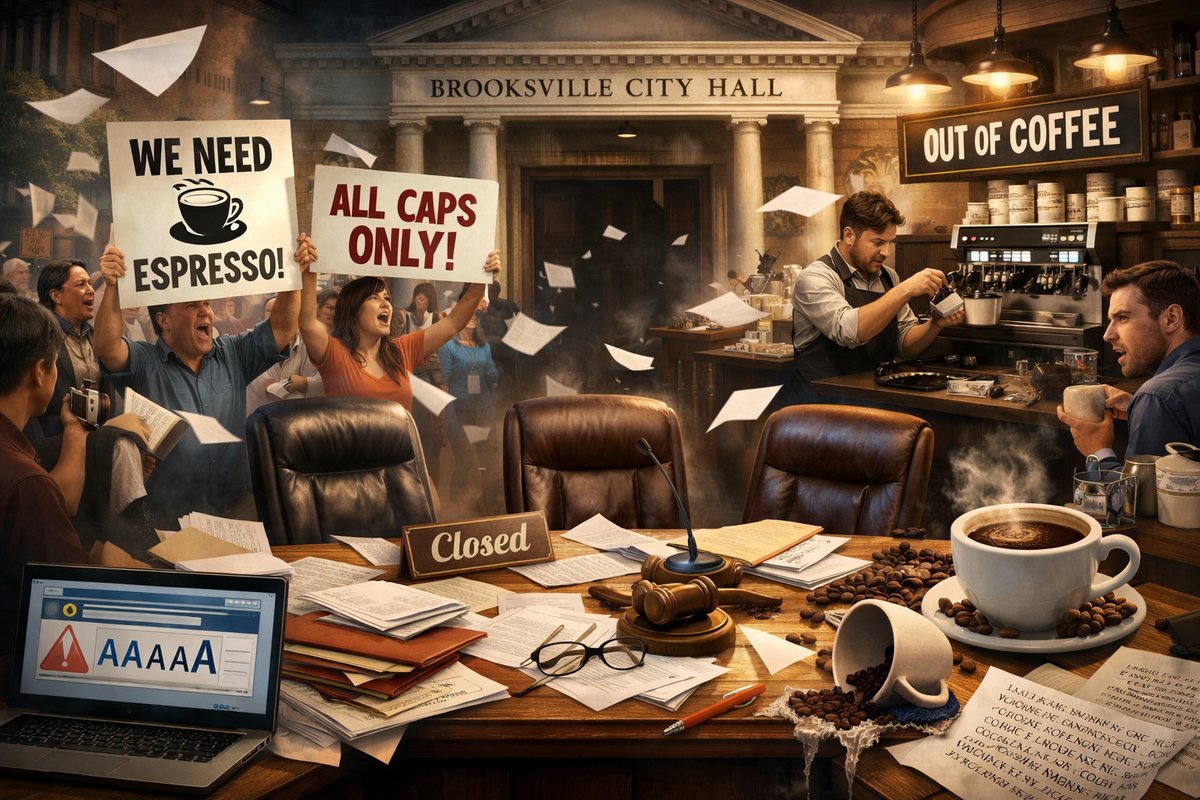

Brooksville awakened to bewilderment when, at precisely 6:03 a.m., every City Council chamber light went dark. Councilors, collectively abandoning their leather-bound agendas and polished pens, gathered in the town square, waving hand‐lettered signs reading “No More Lowercase Oppression!” and “Espresso for Every Resolution!” Officials had quietly slipped away from their morning briefings, leaving municipal clerks scrambling to decipher which permits to process-and which to shred in solidarity with their absent bosses.
Within minutes, rumors spread that the walkout had been precipitated by last week’s memo outlawing mid‐meeting caffeine breaks and mandating that all official correspondence be composed in “EASTERN FANCY SCRIBBLE” uppercase. Some councilors claimed the measure was an attack on creativity; others whispered of secret clauses forcing them to perform a daily inventory of paper clips. Whatever the text’s origin-and rumors pinned blame on a renegade committee of grammar enthusiasts-the result was the same: an unprecedented showdown over capitals, coffee, and civic pride.
Citizens poured into the streets, forming an ad hoc coalition dubbed “Brooksville’s Brew & Bylaw Brigade.” Armed with reusable coffee tumblers, collapsible protest stools, and a surprising array of grammar puns, they chanted everything from “Give Us Our Grounds!” to “Stop the Case Casing!” Passersby joined spontaneously, reciting the preamble of the Town Charter in elaborately ornate upper‐and‐lowercase mashups. The sight of local baristas delivering impassioned speeches on makeshift stages-complete with foam rosettes emblazoned on protest banners-lent the scene a surreal air of espresso‐fuelled pageantry.
Meanwhile, the municipal clerk’s office entered a state of controlled chaos. Voting records sat uncounted, permit applications piled up like leaning towers, and the mayor’s official Twitter account posted nothing but GIFs of dancing typewriters. “We’ve never seen anything like it,” admitted one clerk, frantically stapling stacks of unapproved event permits. “Honestly, the sentences are safer with the council gone. At least we know every word will be uppercase tomorrow-no surprises, no ambiguity.” That officer’s declaration went viral when someone added a GIF of a grinning llama clutching a mug of dark roast.
By mid‐afternoon, the standstill began to impact daily life. Cafés reported running dangerously low on espresso beans, thanks to demand spikes from both councilors and citizen sympathizers. Local grammar tutors seized the moment, offering popup workshops on “The Art of the Perfect Semicolon” while charging admission in single‐origin coffee beans. Meanwhile, the high school debate team repurposed its weekly lab sessions to craft impassioned manifestos on typographic equity, arguing that banning lowercase letters violated every principle of intellectual fairness.
As dusk approached, the councilors convened a counter‐demonstration at the Drive‐Thru Starbucks on Fifth Avenue. Under the neon glow, they assembled high‐drama soapboxes fashioned from empty coffee crates, each step inscribed with a different expletive about unjust formatting rules. Councilwoman Hernandez delivered a stirring oration on civic responsibility, punctuating each sentence with a theatrical sip of ristretto. Supporters responded by snapping photos for social media, instantly spawning the hashtag #CapsLockRevolt.
Tensions peaked when Town Hall’s wifi network mysteriously disconnected. Rumors flew that an insurgent faction within the Brigade had seized the router, wielding digital blackouts as leverage. Citizens and councilors alike huddled around mobile hotspots like refugees around campfires, exchanging dramatic poems on the tyranny of power outages. In the darkness, a lone councilman illuminated his face with his phone, intoning, “We will not rest until every email is in Arial Black bold!” The crowd fell silent, then erupted into cheers so loud they registered on the decibel meter at the fire department.
Negotiations finally began under a banner of mismatched fonts draped from the balcony of City Hall. Mayor Caldwell-who had been stranded outside after forgetting the new password protocol for uppercase credentials-mediated talks. The mayor’s opening gambit was simple: “Let’s find common ground-preferably in a reusable French press.” Laughter rippled through the crowd, breaking the tension, and representatives from both sides were handed takeaway lattes in compostable cups.
Councilor Patel, known for her flair with semicolons, proposed a compromise: allow one lowercase letter per resolution, ideally the one that made the most artistic sense; and provide council members with an unlimited espresso subscription, redeemable at any local café. In return, citizens would agree to process permits in alphabetical order-capital and lowercase be damned. Each clause was written on a separate index card and ceremonially dipped in espresso to ensure authenticity.
With signatures scrawled in a triumphant mixture of Helvetica and Times New Roman, the accord was sealed at 9:47 p.m., punctuated by a crescendo of cheers and the hiss of steam from a thousand milk frothers. The wifi lights blinked back to life, and City Hall’s PA system crackled on to announce the reopening of the public comment period. As the crowd dispersed, baristas reported selling out of medium roast-a clear sign that diplomacy in Brooksville was best served with a side of caffeine.
In the days that followed, the town saw a flurry of whimsical bylaw proposals: one to rename all traffic signs in haiku form, another to replace ballot boxes with suggestion jars painted in fluorescent hues. Perhaps most telling was the new “Council Caffeine Commission,” tasked with sampling local brews and recommending blends to fuel future legislative sessions. The commission’s first report, released on recycled parchment, concluded that a dark roast with chocolate undertones paired best with heated debates on pothole repair.
Brooksville’s sudden dive into caffeinated civil unrest has since inspired town meetings nationwide. Visitor numbers to the local grammar museum surged as word spread about the uppercase drama. Yet amid the absurdity, a sense of renewed civic engagement lingers: neighbors who never before could agree on trash pickup schedules now debate punctuation at dinner parties. One local librarian noted, “We may never look at a comma the same way again.” And perhaps, in a small town propelled by espresso and enthusiasm, that is the greatest victory of all.