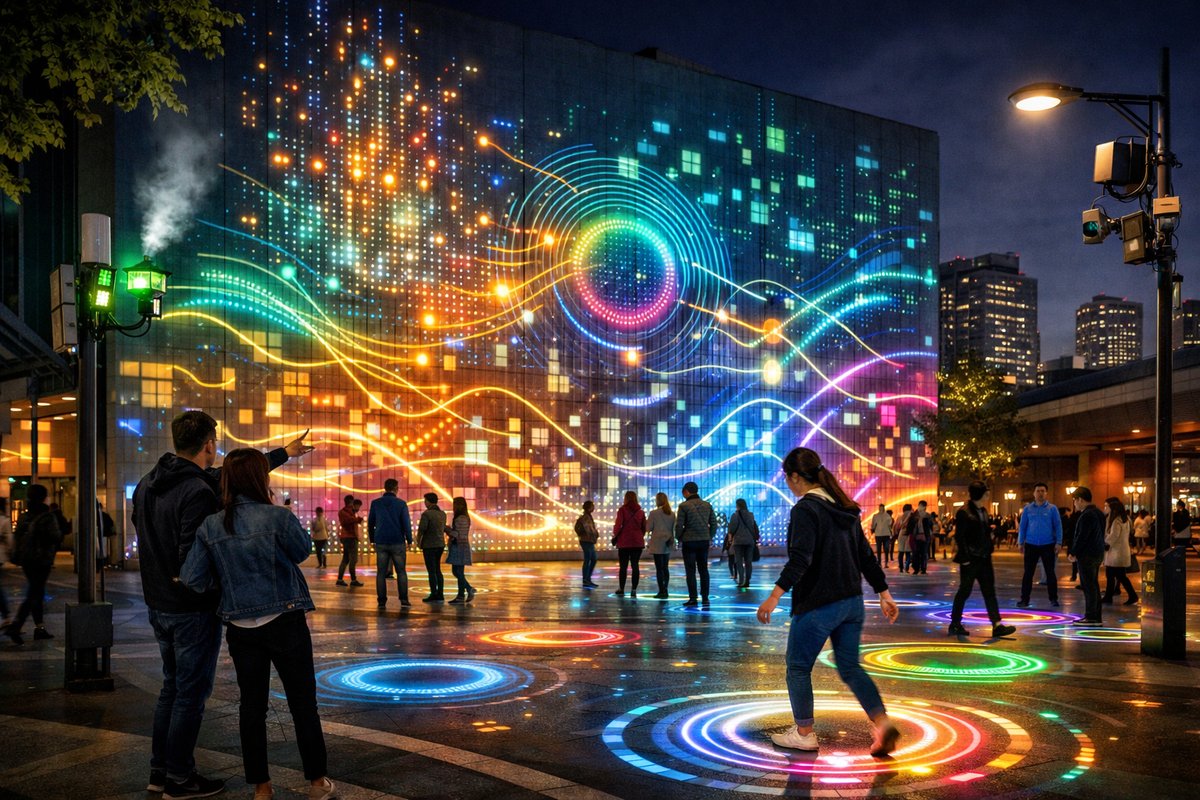

In the heart of a bustling metropolis, a cluster of projection units quietly bathes a weathered façade in dynamic streams of color and motion. Dubbed “Data Bloom,” this new installation harnesses real-time environmental readings-air quality indices, noise levels and pedestrian density-to animate a living tapestry across concrete and glass. The result is an ephemeral sculpture made of light and code, one that shifts in hue and pattern as the city breathes and moves.
Data Bloom is not an isolated experiment. Across parks, plazas and vacant lots, artists and designers are collaborating with data scientists, urban planners and community groups to create immersive experiences that translate invisible urban metrics into sensory encounters. By layering projection mapping, wireless sensors, microcontroller networks and augmented reality interfaces, these projects foreground the hidden flows that shape daily life: pollution spikes, traffic congestion, energy consumption and even social media sentiment.
At a recent unveiling, passersby paused beneath a canopy of pulsing geometries, curious about the rhythmic dance of patterns overhead. A discreet sensor panel near the entrance tracked sound levels in real time, feeding an algorithm that modulated color gradients in response to laughter, conversation and footsteps. Moments later, an unexpected roar from a passing tram caused a burst of crackling fractal forms-an unplanned flourish that prompted onlookers to cheer and share the experience on personal devices.
Such interactivity relies on a modular technical toolkit. Custom projection mapping software runs on high-performance laptops, while networked microcontroller boards gather data from an array of wearable air monitors, noise detectors and infrared footfall counters. Overhead, portable digital projectors equipped with lens shifters ensure precise alignment even on uneven surfaces. Addressable LED strips embedded along the building’s cornices add sculptural accents, reacting instantly to shifts in the data stream.
Beyond the spectacle, these installations provoke questions about privacy, agency and the meaning of public information. In one park-wide piece, users can opt in to share anonymized movement data via a companion mobile app. Their collective trajectories then influence the installation’s evolving form, creating a sense of ownership and collaboration. By anonymizing personal identifiers and aggregating inputs into abstract visuals, designers strike a balance between participatory data art and responsible stewardship of user information.
Sustainability also sits at the core of this movement. Many installations employ solar-charged battery systems to run projectors and microcontrollers, reducing environmental impact. Removable mounting rigs are designed for reuse, minimizing waste during installation and teardown. When projections pause at sunset, low-power architectural lighting takes over, maintaining a soft glow that respects nocturnal wildlife and local residents.
The collaborative process often begins with open data sets provided by city agencies-real-time bus arrival feeds, environmental monitoring networks and anonymized foot traffic counters. Artists mine these sources for narrative potential, crafting algorithms that translate numbers into shapes, motion and color. Some projects layer historical data, letting present readings collide with archival imagery or past weather patterns, creating a time-lapse of collective memory across building surfaces.
“It’s about making the invisible visible,” says a curator who helped commission the program. “When people see their own data unfold as art, they begin to understand complex systems in a visceral way. It sparks reflection, conversation and, ultimately, civic engagement.” By turning streets into interactive canvases, these installations challenge residents to consider their role in the urban ecosystem and the unseen forces that govern it.
This paradigm extends beyond large-scale projections. Pop-up sculptures built with 3D-printed lattices react to environmental sensors embedded in nearby tree roots, showing shifts in moisture levels through subtle mechanical movements. Sound-activated light sculptures illuminate underpasses in response to passing traffic rumbles. Augmented reality overlays, viewed through smartphone cameras, superimpose data-driven murals onto building walls, encouraging visitors to explore neighborhoods with fresh eyes.
Several universities are now offering interdisciplinary labs where design students collaborate with climate scientists and data analysts. These incubators produce speculative prototypes-kinetic light fences powered by wind sensors, interactive soundscapes modulated by real-time air pressure changes and bio-lit sculptures that respond to urban biodiversity metrics. The prototypes themselves often become public exhibitions, inviting feedback from local communities before receiving permanent funding.
As the line between city and canvas blurs, questions of equity and accessibility come to the forefront. Not all neighborhoods have equal access to high-bandwidth networks or stable power grids, and some residents voice concerns about digital divides. To address this, mobile installations can run on offline data logs updated via periodic wireless transfers, ensuring that underserved areas can still participate. Workshops teaching residents how to build basic sensor rigs with low-cost materials further democratize the process.
Looking ahead, artists are exploring the integration of eye-tracking and gesture control, allowing viewers to shape visuals simply by glancing or moving their hands. Advances in on-device machine learning could enable installations to recognize emotional tones in ambient noise, adapting color palettes to evoke calmness or excitement. Remote collaboration tools may let global audiences manipulate light sculptures across continents, weaving diverse data streams into a single interactive tapestry.
Yet at its core, this movement underscores a human desire to connect-to each other, to our environment and to the invisible currents that define urban life. By transforming data into a living artwork, designers and technologists foster empathy for complex systems and invite communities to reimagine public space. In the flicker of projection units and the soft hum of microcontrollers, we glimpse a future where art and information merge to illuminate the hidden rhythms of our cities.
In the coming months, Data Bloom will travel to a waterfront district, mapping tide levels against pedestrian flow and water quality readings. Nearby, a new commission will harness crowd-sourced atmospheric data to animate a century-old façade, forging a dialogue between history and cutting-edge technology. As these installations unfold, they remind us that every data point is a story waiting to be told-and that art remains one of our most powerful tools for making sense of an ever-changing world.