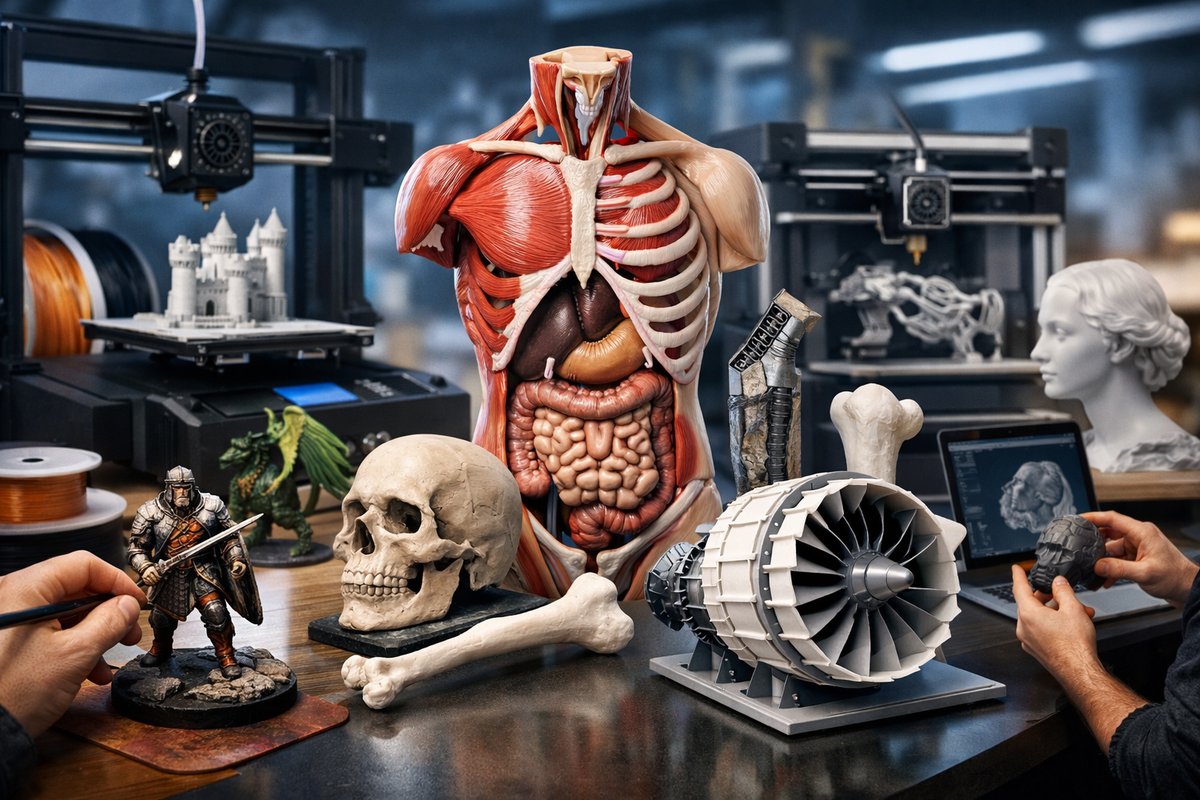

Imagine a workshop where a model engineer sketches a custom tool, hits print and, within hours, holds a fully functional prototype. Picture a small studio where an artist conjures complex sculptures, once impossible to carve, in a matter of print cycles. That is the quiet revolution of layer-by-layer fabrication-where precision meets imagination, and every filament or droplet of resin carries the promise of a new creation.
The roots of 3D printing lie in the 1980s, but what looked like an industrial novelty is now a global ecosystem of makers, educators, researchers and entrepreneurs. Today’s machines range from sub-$200 open-source printers to multi-laser systems that fuse powdered metals at micron-scale resolution. Yet the real breakthroughs are emerging in the grey areas between categories-hybrid machines, recycled materials, AI-driven slicing and modular hardware that can be swapped for specialized tasks.
One of the biggest shifts has been in material innovation. Standard PLA (polylactic acid) filament-derived from renewable resources-remains popular for its ease of use and low warping. But new composite filaments blend PLA with wood, metal powders or even carbon fibers, offering both aesthetic variety and mechanical strength. Pellet extrusion systems have also appeared, letting users feed loose plastic pellets directly, which slashes material costs by up to 60% compared to filaments. On the resin side, low-cost photopolymer blends and water-washable resins eliminate the need for harsh solvents, making post-processing both safer and more sustainable.
Adaptive Hardware and Open Firmware
Hardware design has evolved from bulky, enclosed boxes to modular platforms. Users can now attach heated chambers for engineering-grade nylon or swap in high-resolution optics for micro-SLA prints. Open-source firmware projects like Marlin and Klipper have democratized control systems, enabling overclocked stepper motor drivers and custom temperature profiles. An experimenter can tune acceleration curves or implement closed-loop feedback with end-stops and filament sensors, minimizing layer shifts and print failures. The result is a toolkit that can be tailored to everything from home decor items to aerospace test parts.
Key to cost savings is energy efficiency. Traditional heated beds and enclosures demand significant power, especially for high-temperature materials. Newer systems incorporate rapid-heating sheets, precise PID temperature control and even heat-recapture insulation, cutting electricity usage by half. Combined with sleep-mode firmware that powers down idle axes and heaters, hobbyists have seen monthly power bills drop, making continuous print farms more feasible on a household meter.
Smarter Slicing and Generative Infill
Software is where many breakthroughs converge. Modern slicing engines leverage AI-driven algorithms to optimize support structures, minimizing material use while maintaining structural integrity. Generative infill patterns-such as gyroid, cubic or hierarchical lattices-provide high strength-to-weight ratios and allow parts to flex or absorb energy in controlled ways. Some slicers can simulate thermal stresses in real time, adjusting layer orientations to reduce warping in large prints. And cloud-based farms let users queue dozens of jobs, with remote monitoring and live-feed cameras ensuring that prints stay on track overnight or across continents.
Beyond single-material prints, multi-extrusion setups are gaining traction. Hobbyists combine flexible TPU for grips with rigid PLA for frames, or print full-color prototypes by swapping in pigment-infused filaments. On the resin front, dual-vat machines can produce stiff, transparent parts alongside rubbery gaskets in a single workflow. The result is assemblies that emerge fully integrated, reducing post-print bonding or painting.
Bioprinting and Medical Modeling
While most home users stick to plastics and resins, the most dramatic advances are happening in medical and research labs. Bioprinting platforms now lay down living cells surrounded by hydrogel scaffolds, advancing tissue engineering and drug testing. Surgeons plan complex procedures with patient-specific bone models derived from CT scans, printed in nylon or resin to replicate tactile feedback. Even dental labs use high-precision DLP machines to produce crowns, bridges and clear aligners in hours instead of days. The convergence of imaging, simulation and 3D printing is closing gaps between design and physical proof in critical fields.
On the sustainability front, communities around the world are recycling plastic waste into usable filament. Open hardware pellet extruders transform water bottles, discarded packaging and failed prints into fresh spools of PLA or ABS. This circular approach not only reduces landfill but allows makers to experiment with custom color blends and material properties. As collection programs expand, local maker spaces become micro-factories, churning out low-cost educational kits and spare parts while tackling plastic pollution.
Community, Collaboration and Experimentation
Perhaps the most vibrant layer of this revolution is the culture around it. From online forums and social-media groups to regional maker fairs, users share profiles, troubleshoot failures and push the envelope of what is possible. Firmware forks introduce novel features-dueling nozzles, adaptive bed leveling, dynamic flow control-then merge back into mainstream builds. Designers open-source their models, libraries of functional joints or snap-fit enclosures grow daily, and educators integrate printers into classrooms to teach geometry, chemistry and engineering hands-on.
This communal spirit fuels innovation beyond established boundaries. Artists are experimenting with clay and bio-inks, architects propose 3D-printed emergency shelters on demand, and hobbyists convert decommissioned scanners into hybrid print-scan stations. The barrier to entry is collapsing, and the building blocks of tomorrow’s inventions are now available to anyone with curiosity and a few square feet of workspace.
As we turn the corner on cost-effective, high-precision additive manufacturing, the horizon extends to new frontiers: metal binder jetting for small-batch production, continuous liquid interface production (CLIP) for speed, and even desktop machines that sinter ceramics for heat-resistant components. Each advance brings us closer to a world where bespoke solutions-whether in agriculture, healthcare or consumer goods-are no longer limited by mass-manufacturing constraints.
Whether you’re a novice calibrating your first extruder or an engineer refining lattice structures for mechanical fatigue, the journey is one of layered discovery. Every calibration test, every failed print and every successful prototype is a step toward reshaping how we conceive, design and make. In this world, the hum of a stepper motor is a call to experiment, and the only limit is the next layer.
So power up your slicer, load that spool or vat, and watch the magic unfold one layer at a time. The future of making has never been more accessible, more affordable or more inventive.