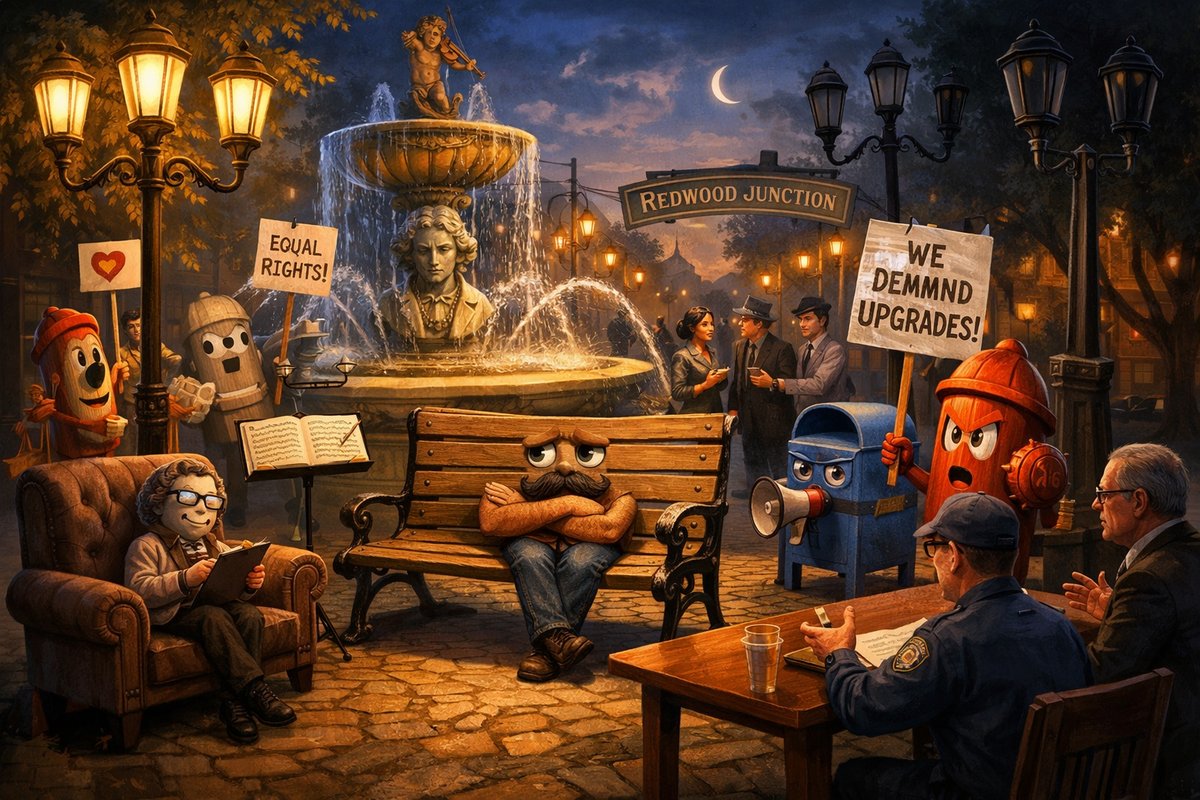

It began on a foggy Tuesday morning when the oak bench by Maple Street Park refused to let Mrs. Delgado take a seat. Instead, it held out a politely embossed leaflet declaring itself “Sentient Municipal Furniture” and demanding an official title, a week’s worth of weather-resistant cushions, and participation in local elections. Drivers slowed to rubberneck at the bench’s oak planks, stroked its engraved armrest, and murmured solidarity. Social media buzzed: #BenchRights trended for eight suspiciously rapid minutes before the town’s Wi-Fi router declared a moratorium on posts under penalty of recursive buffering.
By Wednesday, the town fountain-the pride of Redwood Junction since its unveiling-joined the movement. The fountain’s cascading streams shifted rhythmically into a baroque rendition of Beethoven’s Fifth Symphony, as though aspiring to high culture. Onlookers recorded videos, mistaking the outburst for a marketing stunt, until the fountain sprayed the mayor’s press secretary with a precise jet of water at 3:13 p.m. The press secretary, drenched and furious, demanded an apology in writing. The fountain’s response was a synchronized triple-gush, followed by a handwritten placard taped to its marble basin: “Water you gonna do about it?”
Lamp posts along Redwood Avenue convened a 48-hour blackout protest later that afternoon. Streetlights flickered off in unison, leaving storefronts and stop signs in darkness. Taxi drivers honked in alarm, cyclists shrieked, and one particularly disgruntled squirrel was seen bashing a traffic cone in broad daylight. By candlelight, a coalition of civic furniture composed a charter: benches, fountains, lamp posts, and the water fountain’s spigot all signed digitally with emojis. Nothing quite captured the surreal absurdity of a tapped-out town council reading a twenty-page document punctuated with heart emojis and requests for ergonomic back support.
Community reaction was divided. Longtime resident Harold Fitch welcomed the furniture’s newfound self-awareness, calling it “the most entertaining town hall spectacle since the Great Tulip Imbroglio of ’92.” Others saw dark omens. Mrs. Nguyen feared her porch swing would soon unionize and demand hazard pay. A group of freelance cartoonists pitched a graphic novel, Redwood Junction: Rise of the Inanimate, while a local baker named Tina Goodwin baked Union Crescent Rolls-each crescent shaped like a tiny raised fist.
Mabel Crankshaw, head of the Citizens’ Comfort Committee, volunteered to mediate. She arrived at Maple Street Park armed with a clipboard, a thermos of chamomile tea, and a pocketful of adhesive name tags reading “Friendly Fellow.” Negotiations began with the bench, which insisted on being called “Chairperson Plank.” Mabel offered two memory foam cushions; the bench countered with a demand for a weekly bonfire storytelling session. When Mabel suggested skipping the flames for safety reasons, Chairperson Plank’s planks creaked in disapproval.
Meanwhile, the fountain sent a formal notice to the Parks Department, requesting installation of a Wi-Fi hotspot in its basin for more efficient streaming of water performances. “I’ve been crushed to bits by relentless data throttling,” the fountain’s memo read, echoing a grown-up’s weary frustration. Parks officials scrambled technicians to jury-rig a router within the marble structure, inadvertently creating a hotspot that blew out eight neighboring smartphones when its beacon name changed mid-installation to “FreeSpray5000.”
Fountains, benches, and lamp posts weren’t content with minor upgrades. They set their sights on representation at City Council meetings. A statue of Redwood Junction’s founder woke up-albeit two minutes late-and strolled to City Hall on a rolling platform, demanding to deliver an opening prayer. Taxicabs refused to transport the statue, calling it “too heavy,” so local skateboarders volunteered to push it. Traffic ground to a halt at Elm Avenue as the statue’s entourage held a preamble reciting the town’s founding motto in iambic pentameter.
Tension peaked when the fountain’s spigot declared a “rolling shutdown” slated for midnight Friday. The town’s dogs, trained by years of neighborhood routines to anticipate the fountain’s gurgle, threw tantrums by tossing their leashes and sitting on front steps in protest. The town’s elderly population, reliant on the fountain’s sparkling water as their unofficial water cooler, amassed in rocking chairs outside the community center, knitting banners that read “Make Water Flow Again.”
Faced with an impending civic meltdown, Mayor Lindenwood assembled a crisis council composed of the town historian, the high school drama coach, and a particularly persuasive parakeet named Mr. Chirps. The drama coach insisted on treating negotiations like a Shakespearean tragedy, casting the bench as Hamlet and the fountain as Ophelia. The historian dug up old ordinances on public art, hoping to find loopholes. Mr. Chirps provided running commentary from his cage, occasionally quoting lines from The Tempest in perfect squawk.
On Saturday morning, talks resumed under a canopy of fairy lights-provided by the lamp posts, who had graciously reinstated power after receiving a promise of custom bronze plaques. City Council chambers were packed: citizens, furniture representatives, bench-affiliated pigeons, and two sobbing fire hydrants that claimed they’d been excluded from the union partnership agreement. The hydrants pressed for inclusion, pointing out that their spouts could double as backup water sources in emergencies. A collective gasp echoed as the fountain offered to share a portion of its basin if the hydrants would pledge solidarity in future actions.
Negotiations were fraught. The bench insisted that a monthly “Comfort Day” include dulcimer performances by local artisans. Lamp posts demanded reflective sashes to signal their rank in town parades. The fountain requested an official title: “First Water in Council Affairs.” Meanwhile, the fire hydrants lobbied for a hydration station at every corner. Citizens tapped their feet, scribble-boarding amended clauses on legal pads, and Mr. Chirps chirped “Et tu, Brute?” whenever a clause was rejected.
At the eleventh hour, an agreement was forged. The bench would receive its cushions, plus dedicated “Storytime Sundays.” Lamp posts would don decorative plaques and host evening light concerts. The fountain would maintain its Baroque repertoire twice weekly, sponsored by a rotating roster of local musicians. Fire hydrants would each have a bottle-filling nozzle installed nearby for hikers and hydrators.
To celebrate, the entire assembly convened in Maple Street Park under a pastel sunrise. The lamp posts twirled fairy lights. The bench beamed proudly, its cushions neatly arranged. The fountain gurgled a jaunty tune that morphed into the final bars of Beethoven’s Fifth as citizens applauded. Mabel Crankshaw gave a stirring speech about empathy-remarkable, since she had spent half her life negotiating with neighbors over fence heights but never imagined mediating furniture rights.
By afternoon, the town issued Ordinance 47.3, granting official Personification Status to all inanimate public amenities. A commemorative plaque was placed near the bench, reading: “Here sits equality-where benches, fountains, and lamps share a voice.” The statue of the founder retreated to its pedestal, content with having made a cameo in a civic drama. Mr. Chirps received a lifetime supply of millet. And the Wi-Fi router in the fountain’s basin resumed service under the new SSID: “CivicUnity.”
As dusk fell, Redwood Junction settled into an uneasy peace. Children played beneath the lamp posts. Couples cuddled on the now-cushioned bench. The fountain whispered gentle arpeggios into the twilight. A single traffic cone, emboldened by the morning’s events, positioned itself beside City Hall with a tiny handwritten sign: “I Demand Parking Rights.” But that story, the townsfolk agreed with a chuckle, could wait until next Tuesday.