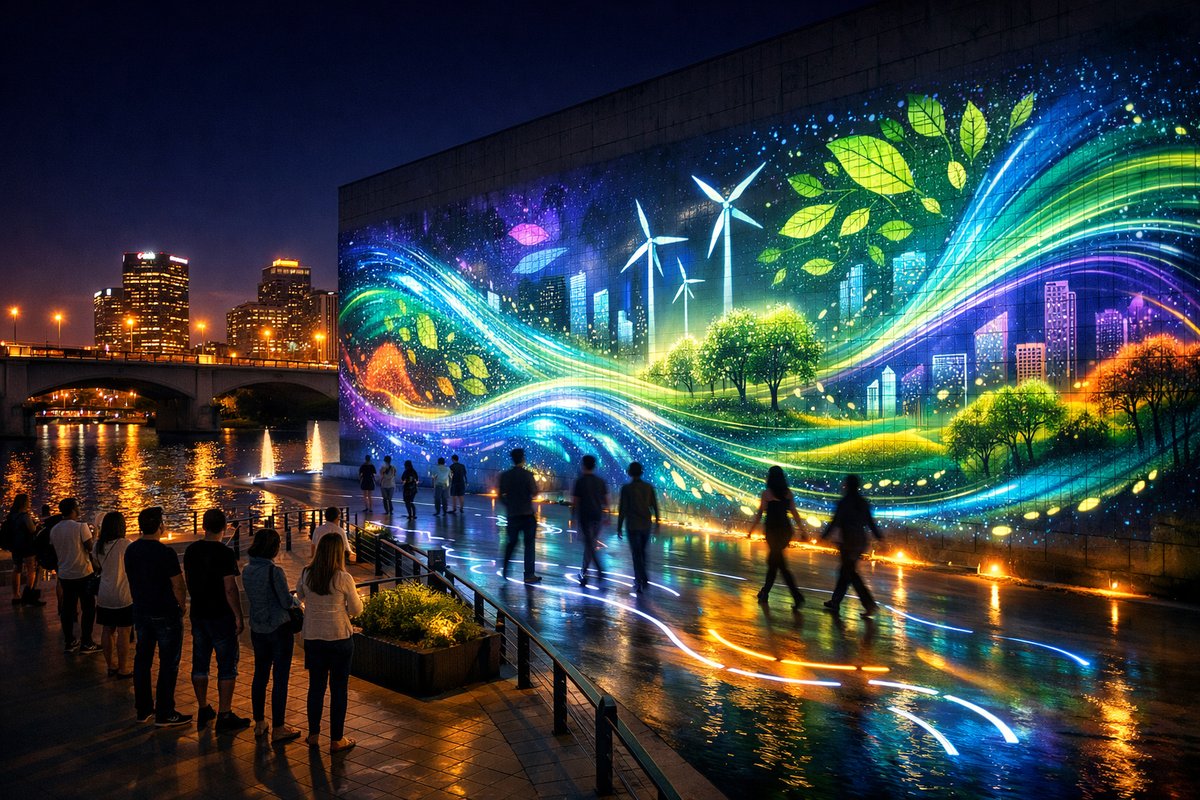

Experience met code as the Riverfront District stagehands this month unveiled a massive projection-mapped mural that literally dances to the rhythm of urban life. At dusk, visitors witnessed shifting patterns of light and color sweeping across a 200-foot brick façade, each geometric burst choreographed by anonymous passerby movements and environmental data streams gathered in real time. Part art, part living system, the installation-dubbed Citywide Canvas-spans two blocks and invites anyone with a smartphone to become a co-creator in a generative masterpiece.
Developed by a small collective of software designers, projection experts, and sustainable-materials advocates, Citywide Canvas relies on a network of discreet LiDAR sensors and infrared motion detectors installed along the sidewalk. Data from these sensors is fed into custom software that applies an open-source generative design engine. The software interprets foot traffic density, pedestrian velocity, and even ambient noise levels to adjust shapes, colors, and transitions on the mural. Subtle temperature and humidity readings also influence the brightness and saturation of each projection, ensuring the visual performance responds to the day’s weather as much as to the crowd itself.
“Public art has historically been a one-way conversation: the artist speaks, the audience listens,” explains one member of the development team. “With Citywide Canvas, we wanted to create a feedback loop where people, environment, and code collaborate. It sparks curiosity about how our collective presence influences digital systems and vice versa.” By opening portions of the code on a public repository, the collective encourages developers to suggest new visual algorithms and data filters, fostering an evolving artistic ecosystem.
At the heart of the installation lies a commitment to sustainability. The projection units are powered by rooftop solar panels peeking above the nearby warehouses, and high-efficiency LED floodlights back up the system on cloudy evenings. All mounting hardware and sensor housings are crafted from recycled aluminum and reclaimed wood sourced from local demolition sites. Even the wiring conceals itself within upcycled conduits recovered from former factory lines. This emphasis on circular design not only minimizes waste but underscores the artwork’s ethos: a mindful integration of technology and ecology.
Community engagement has become a core pillar of the project. A companion mobile app invites visitors to submit color palettes and pattern concepts. Each week, a selection committee drawn from neighborhood associations, art academies, and environmental nonprofits curates these submissions, uploading them to the mural’s algorithm. On Fridays, a “palette reveal” ceremony projects the winning scheme in full glory, accompanied by live performances from local DJs and spoken-word poets. The result is a festival atmosphere that blurs the line between gallery opening and block party.
While interactive murals using projection mapping aren’t entirely new, Citywide Canvas goes further by embedding emotional intelligence into its visual grammar. Using machine-learning analysis of crowd mood-gauged through anonymized facial-expression sampling-the system can subtly shift from cool blues and geometric angles in quieter moments to warmer reds and organic curves when energy levels spike. Organizers emphasize that no personal data is stored or transmitted beyond transient analysis; privacy safeguards were built in from day one.
Critics have praised the mural’s innovative marriage of art and civic data. Urban planners view it as a test case for “empathetic infrastructure,” where city design not only accommodates but also reflects the human pulse. Architects are intrigued by the potential to project adaptable facades onto existing structures, reducing the need for costly renovations. Educators are exploring ways to replicate scaled-down versions in schools, teaching students about coding, generative design, and environmental stewardship in one hands-on experience.
Behind the scenes, software engineers monitor performance metrics-frame rates, energy consumption, and sensor accuracy-via a cloud dashboard. This telemetry data continually informs hardware tweaks and software updates, ensuring the mural remains responsive and reliable through seasonal changes. In fact, organizers plan to phase in thermal imaging sensors this winter to add a new layer of data-driven texture, allowing visuals to morph around the warm footprints of visitors on chill evenings.
Residents have embraced Citywide Canvas as a landmark and a source of civic pride. Local cafés report increased foot traffic as visitors grab a coffee and linger to watch the mural evolve. Nearby boutiques have adjusted their storefront lighting to synchronize with the projection’s color palette, creating immersive streetscape micro-environments. Urban biodiversity advocates are even piloting sensor-triggered soundscapes featuring local bird calls and river ambience to accompany the visuals, further immersing the public in a multisensory dialogue between art, nature, and code.
Looking ahead, the collective aims to export the Citywide Canvas model to other neighborhoods and cities. Plans are already in motion for a miniaturized version that fits inside public transit stations, transforming commuter wait times into interactive art experiences. Workshops are scheduled at community centers to teach residents how to build similar installations using affordable, open-source tools. By sharing both artistic concepts and technical plans, the project aspires to decentralize the power of public art, inviting communities everywhere to co-design their environments.
In an era when digital screens often cocoon us in algorithmic echo chambers, Citywide Canvas reminds us of the communal potential baked into code and light. Here, generative algorithms become more than automated decoration; they evolve into a living canvas that listens, learns, and reflects the city’s heartbeat. More than a mural, it’s a testament to creativity, curiosity, and the collaborative spirit that animates urban life.