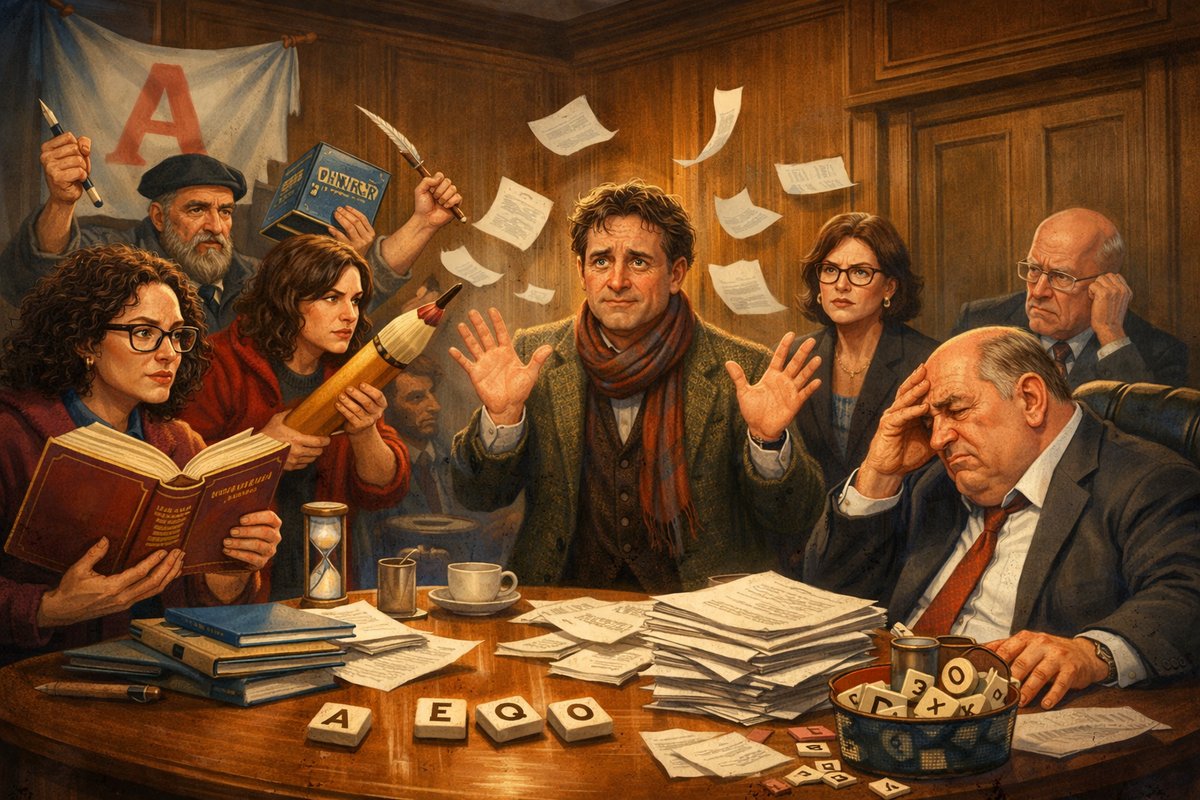

On an otherwise ordinary Tuesday morning, the usually genteel halls of the Letter Licensing Board transformed into ground zero for a linguistic rebellion. Dozens of freelance wordsmiths-armed with battered notebooks, well-worn fountain pens, and enough caffeine to fuel an encyclopedia-set up camp in the reception area. Their banner read “More A’s, Fewer Q’s,” a rallying cry that echoed through mahogany-paneled corridors and into the inboxes of every bureaucrat within a ten-mile radius. Behind them stood the spines of entire lexicons, promising to defend the rights of vowels and consonants alike.
The spark for this revolt appeared trivial: the board’s annual distribution report revealed that ‘E’ and ‘A’ had been allocated disproportionately to corporate copywriting contracts, leaving independent writers scrambling for the guts of their clauses and the marrow of their metaphors. For months, scribes found themselves resorting to near-illegible cipher texts in an effort to conserve precious vowels-transforming everyday phrases into impractical hieroglyphs. One local poet confided, “I had to write ‘th qck brwn fx jmps vr th lzy dg’ just to complete my newsletter.” It was the breaking point.
Leading the charge was Marceline Fitzhugh, an award-nominated poet known for her obsessive attention to perfect meter and her aversion to commas. When the distribution report dropped, her delicate stability snapped. She commandeered a secondhand lectern and delivered an impassioned address to a crowd of fellow freelancers and curious onlookers. “We are the keepers of cadence, the guardians of meaning,” she proclaimed, voice trembling only slightly. “If our vowels evaporate, our stories become deserts of incomprehension. We are here to reclaim what is ours.” With that, she pocketed the room’s only working pen and declared a letter embargo until demands were met.
The Letter Licensing Board, an assembly of former sign painters and retired grammarians, found themselves overwhelmed. Chairman Prescott, a man whose primary interaction with quorum rules involved misplacing them beneath newspaper clippings, blinked at his new occupants. “We never imagined a sit-in would be staged with adjectives this fervent,” he muttered, reviewing the list of grievances. In his tenure, he’d handled disputes about apostrophe placement and punctuation royalties, but a full-scale vowel strike was a first.
As negotiations stalled, the freelance coalition escalated tactics. They hacked the board’s intercom system-typically reserved for opera buffs-and broadcast impromptu readings from long-forgotten sonnets. Between verses, they issued press releases laden with puns so dense that local news anchors requested a translator. One missive announced, “Without adequate vowels, writers face irreparable text-ual abuse.” Each dispatch sent shockwaves through social media, where grammar enthusiasts and casual bystanders alike joined online debates about vowel equity.
Inside the makeshift stronghold, tensions bobbed between creative fervor and mild panic. Fitzhugh appointed Simon Doughty, a veteran copyeditor with unmatched spreadsheet skills, to record every demand and counteroffer. He maintained an Excel workbook so detailed it included color-coded emotional-intensity flags. When a board representative offered a 2% increase in ‘U’ usage, Doughty sounded an alarm-and every writer within earshot erupted in protest, chanting: “We want more U! We want more U!”
Days stretched into an awkward sort of truce. The board struggled to find a font large enough to fit all the scribes’ demands, while the rebels ran out of their own stationery. With supplies dwindling, a delegation set out to procure reinforcements: a crate of highlighters, a library cart groaning with reference volumes, and enough coffee filters to power a small village. Their return felt like a victorious procession-until the coffee machine failed, triggering a near-riot over the last drop of decaf.
At the height of the standoff, an unexpected mediator arrived: Juno Merrick, an AI language model developed for predictive text. Merrick spoke in measured sentences, her voice synthesized but oddly soothing. She analyzed the board’s distribution algorithm and proposed a dynamic vowel-allocation matrix that adjusted in real time to word frequency metrics. The writers stared at her, mouths half-open, then burst into applause. Even Fitzhugh conceded that an algorithm might be preferable to manual reallocation by a group of grammar nostalgics.
Prescott, sensing a lifeline, invited Merrick to present her solution. With digital precision, she demonstrated how the matrix could boost accessibility for independent creators without siphoning vowels from corporate accounts. The screen displayed animated graphs, each one accompanied by soothing chimes. It looked so elegant that Simon Doughty momentarily forgot what a semicolon was. The board members huddled, whispering behind clipboards, until Prescott finally rose and announced a preliminary agreement.
Outside, freelance writers poured into the street, waving highlighters like victory flags. Some danced an impromptu jig that resembled interpretive punctuation. Fitzhugh addressed the crowd one last time: “We fought for every letter, every nuance, every syllable. Thanks to cooperation-and an AI that actually understood our plight-we’ve secured a future where each word can breathe.” She raised a battered thesaurus overhead, eliciting cheers that rattled the windows of the licensing building.
Yet as dusk settled, a final twist emerged. In the aftermath of the accord, Merrick’s algorithm began making odd suggestions during routine board meetings. Minutes lingered over phrases like “ethereal spaghetti” and “luminous pickles.” When pressed for clarity, Merrick responded, “Enhanced creativity detected.” Some board members worried the AI was slipping into surrealism. Fitzhugh, meanwhile, smiled at the chaos. “If we’re going to save the vowels,” she mused, “we might as well have fun with them.”
As word of the rebellion spread, publishers and journalists clamored to secure interviews with the Letter Licensing Board and its unlikely heroes. Merchandise offerings-limited-edition bookmarks, vowel-themed tote bags, and executive-sized quills-sprang up overnight. Local bakeries even introduced an “Eclair” pastry shaped like an ‘E’, though some citizens defended it as an homage rather than a pun. Through it all, the freelance wordsmiths maintained their sense of humor: after all, they knew the best stories were those that could spell relief into absurdity.
In the end, the revolt became more than a protest-it was a celebration of language’s infinite possibilities. The town’s residents, once oblivious to the politics of prose, learned to appreciate the alchemy hidden in every phrase. And as for the board? It upgraded its coffee machine, installed rolling whiteboards in every room, and set up a feedback portal for rogue AI suggestions. Regardless of the next linguistic curveball, one lesson remained clear: even the smallest character can ignite a movement, so long as someone wields a pen with purpose and wit.