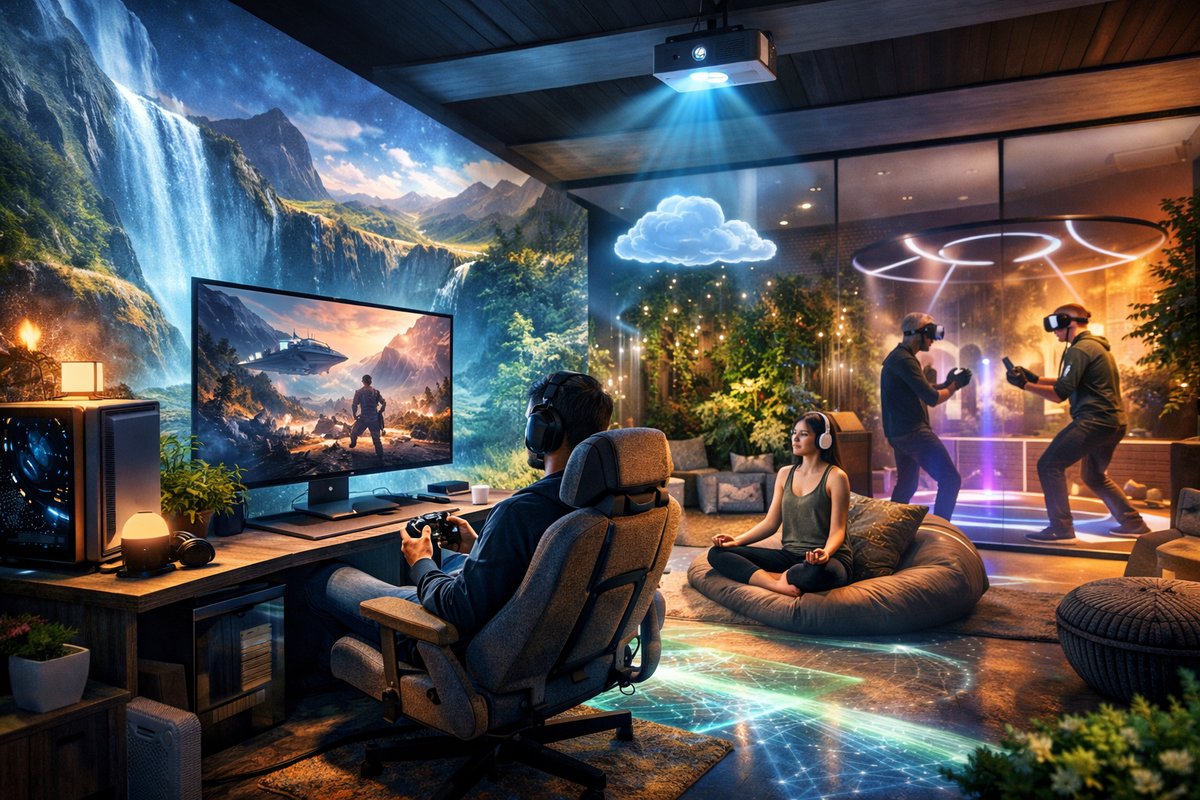

In the span of just a few seasons, gaming setups have evolved from static desktop towers and single monitors into fluid, transformable environments that respond to physical space, emotional state, and cloud-hosted worlds. At recent expos and community showcases, hobbyists and developers alike revealed innovations that turn any flat wall or tabletop into an interactive arena. Meanwhile, ergonomic furniture brands are weaving biofeedback sensors into chairs and desks, guiding players toward healthier posture and mental breaks. This shift marks a broader reinvention: play is no longer confined to a screen, but woven into entire rooms and routines.
Early adopters demonstrated projection-mapping kits that automatically detect floor patterns, furniture edges, even pets, and then cast real-time game visuals calibrated to avoid obstacles. Imagine rallying mini-drones through a virtual canyon projected on your living room carpet, or co-op adventurers traversing a dungeon that sprawls across walls and ceilings. These plug-and-play projectors tie into cloud gaming platforms, so the heavy graphics rendering happens on remote servers. What shows up in your home is a silky 4K stream painstakingly aligned to your spatial layout.
Behind the scenes, advances in edge computing and low-latency streaming protocols are making these projected arenas possible. Local companion hubs-small boxes no larger than a paperback novel-run AI algorithms to map a room’s dimensions, optimize projection angles, and track hand gestures or controller movements. They link via Wi-Fi 6E or dedicated networking bands to data centers equipped with GPU clusters. In practice, this means virtually any light-receptive surface can become an immersive battleground or cooperative puzzle board.
But the real twist lies in emotional-responsive design. A handful of startups unveiled chairs embedded with discreet biofeedback sensors that monitor heart rate variability, muscle tension, and even brief micro-expressions. When signs of fatigue, frustration, or stress appear, the system can gently cue players to take a stretch break, dim the display for a moment of calm, or switch to a guided breathing exercise. It’s a form of digital empathy applied to gaming: recognizing that marathon sessions demand more than quick reflexes-they require mindful pace and physical care.
The same principle extends to lighting and sound. Addressable LED strips, synchronized with in-game events, can adjust their brightness and hue following a wellness protocol. Too many high-contrast flashes can trigger fatigue or eye strain, so the system automatically tempers intense sequences. On the audio side, surround soundbars equipped with real-time equalizers can detect when volume spikes might become overwhelming, smoothing transitions and protecting hearing health over long sessions.
At the intersection of these trends lies augmented reality projection glasses. Rather than relying solely on projectors, some innovators are experimenting with near-field microprojection embedded in wearable frames. These prototypes beam virtual overlays onto any surface in your peripheral vision, eliminating the need for a fixed screen altogether. You can literally carry your dungeon crawl on the back of your hand, adjust spell parameters with finger gestures, and pass control to a friend by sliding the hologram across a table top.
Crucially, sustainability and modular design are top of mind. Controllers and keyboards built with snap-on modules allow users to swap thumbsticks, trackpads, and haptic actuators rather than discarding an entire gamepad when one piece wears out. Plastic parts come with refillable resin pockets for 3D-printed replacements, while transaction records on the blockchain ensure genuine parts and reward users who recycle old modules. Even disposable packaging has been replaced by seed-embedded paper that can sprout native wildflowers once unboxed.
Beyond hardware, software ecosystems are reimagining how communities gather. Micro-arcades are popping up in co-working cafés and university lounges: portable “play pods” that look like oversize backpacks but fold into single-player or four-station multiplayer rigs. In one of the latest campus pilots, students can book a pod for 30 minutes of social gaming-streamed from the same cloud gaming platform that delivers the projected arenas-then fold it back up and wheel it away in under two minutes. It’s campus-wide gaming on demand, minus the need for permanent consoles and chairs.
These developments also highlight the rise of hybrid game-theater nights. Instead of traditional movie screenings, hosts are blending live-action role-play with digital overlays. Attendees don lightweight AR glasses and follow a guided narrative that unfolds on walls and across tabletops. A dungeon master triggers environmental changes-storm sounds, shifting shadows, emergent puzzles-and remote players can join via livestream, choosing to influence events with digital artifacts that appear in the host’s space. Early trials of this format have drawn crowds of curious gamers and theater buffs alike.
In the background, cloud gaming services are adding customization layers that allow players to personalize visual themes, music playlists, and even in-game physics rules before launching a session. A group of friends might agree on a “no-gravity mode” for casual exploration, or set an “eco-realism filter” to simulate energy consumption and waste management as part of a city-builder game. These social modifiers not only deepen collaboration but also foster awareness of real-world issues like sustainability and resource use.
Looking ahead, the merging of these technologies promises turn-key gaming experiences that feel less like a barricaded fortress of screens and wires, and more like a fluid performance space. Whether you’re an esports contender craving 8K projection and hyper-responsive chairs, or a casual player seeking mindful breaks and eco-friendly gear, the next generation of setups has something to offer.
For small studios and indie designers, this wave presents opportunities to craft localized content: projection-mapped escape rooms in coffee shops, community art exhibits that invite play, or educational simulations for schools. By lowering the barrier to immersive tech-through affordable companion hubs, subscription-based map packs, and open APIs-the landscape shifts from high-end showrooms to everyday living rooms and shared public spaces.
Play remains serious business, but its seriousness is evolving. No longer confined to isolated PC battlestations or locked-in console dens, gaming now sprawls across furniture surfaces, floats in the air through AR frames, and hums in the background with wellness-centric audio cues. It’s a hybrid world where physical space and mental state matter as much as graphics and frame rates. As these trends coalesce, one thing is certain: tomorrow’s playgrounds will be as adaptive and interconnected as the players who inhabit them.