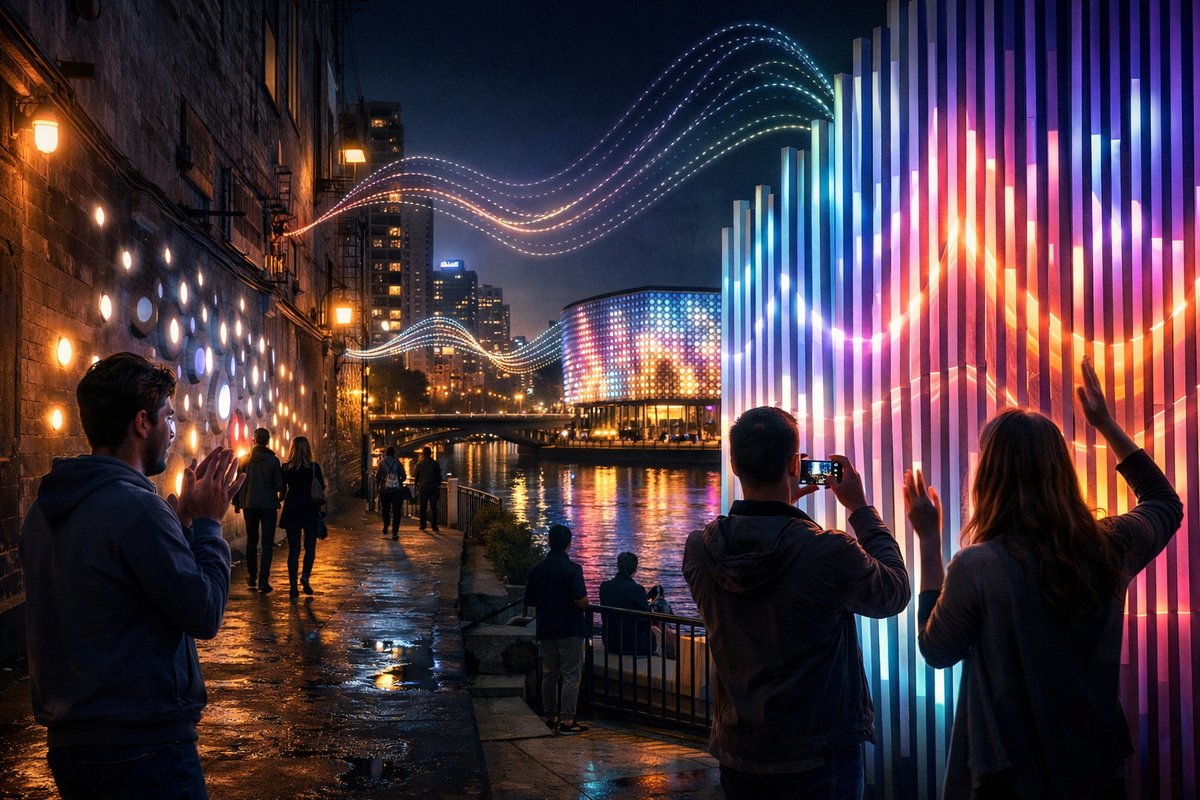

Cities have always spoken in voices of traffic hum, footsteps on pavement and distant chatter. Now, a growing community of artists and designers is tuning into those ambient vibrations to create public installations that light up, shift shape or bloom with color in direct response to the city’s soundtrack. This new wave of sound-activated art uses a blend of motion detectors, audio sensors, programmable lighting and sustainable power sources to craft dynamic environments that feel alive under our feet and around our ears.
Last month, a converted warehouse in East London hosted “PulseLine,” an experimental showcase where walls pulsed with neon patterns whenever a visitor’s voice reached a certain decibel. The entire space was rigged with discreet microphones and breakdown speakers, linked via an open-source microcontroller network. As pedestrians ventured through the installation, whispered conversations triggered soft washes of color, while louder exclamations unleashed swift geometric streaks across adjoining panels. Designers described it as a living canvas that rewards curiosity and playful noise-making.
At the heart of these installations lie compact sensor modules that detect sound intensity and motion. Mounted on repurposed scaffolding or embedded in reclaimed timber panels, the sensors feed data to development boards programmed to translate acoustic spikes into visual commands. Lightweight addressable LED strips wrap around columns and fences, ready to morph their hue and brightness at a moment’s notice. Since many of these projects are presented in public thoroughfares, teams often rely on USB-rechargeable solar chargers to keep the circuitry running through daylight hours without tapping into city power grids.
The impact on passerby experience can be profound. During an evening activation in a riverside underpass, a student-led collective transformed concrete walls into undulating patterns of turquoise and amber. As a jogger’s footsteps echoed, segments of the wall rippled onward like water. A distant motorbike’s roar sent asymmetrical spikes shooting upward toward the arching ceiling. Listeners couldn’t help but stop, record short clips and then circle back to see how their own presence shaped the visuals. Social media feeds quickly filled with firsthand reactions, amplifying the artwork’s reach beyond its physical confines.
Curators say that one of the most surprising effects is how the spontaneity of collective behavior influences the piece. Two bystanders laughing together can create a synchronized wave of color that differs entirely from a solo passerby’s soft murmur. In one version of the exhibition, participants were invited to speak phrases into a microphone, watching words trigger both visual and sonic responses in real time. This interactive twist turned every visitor into a co-creator, reinforcing a sense of shared ownership over the public realm.
Technically, many of these installations leverage projection mapping techniques alongside LED elements. Short-throw projectors beam animated shapes onto uneven surfaces-brick facades, corrugated metal sheets or even rippled water. Special algorithms track 2D images and warp them to fit three-dimensional contours, creating the illusion that murals ebb and flow. When programmed to respond to frequency-based inputs, these projections can transform a muted bassline into a rolling horizon of light or a high-pitched whistle into darting particles dancing across walls.
Open-source software libraries, originally designed for stage lighting, have been repurposed to handle both data ingestion and visual rendering. Artists configure graphical interfaces to map incoming sensor values to color palettes, motion sequences or audio samples. They fine-tune parameters so that everyday sounds-bus brakes, distant construction, wind whistling through overhead cables-become motifs in a larger kinetic composition. This hybrid approach of art and code underscores a growing appetite for crossover skill sets: designers with programming chops and technologists with an eye for aesthetics.
As sustainability remains a priority, many teams turn to recycled and upcycled materials. Wooden pallets, salvaged acrylic panels and discarded shipping containers serve as the physical backbone of these displays. At a recent pop-up in Berlin’s Mitte district, steel oil drums were hollowed out and fitted with interior LED arrays. Outside, solar panels affixed to curved metal frames gathered morning light, powering the show throughout the evening. When the installation closed, most parts were dismantled and reassembled into new configurations for a future exhibit, illustrating a circular design ethos.
Beyond aesthetics and interactivity, these sound-responsive installations are sparking conversations about urban wellbeing. City planners have started piloting programs that integrate responsive art into transit hubs, aiming to alleviate stress during rush hours. Commuters passing through a busy metro walkway were greeted by subtle glowing panels that shifted from frenetic reds to calming blues in reaction to crowd noise levels. Early surveys indicated that riders reported a noticeable decrease in perceived crowding and tension after just a few daily interactions with the display.
Several art and design schools are also incorporating sound-activated projects into their curricula. Coursework now often includes lessons on soldering sensor modules, writing firmware and mapping audio streams. Students learn to collaborate across disciplines-industrial design, electrical engineering, environmental science-to realize installations that are as functional as they are poetic. The aim is to prepare a new generation of creatives who can bridge the divide between technology and storytelling in public spaces.
Across continents, urban art collectives are starting to share blueprints and best practices online. A dedicated forum hosts tutorials on programming sensor thresholds, tips for weatherproofing electronic components and strategies for securing permits from municipal authorities. This communal knowledge base has accelerated the growth of the medium, making sound-responsive art accessible to smaller teams with limited budgets.
Looking ahead, some pioneers envision networks of synchronized installations spanning multiple neighborhoods. Imagine an entire district where streetlights, building façades and bench-mounted panels react in concert to local soundscapes-morning coffee clinks, schoolyard chatter, evening traffic lullabies. By weaving these responsive elements into the urban fabric, designers hope to foster moments of awe and connection in our daily routines, reminding us that art need not be confined to museums or galleries.
Ultimately, sound-activated public art represents a pragmatic blend of sustainability, technology and human-centered design philosophy. It invites participants to step out of autopilot and engage with their environment, forming an interactive dialogue between body, machine and city. As more urban centers embrace this trend, our streets and plazas may soon resonate not just with the usual din but with a shared creative echo that celebrates collective expression.
-
Stemedu LM393 Sound Sensor Module - High Sensitivity ...
This is a LM393 Sound Detection Sensor Module for Ar duino to detect whether sound has exceeded a threshold value. The sound is detected via microphone and ... -
Amazon.com: Speclux PC Addressable RGB LED Strip Lights Kit
PACKAGE INCLUDES · 2 x Addressable LED Strip (35cm) · 1 x Extension Cable (40cm) · 1 x Key Controller with 5V SATA Connection Cable · 1 x ADD-RGB Extension ... -
KEYESTUDIO Leonardo R3 Microcontroller Development Board ...
KEYESTUDIO Leonardo R3 is an ATmega32u4 microcontroller board. The Leonardo differs from other Arduino boards using separate USB-Serial chip in that the ...