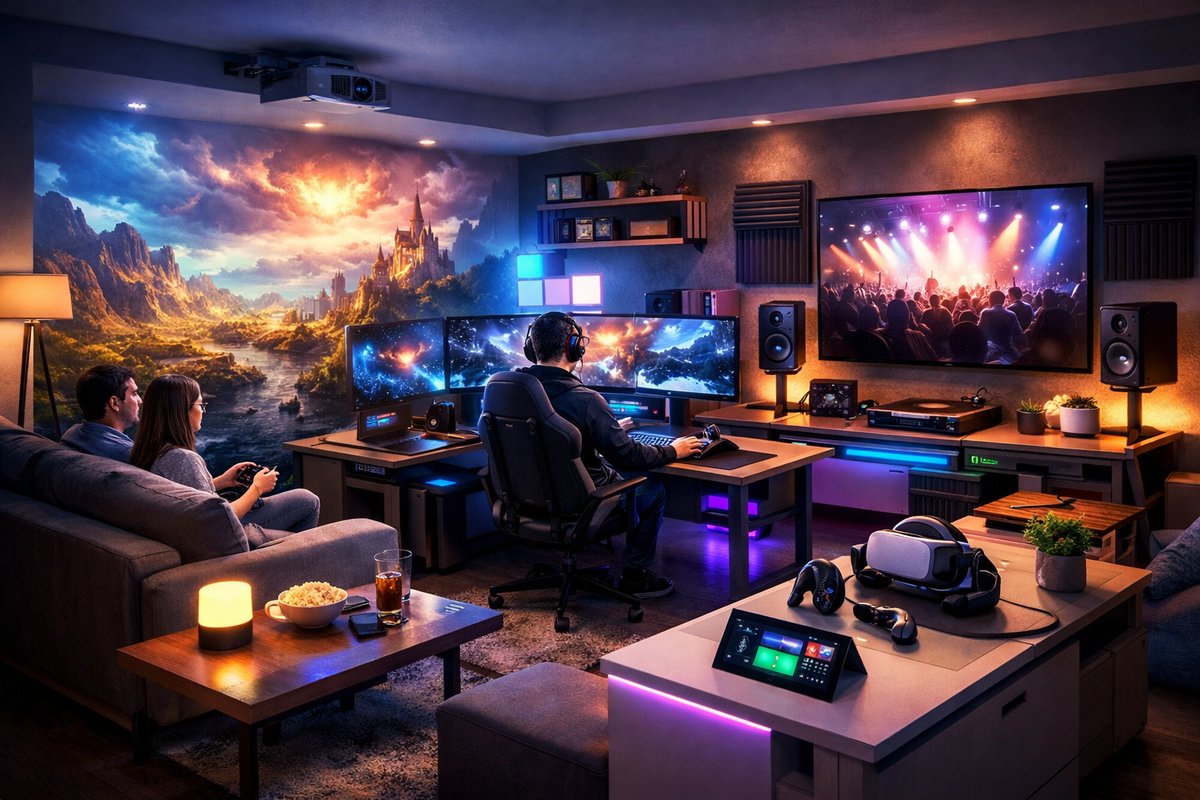

Play has evolved beyond couch time and solo controllers. Today’s enthusiasts craft elaborate setups that blur lines between living rooms, arcades, and digital arenas. A growing community of developers, designers, and hobbyists is pushing the boundaries of hardware and software integration, creating environments where every surface, light source, and speaker contributes to a seamless, immersive experience.
The transformation began with modest hacks-an LED strip behind the TV, a Bluetooth speaker tucked under the coffee table-but has accelerated into a full-scale reinvention of at-home entertainment. Instead of dedicating corners to gaming, many now build hybrid zones that support live streaming, virtual co-play, tabletop RPGs, and media marathons all under one roof. What used to be a single console now syncs with projection mapping systems, modular desks, haptic feedback devices, and spatial audio rigs.
In urban apartments where space is at a premium, portable mini projectors have carved out a niche. These pint-sized devices can turn any blank wall, ceiling, or tabletop into a widescreen battlefield or cinematic backdrop in seconds. Coupled with retractable screens or even bare plaster, they deliver a true “pocket arena” that folds away when the next Zoom call beckons. Newer models boast automated keystone correction, built-in speakers tuned for movie dialogue, and app-driven color profiles that adapt brightness to ambient light.
Meanwhile, the modular gaming desk movement has taken off among DIY designers and off-the-shelf shoppers alike. Freestanding platforms built from slotted aluminum rails and snap-in panels let users swap storage cubbies, headphone hooks, or cup holders on the fly. Some setups integrate interchangeable top surfaces-tempered glass one week, a writable mouse-pad finish the next-while others nestle wireless charging pads directly into accessory trays. When these desks pair with multi-zone smart lighting, you can code entire color sequences that flash in rhythm with in-game events or movie cues.
Audio, long relegated to a single soundbar or a pair of computer speakers, is undergoing its own revolution. Spatial audio protocols once exotic to flight simulators are now shipping in consumer-level soundbars and compact surround-sound towers. These systems shape soundfields to mimic objects or characters moving around the room. Imagine footsteps circling behind you in a stealth title or rain droplets falling from above during a cinematic storm sequence-without donning a VR headset.
One of the most compelling frontiers is projection haptics, where ultrasonic waves produce tactile feedback on flat surfaces. Early adopters have rigged transparent tabletops or acrylic sheets with haptic emitters that create a sense of texture when you slide a finger across a projected map or game board. Board-game nights take on a new dimension when tiles shimmer beneath your fingertips and terrain warps with every marker stroke. Though still niche and requiring custom mounting gear, projection haptics hints at future interfaces that dispense with touchscreens altogether.
Community hubs have also embraced these innovations. A revived arcade in a repurposed warehouse now offers rotating “hybrid nights” where tabletop gamers challenge VR enthusiasts in collaborative puzzle hunts. Attendees mingle across projection-mapped tabletops and LED-lit lounge pods, sharing tips on desk-mounted cable management and showing off their customizable RGB layouts. The social currency is no longer just high scores but clever mod rigs and continuity scripts that automate light and sound sequences for dramatic reveals.
Home builders have applied similar thinking to theater rooms. Beyond velvet recliners and popcorn machines, they’re embedding panels of acoustical foam that double as projection screens with acoustic-transparent surfaces. Discrete step lights and glow-in-the-dark exit markers help preserve immersion even during bathroom runs. For families, these rooms morph from morning workout studios-complete with mirrorless smart displays-to evening cinema sanctuaries, all by changing a single source input and sliding out hidden floor panels.
Energy efficiency and sustainability have emerged as guiding principles in this ecosystem. Low-power OLED strips, solar-powered desk lamps, and reclaimed-wood desk frames minimize environmental footprints. Some enthusiasts salvage discarded server racks to house cable routing, attaching modular panels built from recycled plastic and wood scraps. A growing marketplace for pre-owned projection gear and refurbished PC components underscores how circular economy thinking is starting to influence even high-performance setups.
The trend toward convergence doesn’t end at hardware. Software platforms now integrate macro scripting across devices. A single app can launch a game, trigger adaptive lighting scenes, cue surround-sound presets, and even adjust desk height for sit-stand comfort-one button press does it all. Modders have built open-source dashboards that display frame rates and network latency alongside calendar reminders and ambient weather conditions. These multifunction hubs empower hosts to switch from late-night raid sessions to morning yoga or virtual art shows with zero friction.
Looking ahead, the boundary between physical and digital play will continue to dissolve. Augmented reality glasses promise to overlay game elements onto real objects, while gesture-tracking cameras could replace both controllers and motion-capture suits. Holographic communication portals could let distant friends share a table dungeon experience. Yet even as headsets get lighter and tracking algorithms smarter, many will still crave the shared, tactile social rituals that only a well-crafted environment can supply.
Whether it’s a micro-studio in a New York micro-loft or a converted attic in a suburban home, the future of entertainment setups lies in flexibility and personalization. Gamers and hosts alike are embracing the challenge of turning ordinary rooms into interactive stages where every click, flash, and rumble deepens the illusion of play. It’s a testament to human creativity: when tools evolve, so does the game.
For anyone looking to level up their own space, the key is to start with one or two modular elements-perhaps a compact projector platform or an adaptive LED rig-and grow from there. Document your builds, share your scripts, and swap tips in online communities. Your setup won’t just be a platform for games and movies; it becomes part of the story, as alive and malleable as the worlds you explore.