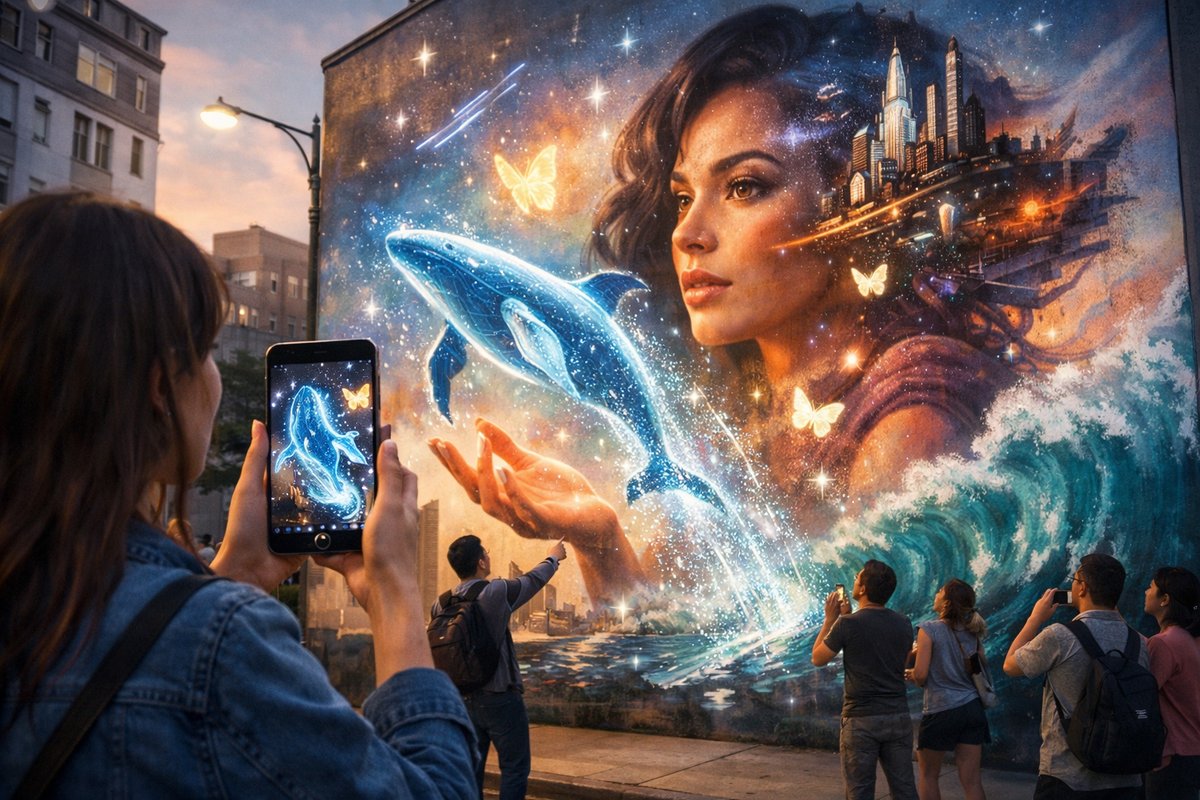

Cities have long served as canvases for artists eager to expand the reach of their work beyond gallery walls. Now, a growing number of creators are layering digital content over painted murals, harnessing smartphone cameras and specialized apps to reveal hidden animations, soundscapes, and interactive elements. This marriage of paint and pixels is ushering in a new era of public art-one that evolves in response to environmental cues, community participation, and the shifting tides of local culture.
On a bustling corner in downtown Rotterdam, a once-static mural depicting the city’s maritime heritage has come to life. As passersby raise their phones, the dockside scene transforms: cranes swing into motion, seagulls wheel across the sky, and local voices recount stories of generations who shaped the port. Created by an Amsterdam art collective, the installation debuted at the city’s Urban Design Festival, drawing curious crowds and sparking conversations about the role of technology in preserving history. Participants quickly discovered that tapping on specific animated vessels triggers audio interviews with workers who witnessed the port’s evolution firsthand.
Not every augmented mural requires a major festival backdrop. In a quiet neighborhood of Brooklyn, a grassroots project invited residents to submit personal photographs and memories online. Artists then integrated those images into a mural that, through an AR app, reveals an evolving slideshow of local life. The digital overlay pulls from a community-driven database: when someone adds a new image-an old storefront sign or a family portrait-it appears in the animation sequence. This open-source approach offers a model for hyperlocal storytelling, dissolving barriers between creator and observer.
At its core, augmented mural art relies on three components: a painted surface, digital assets (animation, audio, or 3D models), and a delivery platform-usually a smartphone or tablet. Many artists are turning to open-source AR frameworks for the heavy lifting, using markerless tracking so their overlays align seamlessly with the real world. Behind the scenes, 3D modeling software, animation suites, and audio editing tools work in concert to craft experiences that feel organic rather than forced. The result is a multi-sensory journey: visuals come alive, ambient soundscapes emerge, and even interactive hotspots encourage viewers to shape the narrative.
One installation in São Paulo invites exploration through nighttime projections. In this project, a traditional mural depicting tropical flora incorporates bioluminescent animations that glow when activated under a blue light filter in the AR app. As viewers move closer, hidden insects scuttle among painted leaves, and their movement triggers soft insect calls and rustling foliage. This fusion of projection mapping techniques and mobile AR demonstrates how artists can harness darkness to reveal secret layers, turning a routine walk into a woodland reverie.
Interactivity extends beyond passive observation. In Melbourne, a large-scale mural collaborates with a citywide scavenger hunt. Viewers scan different mural sections with an AR app to unlock clues, leading them to the next physical location. Along the way, they collect digital badges embedded in the animations. By completing the quest, participants earn access to a final augmented experience: a hidden 3D sculpture hovering above a nearby fountain, visible only through the app. This gamified approach transforms public art into a participatory event, fostering local tourism and highlighting underexplored neighborhoods.
Environmental considerations also shape this movement. Some artists are experimenting with sustainable paint formulas and solar-powered projection units to minimize their ecological footprint. Digital overlays can be updated remotely, reducing the need for repeated physical repainting and eliminating excessive material waste. A recent pop-up in Copenhagen used biodegradable paint for its mural base and solar-charged LED projectors for after-dark activations. The project’s clean energy focus resonated strongly in a climate-conscious city, illustrating how digital augmentation can dovetail with green design principles.
Communities are finding that augmented murals spur new forms of engagement. Social media channels dedicated to geo-tagged mural experiences allow participants to share screenshots of particularly striking animations or to post recordings of triggered soundscapes. Schools have incorporated AR mural mapping into art and history curricula, encouraging students to research local narratives and collaborate on digital asset creation. Local authorities, once wary of graffiti and vandalism, are increasingly partnering with artists to designate legal walls specifically for AR-enhanced works, seeing them as a way to boost cultural tourism without sacrificing public space.
Yet challenges remain. Achieving seamless alignment between the painted surface and the digital overlay demands precision during installation, and weather conditions can alter wall textures over time, potentially affecting tracking accuracy. Compatibility issues with older smartphones limit access for some users, creating digital divides among audiences. And while open-source frameworks lower the barrier to entry, artists without technical backgrounds often need to collaborate with developers and animators, adding to project costs.
Despite these hurdles, the momentum behind AR murals shows no sign of slowing. The next frontier may involve mixed-reality glasses, freeing viewers from handheld devices, or integrating real-time data streams-such as air quality metrics or pedestrian traffic patterns-into the visual experience. Imagine a mural that shifts color based on local pollution levels or animates only when a nearby park reaches a certain occupancy threshold, blending activism with aesthetics.
As cities grapple with how to keep public spaces vibrant and inclusive, augmented reality murals offer a flexible, future-minded solution. They invite artists to rethink the permanence of paint, communities to become co-creators of living canvases, and passersby to pause, focus, and reconnect with their environment in novel ways. The walls that once stood as silent backdrops are now stages for dynamic stories, responsive art, and collective memory-proof that creativity thrives at the intersection of human imagination and technological innovation.