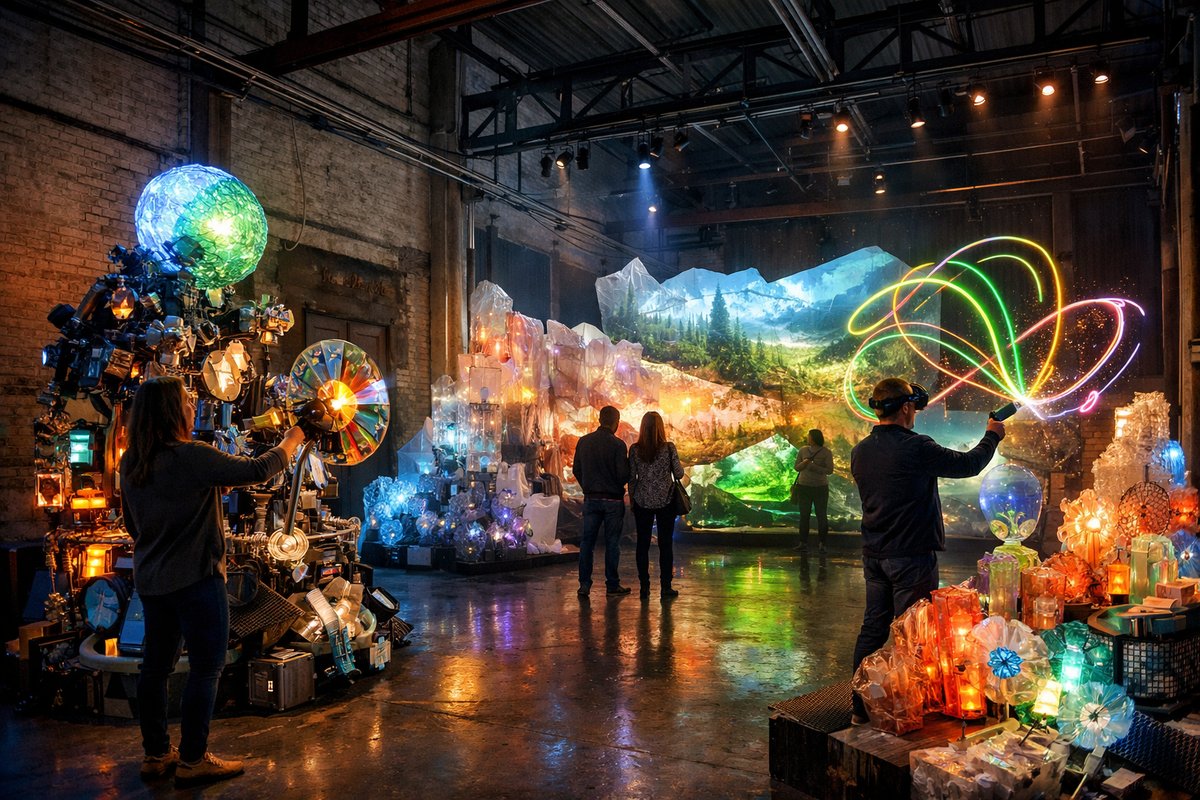

A sprawling converted warehouse on the city’s former shipping pier has become a laboratory for experimental art and design this season. Curators have filled the space with installations that fuse raw materials-scrap wood, recycled plastic, plant-based pigments-with live data feeds, projected light, and responsive sound. The result is a sensory landscape that shifts as temperatures, humidity readings, and crowd movement flow through concealed networks of sensors and microcontrollers.
One of the first works encountered features strips of dovetailed bark and salvaged textile fibers dyed with indicator pigments that change color when exposed to varying levels of ambient moisture. Hidden capacitive sensors detect shifts in humidity near the gallery entrance, altering the hue of the organic strands in real time. Under a narrow beam of adjustable LED panels, visitors watch the rain-forest-inspired threads pulse from coppery orange to teal blue, a subtle reminder of climate variability translated into living artwork.
Nearby, a collection of translucent sculptures carved from discarded packaging materials acts as projection surfaces for a mapping sequence generated by custom open-source software. Each angle of observation triggers an algorithm that remaps the projected pattern, morphing geometric grids into undulating topographies of light. The projections respond not only to the viewer’s position but also to a live feed of particulate readings taken from the courtyard outside, marrying the city’s air quality data with a poetic interplay of shadow and glow.
In an adjacent room, a motion-tracked drawing station lets participants shape a virtual brush with hand gestures. A depth camera watches hand movements above a matte black table surface; software converts those motions into strokes of digital ink that swirl across a suspended translucent screen. Users can select textures derived from local wood grain scans or river pebble impressions captured by a handheld 3D scanning device. As each participant adds layers to the communal composition, the work evolves into a dynamic tapestry of collective expression.
The exhibition’s central corridor is lined with interactive wall panels built from repurposed circuit boards and lengths of fiber-optic cable. Subtle pulses of light travel through the fibers in response to sensor readings tracking the gallery’s foot traffic. As groups form and disperse, the fibers glow more intensely or dim, visualizing social density in abstract filaments of color. Visitors often pause to trace their fingers along the glowing strands, curious to see how their own movement contributes to the luminous choreography.
Behind the scenes, the production team faced challenges marrying digital electronics with sustainable materials. Engineers developed custom sealants to protect microcontroller boards embedded in moisture-sensitive sculptures, while artists experimented with plant-based resins to coat recycled plastic surfaces. The collaborative ethos encouraged designers, coders, and fabricators to share prototypes in an open-workshop environment. Surplus wood offcuts became casting molds for hand-mixed plaster; remnants of water-soluble inks were repurposed into monoprint textures.
The show highlights tools emblematic of a hybrid creative process: handheld 3D scanners for capturing physical models, laser cutters for precision patterns, programmable microcontroller kits for sensor integration, and traditional carving tools for refining tactile surfaces. This blended approach underscores a belief that digital fabrication techniques and analog craft traditions can reinforce rather than replace one another. Visitors witness machine-assisted precision alongside the irregular beauty of hand-applied brushstrokes.
Interactivity extends beyond the visual; ambient audio tracks composed using live data modulate pitch and rhythm in response to visitor presence. Ultrasonic proximity sensors hidden in freestanding totems trigger field recordings of rustling leaves or distant city noise, creating an immersive soundscape that ebbs and flows with human traffic. The result is less a passive gallery visit than an evolving performance guided by both human and environmental inputs.
The exhibition also probes questions of emotional intelligence in art. By translating invisible data streams into sensory experiences, the works invite viewers to consider how quantifiable metrics-humidity, air quality, crowd density-intersect with subjective perception. When a cluster of visitors huddles to examine a sculpture, the amplified sensor readings heighten the piece’s glow, forging an ephemeral bond that feels equal parts technological marvel and poetic revelation.
Given the reliance on personal movement and biometric readings, the curatorial team established strict privacy safeguards. No personally identifiable information is collected; sensors record only ambient metrics such as proximity or motion. All data remains anonymized on local servers, with algorithmic processes confined to closed systems. In an era of ubiquitous surveillance, this stance reinforces the exhibition’s commitment to ethical data practices.
From a design perspective, the modular architecture of the installations champions reuse and adaptability. Components are built to be disassembled, reconfigured, and redeployed in new contexts. Fiber-optic strands can be rewoven into different display matrices; projection software is open-source, ready for adaptation at future venues; carved wood elements can be refinished and reassembled into distinct compositions. This modular ethos reflects an ecological mindset, reducing waste while enabling ongoing experimentation.
Technological highlights include vibrant fiber-optic LED strands that serve both as sculptural medium and interactive interface, programmable high-lumen projectors for dynamic mapping on irregular surfaces, and water-based pigment inks allowing safe, non-toxic color shifts on porous materials. A network of compact single-board computers orchestrates sensor data flows, while custom scripts animate the visual transformations. For many attendees, the fusion of low-tech materials with cutting-edge electronics provides an inspiring template for their own creative practices.
Academic workshops held alongside the exhibition delve into the marriage of local craft traditions and algorithmic design. Craft practitioners demonstrate hand-dyeing techniques using plant extracts, while technologists guide participants through writing simple code to drive sensor-based color changes. This cross-disciplinary dialogue fosters a deeper understanding of how ancestral making methods can inform-and be informed by-contemporary digital tools.
Audience responses have been enthusiastic. Visitors express delight at seeing everyday environmental conditions rendered as mesmerizing color shifts and responsive light shows. Designers and educators cite the exhibition as a case study in sustainable interactivity, praising its transparent data policies and modular construction. Many leave inspired to integrate analogous techniques-such as embedding simple sensors in textile projects or using projection mapping to enliven static objects-into community art programs or educational initiatives.
As the show continues to travel to satellite venues in other cities, organizers hope the experiments in combining data aesthetics, material reuse, and collaborative fabrication will ripple outward. Future iterations may incorporate additional sensor types-noise level meters, soil moisture probes, or real-time energy consumption trackers-expanding the palette of experiences. Whether viewed as a design showcase or a provocation about our relationship to invisible environmental forces, the exhibition offers a vivid testament to the creative potential unlocked at the nexus of digital and handmade.