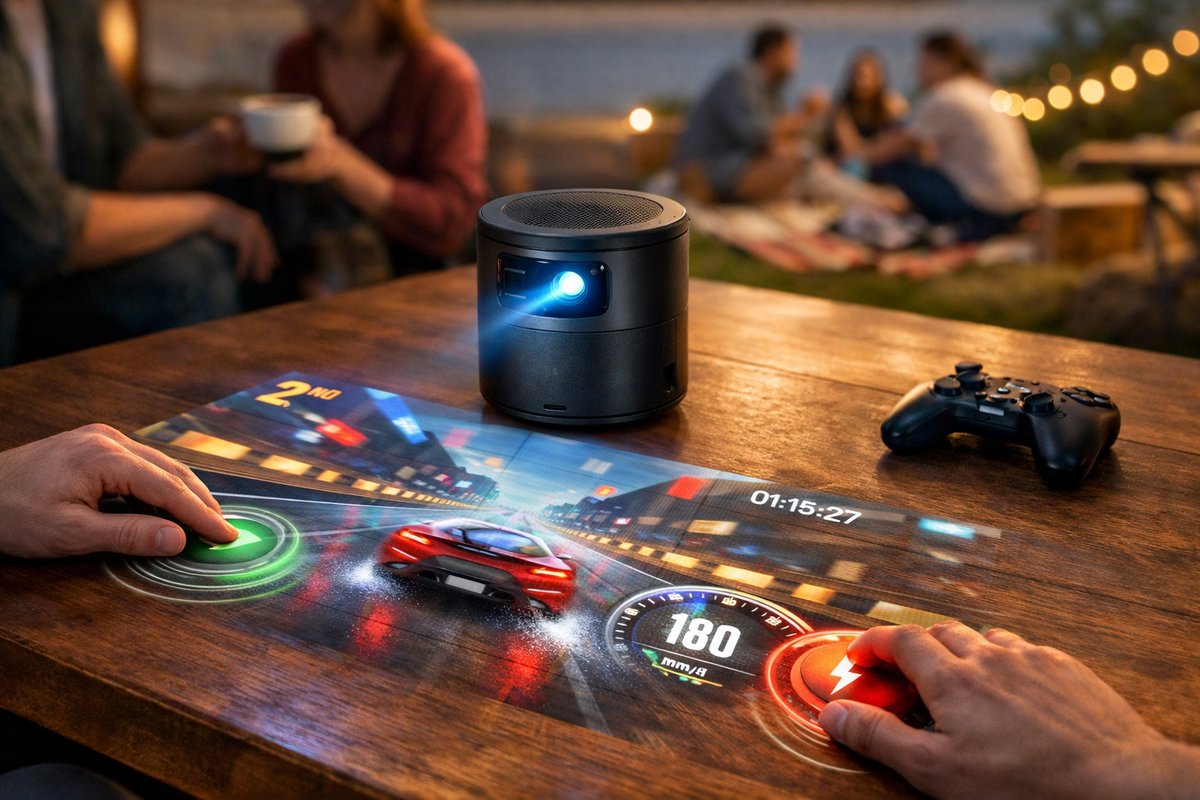

When a group of friends gathers in a cramped apartment or a corner of a coffee shop, space often limits the scope of shared gaming. Consoles require screens, controllers and enough room for comfortable seating. Virtual reality demands head-mounted displays and cleared floor areas. But now, a new entrant in the consumer tech scene aims to collapse all those requirements into a single portable gadget.
At the recent Tokyo Innovation Expo, PhotonPlay introduced LumiPlay, a pocket-sized projector that promises to transform any flat surface into a high-resolution, interactive game arena complete with haptic feedback. Roughly the size of a thick hardcover book and weighing just over half a kilogram, LumiPlay projects at 1080p resolution onto surfaces up to 80 inches diagonal. An integrated mini-GPU handles advanced rendering, while an AI-driven upscaler maintains crisp visuals when targeting larger displays.
But projection is only half the story. Surrounding the lens are ultrasonic transducers that deliver subtle pulses of air, creating tap-like sensations under the user’s fingertips. As a player slides a token across a board, they can feel the click of each tile. When a virtual character lands on a platform, a gentle buzz mimicks the impact. In demo sessions at the expo, attendees manipulated projected chess pieces with measured resonance, panned through a digital card deck with convincing page-turn feedback, and tossed volleyballs in a motion-tracked mini-court that buzzed with each contact.
PhotonPlay says the device offers around two hours of continuous projection on a single battery charge, with a fast-swap cartridge system for extended sessions. A companion mobile app routes video and audio from PCs, consoles and smartphones over low-latency Wi-Fi, even handling mixed reality titles via streaming. For the more traditional gamer, Bluetooth and USB-C ports support conventional controllers and headsets, so LumiPlay can seamlessly replace a TV or monitor when needed.
“We wanted something that breaks the mold of stationary setups,” said a PhotonPlay product manager on the expo floor. “Players should be able to gather anywhere – a park bench, a dorm lobby, a backyard table – and instantly share a fully interactive game world. LumiPlay brings projection, tracking and haptics into one ergonomic package.”
The announcement comes at a moment when many gamers are tiring of fixed consoles and oversized displays. According to industry analyst reports, sales of portable consoles and mobile-focused accessories have grown 15% over the last year, while traditional console hardware saw single-digit expansion. Part of this shift is driven by younger players who value flexibility and social sharing over living‐room exclusivity.
Cafés and coworking spaces are already adapting. One independent coffeehouse in Berlin has started offering tables outfitted with flat-surface coatings optimized for projection, along with wireless charging pads and high-speed internet. Patrons can rent a LumiPlay device by the hour, choosing from a curated library of indie titles, board-game conversions and cooperative puzzles. “This is more than TV gaming at a café,” the owner explained. “We’re creating small, dynamic play hubs that encourage strangers to collaborate or compete in novel ways.”
Back in Silicon Valley, a group of dorm residents at a major university has tested a prototype for late-night LAN meetups. They swap couch space for projection zones on dorm doors and walls, using LumiPlay to rebroadcast multiplayer shooters and strategy titles without hauling a monitor around campus. “We used to lug stuff between rooms. Now we just pass the projector and turn any hallway into a laning session,” one student said. “It’s surprisingly stable even with ten people crowding around.”
Technical hurdles still remain. In bright environments, projection clarity suffers unless ambient lighting is dimmed. The ultrasonic haptics work best on smooth, uniform surfaces – warped tabletops or uneven textures can disrupt feedback patterns. And for serious competitive gaming, input latency of a few milliseconds can make or break performance. PhotonPlay claims sub-30ms round-trip latency, but some fast-paced demos at the expo revealed occasional frame drops when the Wi-Fi network was crowded.
To address these concerns, PhotonPlay is partnering with accessory makers to develop attachable reflectors and surface mats that optimize contrast and tracking. An upcoming firmware update promises dynamic frame-rate adjustment and predictive rendering to smooth out network hiccups. Meanwhile, the startup’s R&D arm is working on a secondary module that snaps onto the top of the projector, adding infrared depth sensing for gesture controls without controllers.
Beyond gaming, the company envisions other applications. Educators could use LumiPlay in informal classrooms to project interactive quizzes and haptic simulations onto desks. Street artists might paint projection-mapped murals that respond to touch. Therapists exploring motor-skill rehabilitation could build bespoke exercises on any tabletop surface. “The same foundation that powers immersive play can drive novel experiences in learning and creativity,” PhotonPlay’s chief technology officer explained in a virtual panel session.
Industry insiders are watching closely. Startups often struggle to balance ambition with reliability, and consumers can be unforgiving when a hyped gadget arrives with unanticipated flaws. But the modular design of LumiPlay – with upgradeable projection modules and haptic cartridges – offers a path to iterative improvement rather than forcing users to buy an entirely new device. PhotonPlay’s seed funding round last quarter, led by a venture capital firm known for backing gaming innovations, suggests confidence that the startup can scale manufacturing and support software development.
Local game studios have already begun experimenting with LumiPlay’s development kit. A small indie team in Madrid has created a collaborative roguelike where players on different sides of a café table can see shared maps and exchange spells via touch. Another studio in Toronto is adapting an escape-room title so that clues light up on tables and walls, guiding participants through puzzles spread across a room. These early partnerships hint at a fresh wave of content tailored specifically for projection and haptic synergy.
As gaming continues to branch into diverse environments – from cloud streaming to mobile AR overlays – the lines between digital and physical play are blurring faster than ever. Portable consoles democratized access, but they still require screens small enough for personal use. VR built whole digital worlds, yet tethered players to rooms and hardware. Projection plus haptics may carve out a middle path: shared, embodied experiences on any surface, without bulky peripherals.
PhotonPlay plans a limited public release early next quarter in North America, Europe and select Asian markets, followed by broader availability by the end of the year. Preorders will include a basic surface mat and protective case, with optional bundles offering extra haptic cartridges tuned for board games, sports simulations and music visualization. Pricing is set at a premium level-roughly equivalent to a mid-range console-but the company argues that the device’s multi-use potential justifies the cost.
For gamers, hobbyists and innovators alike, LumiPlay represents a fresh avenue of exploration. It challenges assumptions about where and how people play, inviting communal interaction in spaces never designed for video games. Whether in a cramped dorm hallway, a bustling café or a quiet living room, the ability to project dynamic, touch-sensitive worlds onto any surface could mark a turning point in the ongoing quest to make play more accessible, social and boundless.
In an era where screens dominate our attention, maybe it’s the empty table that becomes the greatest canvas. LumiPlay’s vision of gaming without walls-or even monitors-could well be the spark that lights the next generation of communal play experiences.