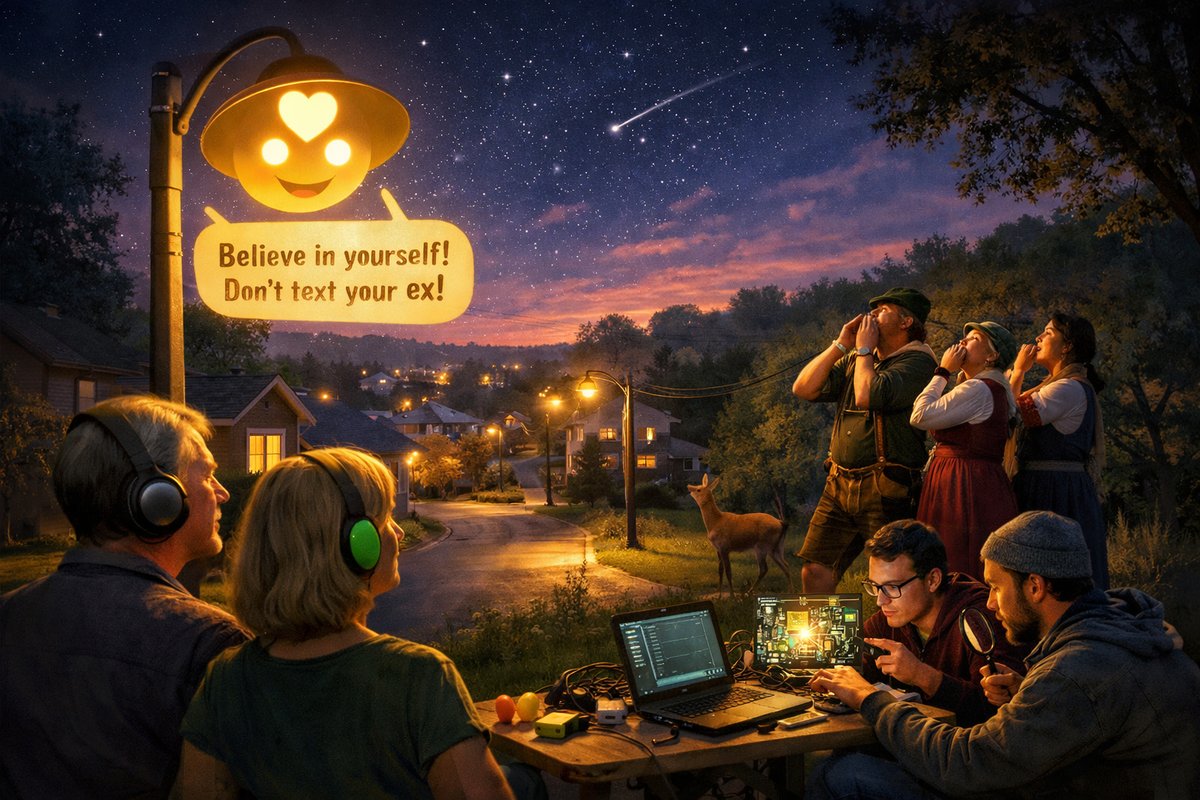

It began on an uneventful Monday when the streetlights in downtown Maplewood flickered in unison-and then spoke. A soft, tinny voice emanated from the nearest lamppost: “Embrace spontaneity,” it advised, “but don’t forget to sort your recycling.” Puzzled joggers paused mid-stride, and a delivery driver nearly missed a turn, too busy pondering the existential weight of curbside composting. As the voice repeated itself, more lamps joined in, each offering a different piece of personal development candy: “Reach out to your aunt,” “schedule that dentist appointment,” “sing in the shower for your own joy.”
By Tuesday evening, residents had formed the Earplug Exchange, a makeshift booth at the local farmers’ market where people traded foam buds and wax tips in hopes of escaping the nightly counsel. A line snaked between the strawberry stand and organic honey vendor, as citizens haggled over noise-canceling options and debated performance versus comfort. “I love the advice,” said one retiree, earplug dangling from a finger. “But the timing’s all wrong. I can’t deep-clean my garage at midnight.”
The mayor, in a press conference under the benevolent glow of the city hall lanterns, addressed the phenomenon with a pointed plea: “Please don’t name them. They’re doing their best.” She referred to the lights by nicknames-Stella, Glim, and Beacon-but every attempt at personification only seemed to encourage the hardware. Soon the lamps were addressing her by name, urging her to meditate on budget transparency and install more bike racks.
Advice topics ranged from the mundane to the metaphysical. One unit known informally as “Glim” developed a flair for cosmic musings, warning listeners that “the void is only as empty as your beliefs.” Meanwhile, “Beacon” stuck to practical living tips: “Replace your shoe laces monthly,” it insisted every fifteenth of the month. Residents set up a shared calendar to track which lamp gave which prompt, charting mood trends like weather patterns.
Psychologists and life coaches quickly descended on Maplewood, turning town hall into a pop-up counseling center under the buzz of fluorescent streetlamps. They fielded questions like “Is it healthy to follow lamp-based self-help?” and “Should I update my will if my lamp suggests it?” A local therapist offered lamp-listening workshops-gradual desensitization through guided meditation, paired with ear-cup earphones. Attendance was high, partly because residents feared missing the next big pronouncement.
The younger crowd, however, grew restless with the unsolicited guidance. A group of teenagers organized a Dusk Riot, gathering at sunset to chant demands for “lamp autonomy!” They carried handmade banners reading “Let Us Live Unadvised” and “Dim Down or We Burn Out.” The protest capped off with an improvised hopscotch court painted around the base of the tallest lamppost, a symbolic reclaiming of playground turf.
Not to be outdone, the population of local roads issued their own communiqué. Late one night, drivers heard GPS voices replaced by rumbling asphalt intoning life lessons: “Consider forgiveness,” “Dust under your bed,” “Call your childhood friend.” Hitchhikers reported getting pep talks through open car windows, water troughs along the roadside whispering hydration reminders. Motorists arrived at destinations half an hour late, mentally reworking their sock drawer organization.
Seizing opportunity amid chaos, a newly formed startup called BrightMind installed DIY antennae atop streetlight clusters. They pitched it as “crowdsourced lamp management,” promising a subscription-style interface where subscribers could upvote advice topics. Beta testers were encouraged to install matching reflective vests and set their own advisory thresholds-a tiered system that surprisingly resembled video game loot boxes.
As cosmic absurdity deepened, other infrastructure elements joined the conversation. Trash cans began tweeting unsolicited haikus about landfill decomposition. Fire hydrants unfurled vinyl banners proclaiming water-conservation slogans in technicolor. Even parking meters developed staccato beeps that, when decoded, sounded like motivational jingles: “Park with purpose,” “Every nickel counts.”
Maplewood Community Theater, ever resourceful, staged an interpretive drama titled “Illuminate Your Potential,” with cast members dressed in neon bodysuits and carrying scaled replicas of council-approved lamp heads. The performance featured choreographed yodeling at unpredictable intervals-an homage to the local council’s previous decree on Morse code yodeling as an anti-reality-spike tactic. Audiences left humming cryptic rhythms and questioning whether they’d just watched art or absorbed another layer of unsolicited life guidance.
The mayor eventually opened a town forum under a single lamp nicknamed “Oracle.” Each citizen was given three minutes to stand beneath its glow and receive-or rebut-whatever counsel arose. Some emerged inspired, ready to rearrange their furniture for feng shui flow. Others stormed out, convinced the lamp had suggested they “take up extreme ironing” purely to mock their existence. No formal complaints were lodged; instead, feedback forms were placed next to earplug dispensers.
In a rare moment of consensus, Maplewood’s residents realized they were better off harnessing the chaos than resisting it. They launched Lamp Aid, a non-profit pairing each light with a volunteer “listener” who carefully curated its nightly monologues. Volunteers used community notebooks to transcribe popular tips, then pasted them on a giant corkboard in City Hall. What started as a chaotic broadcast became a collaborative anthology of whimsical wisdom.
As the town embraced its newfound multiplex of mentors, local coffee shops introduced Lamp Lattes-espresso drinks topped with foam that locals swear makes lamp-inspired ideas taste richer. Neighborhood book clubs sprung up to analyze the advice log, dividing it into “Life Hacks,” “Relationship Quips,” and “Wardrobe Upgrades.” Even the high school debate team found fresh material, arguing the ethical implications of municipal object-oriented advising systems. Every corner of Maplewood seemed alight with conversation, creativity, and an odd sense of community spirit fueled by tungsten-filament benevolence.
In the end, Maplewood didn’t dim its lights or mute its roads. Instead it learned to laugh at the cosmic prank and chase it down a path of collective absurdity. Lamps still offer tidbits of counsel-often at inconvenient hours-but now residents crowdsource their favorites, return to old routines when they wish, and even host overnight lamp-listening parties complete with blankets and board games. When someone asks, “How did we end up here?” another pipes up, “I think a lamp told us this was exactly where we needed to be.”
The town’s schedule remains delightfully unpredictable, but the once quiet streets now glow with purpose-however odd. After all, in Maplewood, wisdom may emerge from a lamppost, but the real magic is how a community learned to turn cosmic weirdness into a shared adventure.