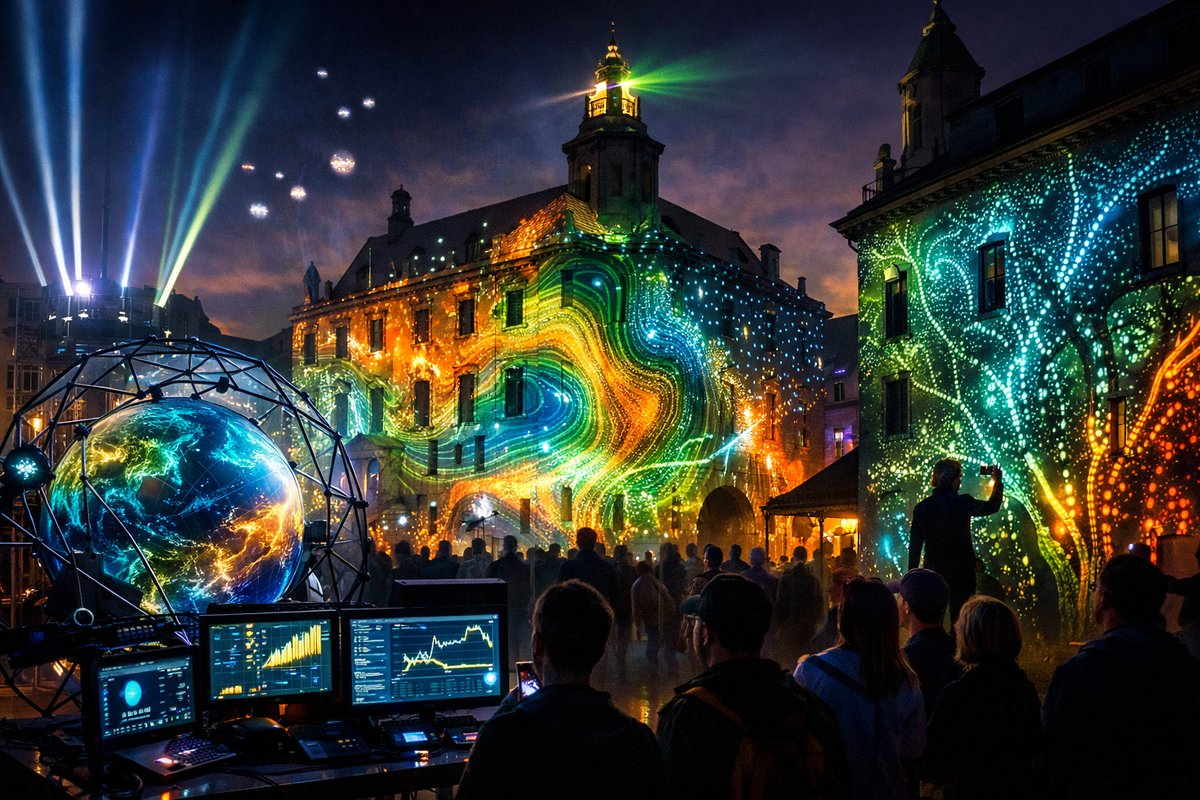

Across the winding lanes and grand façades of a historic European city, a new wave of site-specific art installations is reshaping our understanding of public space. At a leading media arts festival, a cohort of collectives and solo practitioners introduced a suite of eco-responsive projection works that map pollution, humidity, and even microbial life onto architectural surfaces. Far from static displays, these projects engage passersby through smartphone interfaces and tactile sensors, positioning the city itself as both subject and collaborator.
One standout piece, dubbed Living Cityscape by an international design collective, employs a network of low-power environmental loggers mounted on streetlights and building corners. The sensors continuously capture air-quality metrics-CO₂, particulate matter, temperature-and feed the data into a custom projection engine. As pollution levels rise in dense traffic zones, swirling plumes of emerald light seep across adjacent façades. In greener, park-lined boulevards, patterns shift to soft amber ribbons that ebb and flow like gentle currents. By visualizing invisible urban atmospheres in real time, Living Cityscape offers residents an immediate, poetic sense of the air they breathe.
Elsewhere in the festival grounds, a research team from a technical university unveiled LuminoWall, a bio-hybrid mural that combines bioluminescent algae cultures with programmable LED arrays. Viewers are invited to touch discrete zones of conductive paint, triggering micro-electrodes that stimulate the living algae embedded in translucent panels. Under low lighting, faint glows emerge where fingertips rest, extending outward in branching filaments. What begins as a ghostly fingerprint blossoms into fractal blooms of pale green light, slowly waning as the biological system recovers. By emphasizing cyclical interactions between human touch, living organisms, and electronic controls, LuminoWall interrogates our relationship to delicate ecosystems.
Not far away, an urban intervention titled Flux Graffiti repurposes LED-embedded stencil graffiti for dynamic street art. A team of technologists and graffiti writers teamed up to spray-paint polymer stencils onto concrete walls, integrating flexible addressable LED strips within the pigments. Using a mobile app, pedestrians can select color palettes or motion presets: loops of pulsing neon, chasing gradients, or audio-reactive sequences that dance to ambient noise. Through open-source code, Flux Graffiti invites communities to customize-and even co-code-public murals, challenging conventions around authorship, ownership, and the temporal nature of street art.
One of the most talked-about installations, Symbiotic Silhouettes, navigates the boundary between ephemeral projection and sculptural presence. Hung in a centuries-old courtyard, a translucent mesh is suspended between crumbling stone arches. Within this mesh, a swarm of miniaturized projectors casts silhouettes of passing birds, pedestrians, and urban flora. Meanwhile, ultrasonic distance sensors modulate the speed and density of the imagery-when crowds gather, the silhouettes slow and cluster; when the space is empty, they disperse into fleeting, ghost-like traces. Visitors describe the work as a dreamscape that responds to their own movement patterns, highlighting the porous divide between observer and observed.
Underlying many of these installations is a surge in accessible, open-source hardware and a revival of hands-on prototyping. Microcontroller boards, affordable sensors, and compact projection modules have democratized the tools once reserved for specialized production studios. At the festival’s accompanying maker pavilion, workshops guided attendees through building portable projection rigs, setting up environmental data feeds, and programming simple interaction scripts. By stripping away technical barriers, these sessions promoted a DIY ethos that dovetails with calls for sustainability and communal stewardship.
Beyond the immersive spectacles, several installations also grapple with material ethics. One collective showcased a series of sculptural forms printed from recycled polymer waste sourced from local construction sites. These amorphous objects double as projection screens, their irregular surfaces refracting light in unexpected ways. Another designer presented wearable accessories woven from industrial hemp and conductive threads-garments that can transmit low-voltage signals to nearby projection nodes, effectively turning the wearer into a walking canvas.
The convergence of biotic materials, sensor networks, and light mapping suggests a future where cities are not just backdrops but active participants in creative expression. As climate awareness deepens, artists are seeking ways to bring environmental data into the realm of sensory experience. By turning pollution maps into living light, humidity readings into flowing ribbons, and biological processes into interactive murals, they invite citizens to reflect on their place within complex ecological systems.
These eco-responsive installations also point toward practical implications for urban planning and civic engagement. Real-time visualizations of air quality could inform pedestrian routes or outdoor seating arrangements. Touch-sensitive murals could double as public-data kiosks, allowing communities to report maintenance issues or share hyperlocal updates. Wearable tech that communicates with city sensors might empower residents to participate directly in participatory budgeting or crowd-sourced mapping projects.
Critics have noted that such works still require careful calibration to avoid aestheticizing serious environmental challenges. Yet proponents argue that abstract beauty can serve as a powerful gateway to awareness and action. When a pastel wave of illumination moves across a familiar streetscape, it can jolt observers out of complacency, prompting questions about renewable energy, pedestrian rights, or air-filtration initiatives.
In a follow-up panel discussion, festival organizers challenged attendees to imagine how these techniques could be scaled beyond temporary exhibitions. Could entire districts adopt programmable façades powered by solar cells? Might civic authorities integrate sensor arrays into public art commissions? And how can communities ensure equitable access to the data and creative tools at play?
As the festival draws to a close, the installations will disperse-LED strips packed away, bioluminescent cultures returned to labs, projection rigs dismantled. But the impression they leave promises to linger in both mind and skyline. By weaving data streams, living matter, and everyday surfaces into choreographed symphonies of light, artists are charting new territories of urban empathy and ecological imagination.
The ecological urgency of our era demands forms of expression that speak not only to reason but to visceral feeling. When technology and biology converge on stone walls and city streets, they reveal unexpected dialogues between human desire and environmental contingency. These symbiotic silhouettes challenge us to look beyond smoke and smog, to see the cityscape as a living organism in need of care, creativity, and co-authorship.