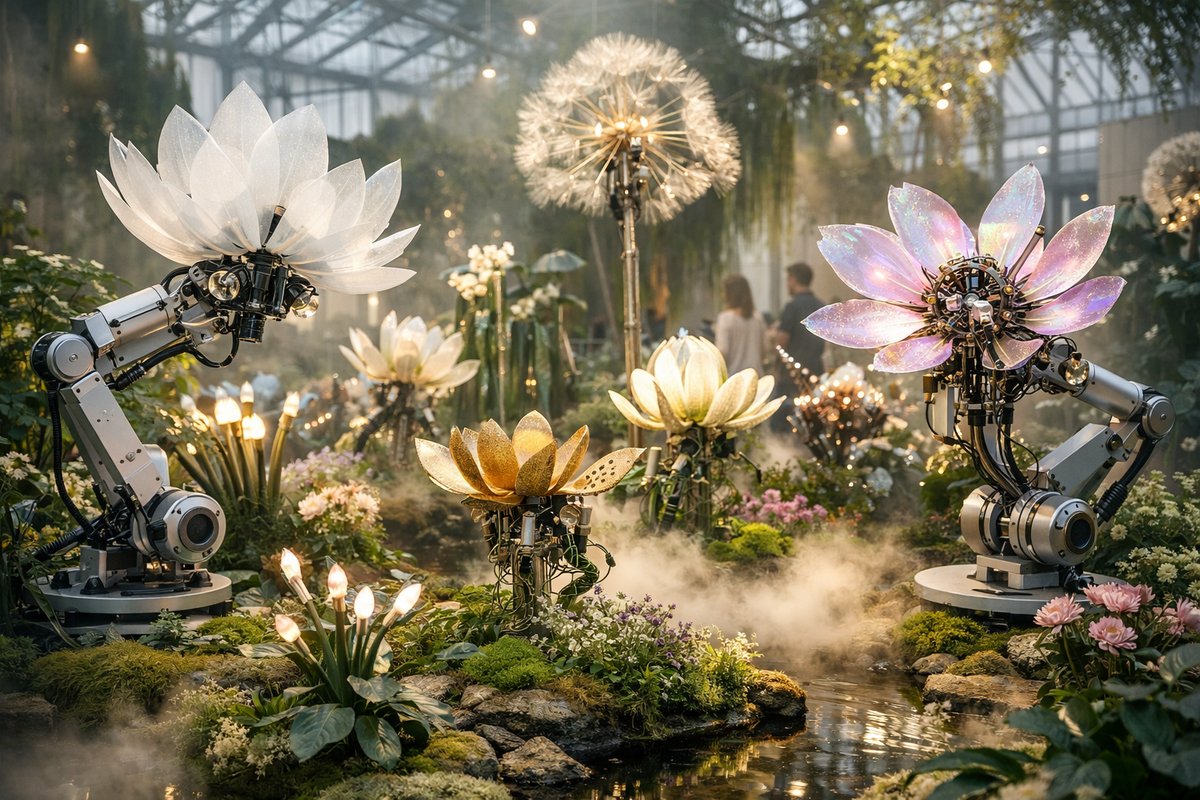

Located along the winding canals of Amsterdam, a clearing in the historic Westergasfabriek complex now hosts an unprecedented fusion of art, technology, and ecological inquiry. At the heart of this experiment, dozens of robotic blooms reach and swivel toward shafts of sunlight, powered entirely by miniature solar panels and clever programming. Kinetic Botany, unveiled on opening night of this year’s Design Fair, invites visitors to wander through a living gallery where motion and material converge in a quiet commentary on regeneration and renewal.
The fair itself has long celebrated forward-looking practitioners who push the boundaries of design, but this year’s edition feels more urgent. Climate concerns and resource scarcity have driven curators to spotlight work that embodies a circular ethos. In past seasons one might have seen experimental furniture built from upcycled plastics or virtual reality prototypes that simulate natural ecosystems. Now, Kinetic Botany stakes a claim as the centerpiece, not only for its scale but for the poetic interplay of movement, sunlight, and compostable materials.
The installation comprises over fifty sculptural stalks, each rigged with servo motors, motion sensors, and delicate microphone arrays. When a visitor approaches, the nearest stalks lean in as though to listen, their photonic petals unfolding in a slow choreography. The effect is both surreal and intimate you feel acknowledged in your presence. On the hottest afternoons, the stands pivot to capture solar input, ensuring sustained motion even as cloud cover drifts overhead. Engineered for efficiency, each stalk can operate for more than eight hours on a single charge of stored energy, courtesy of a compact lithium-iron battery that charges exclusively via the integrated solar cells.
Sustainability extends beyond energy. Many structural elements were 3D printed using biodegradable filament derived from cornstarch and reclaimed cellulose waste. That photonic film coating the petals comes from research into cellulose-based holographic sheets originally developed for packaging prototypes. Here, the sparkling reflections mimic the iridescence of insect wings, yet dissolve harmlessly in compost over months rather than decades. Even the wiring harness is insulated with plant-based polymer rather than traditional PVC, underscoring the team’s commitment to minimize plastic pollution at every turn.
Behind Kinetic Botany stands an interdisciplinary collective of designers, material scientists, software engineers, and horticultural experts. The project’s lead artist studied experimental sculpture, while a biomaterials researcher devised the biodegradable coatings. Robotics specialists contributed the servo and battery systems, and a small team of landscape architects curated the flow of foot traffic to shape each visitor’s encounter. Programming duties fell to an open-source coder who wrote custom scripts for real-time motion analysis, adjusting each flower’s responsiveness based on ambient noise, light intensity, and human proximity.
Responsive design sits at the core of this work. Real-time data streams from environmental sensors feed into a lightweight AI algorithm that modulates both motion and sound. Tiny speakers embedded at the base translate sensor readings into gentle hums or chirps, creating an evolving soundscape. By using on-device processing rather than cloud computing, the team prioritized privacy and reduced latency, ensuring that no personal data ever leaves the site. Visitors can opt in to share anonymous movement patterns for research, but their identities remain protected by design.
As dusk falls, Kinetic Botany reveals another dimension. Ultraviolet LEDs concealed at ground level cause the cellulose petals to glow, revealing hidden patterns and amplifying the sense of otherworldliness. Observers are drawn to the way light and shadow play across the forms, as if stepping into an alien forest. The installation demonstrates how art can guide reflection on renewable energy while delivering a graceful aesthetic experience.
Public reaction has been overwhelmingly positive. Families linger to watch the slow, deliberate unfolding of each petal. Educators bring groups of students to discuss how material innovation can transform everyday objects into sources of wonder. Social media posts capture the installation’s dreamlike quality, yet the underlying message resonates far beyond a few viral images. Kinetic Botany poses questions: What might our cities look like if every lamppost responded to pedestrians? How could our street architecture harvest and repurpose ambient energy? By reframing common hardware around ecological values, the project sparks curiosity about life in a more sustainable world.
In a broader perspective, this installation reflects a shift in the art world toward functional ecologies rather than static objects. More galleries now commission pieces that blur discipline boundaries and incorporate living systems. At a recent symposium in Rotterdam, designers showcased prototype windows that adapt their transparency based on air quality. Meanwhile, elsewhere in Europe, architects experiment with bio-cement grown from algae and mycelium. Kinetic Botany stands among these experiments as an exemplar of optimism, demonstrating that art and design can be both evocative and ecologically responsible.
As the fair continues through the weekend, visitors are encouraged to participate in workshops on building simple solar modules or printing their own biodegradable components. By inviting hands-on exploration, the curators hope to inspire makers to adopt these principles in everyday designs. The collective behind the installation plans to donate open-source files, encouraging educators and hobbyists to replicate simplified versions in community labs and classrooms.
Kinetic Botany is more than an ephemeral phenomenon. It invites us to reimagine the boundless potential of materials once deemed waste, to consider algorithms as collaborators rather than mere tools, and to embrace an ethic of care as central to creative practice. In a time when both technology and ecology can feel at odds, the blossoming of these robotic flowers offers a hopeful vision of co-creation between human ingenuity and the natural world.
As you step away from the glowing field of motion and light, you carry with you a new awareness. A dial of possibility has been turned, suggesting that design can serve as a bridge between art and life systems. The future of creation, it seems, lies where curiosity meets sustainability and where every material choice tells a story of renewal.
In the weeks ahead, Kinetic Botany will travel to partner institutions across Europe and North America, adapting its choreography to new climates and architectural contexts. Each iteration will incorporate locally sourced biomass feedstocks for the composite petals, ensuring the work remains grounded in community and place. By the time it returns to Amsterdam, it will have evolved into a living archive of regenerative design. That journey alone hints at the promise of art practices that are fluid and responsive, crossing borders as readily as the wind carries seeds. In these cycles of bloom and decay, we discover a lesson in resilience: true creativity grows only when it lives in harmony with the world around it.