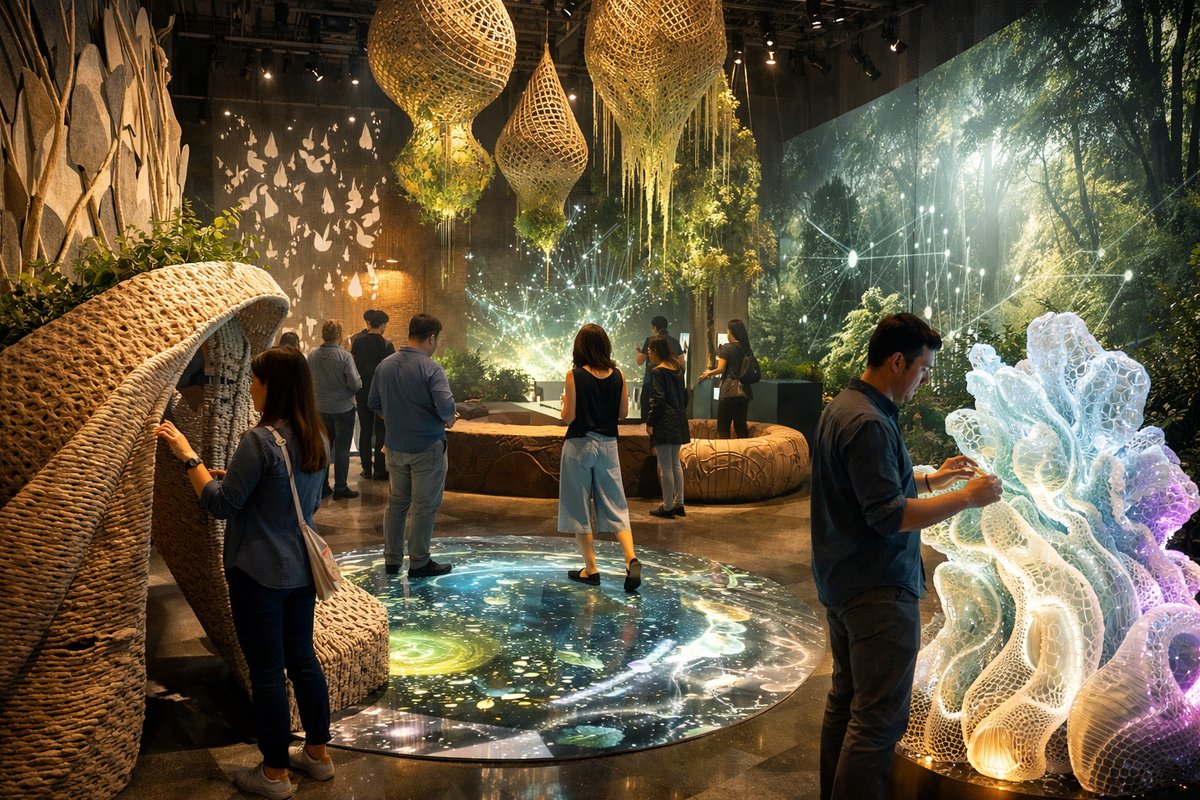

The Modern Arts Center’s latest show invites audiences into a world where sustainability and cutting-edge technology collide in forms that feel both ancient and futuristic. From sculptures carved from reclaimed driftwood to interactive projections powered by solar-charged sensors, the exhibition reframes everyday materials as sites of wonder. Against the muted gray walls, luminous shapes pulse and shift, responding to the movement of viewers as if guided by an unseen hand.
Curators describe the exhibition as a conversation between three realms: the physical, the digital, and the elemental. In one room, visitors encounter a cluster of “living canvases,” panels coated with bioluminescent algae that glow softly when touched. Nearby, a series of minimalist steel frames holds hidden e-ink displays that reveal shifting patterns only when approached. These pieces, it is said, explore the tension between permanence and change, urging us to reflect on the transient nature of our environmental footprint.
Beyond the walls of the galleries, design studios and maker spaces have begun replicating the show’s ethos in city workshops. Local students gather around high-precision laser cutters to transform salvaged plywood into modular light fixtures. In a corner of the workshop, a group experiments with hand-molded clay infused with pulverized ceramic waste, crafting vessels that honor ancient craft traditions while minimizing landfill contributions.
A highlight of the exhibition is a room devoted to augmented reality sculptures. Visitors don lightweight headsets (supplied on loan) and step into a field of floating geometric forms. These virtual objects cast shadows on the floor and respond to gestures – a swirling hexagon might expand into a ribbon of light that sweeps across the ceiling. The seamless fusion of hardware, software, and spatial design hints at new possibilities for collaborative creation, where artists, coders, and engineers converge around a single vision.
It’s not only the art that feels innovative. The gallery’s approach to lighting and display also speaks to a broader shift in design thinking. Curators worked with lighting designers to install adjustable LED fixtures capable of shifting color temperature on the fly. As visitors move through the halls, motion sensors trigger subtle shifts from cool daylight to warm amber, altering the mood and inviting fresh interpretations of each work. This dynamic environment underscores how ambient design can shape perception and heighten emotional engagement.
One artist’s work in the show stands out for its dramatic simplicity. A tall, tapering sculpture assembled from recycled metal piping towers over a shallow pool of water. When a visitor steps onto a small platform, sensors activate a gentle burst of steam that weaves around the sculpture’s base, evoking mist rising from a mountain top. The piece exemplifies the exhibition’s overarching theme: design as experience, with form and function unified in a poetic gesture.
Of course, translating these ambitious works from concept to reality poses challenges. Many creators speak of late nights troubleshooting interactive circuits or scouring scrap yards for the perfect piece of reclaimed wood. The result, however, is a body of work that feels both handcrafted and digitally native. For those inspired to launch their own projects, the exhibition doubles as a practical blueprint, offering glimpses of materials, tools, and techniques that novices and seasoned makers alike can adopt.
Educational outreach has become a featured component of the show. Weekly workshops introduce attendees to techniques such as cyanotype printing on recycled fabric, circuit-bending simple electronics to create sound sculptures, and basic coding for motion-responsive installations. Each session prioritizes accessibility: facilitators bring ready-to-assemble kits so that learners can walk away with a working prototype.
In reflecting on the larger impact of the exhibition, it’s clear that art and design are moving toward a more inclusive, participatory model. Gone are the days of static display cases; instead, the emphasis is on co-creation and dialogue. The gallery has opened an online portal where visitors can download templates for DIY lanterns made from upcycled plastic, along with step-by-step instructions for programming simple light patterns via accessible microcontrollers.
This interplay between physical craft and digital experimentation underscores a deeper philosophical inquiry. How do we define authenticity in an age when pixels can mimic brushstrokes, and code can simulate texture as convincingly as oil on canvas? Some artists in the show embrace hybrid approaches, painting on transparent substrates that become canvases for projection mapping. Others insist on the tactile resistance of charcoal on paper, amplified by live-capture cameras that project every expressive mark onto towering screens.
The momentum generated by this exhibition extends beyond city limits. Satellite events are planned in smaller communities, where mobile versions of key works will travel in retrofitted shipping containers. Each pop-up focuses on regionally sourced materials: driftwood from nearby beaches, pigments derived from local soils, and community-sourced textiles. By anchoring projects in a specific locale, curators hope to cultivate a sense of place and underscore the global relevance of sustainable design practices.
At its core, the show is a manifesto: creativity need not be synonymous with excess, and innovation thrives when artists embrace constraints rather than evade them. Whether through the gentle glow of algae-powered panels or the crisp precision of laser-cut forms, the exhibition makes a persuasive case for art and design as forces for ecological stewardship and social connection.
For readers eager to explore these ideas in their own studios, certain tools and materials stand out as essential starting points. High-quality sketchbooks with acid-free paper provide a reliable surface for concept sketches and exploratory renderings. Water-soluble brush pens bridge the gap between drawing and painting, offering vibrant color washes without the mess of traditional paints. An adjustable artist’s easel brings flexibility to small workspaces, while a daylight-balanced LED floor lamp ensures accurate color perception under any conditions. Mechanical pencil sets with fine leads deliver precise lines for technical drawings, and professional acrylic paint sets open up a full spectrum of pigment options for mixed-media experiments.
Ultimately, the Modern Arts Center’s exhibition serves as both inspiration and invitation. It sparks curiosity about what lies beyond the frame and encourages readers to reimagine the tools they use every day. In a moment when environmental concerns weigh heavily on collective imagination, this show charts a hopeful course: one where art and design renew our sense of wonder while honoring the planet we share.
-
2Pcs Liquid Chrome Markers with Silver Paint Pens Medium and ...
These silver paint pens with liquid chrome paints that are pigment-based and acid-free inks. They are completely opaque, high glossy, and water-resistant. These ... -
Acid Free Sketch Book
Explore acid-free sketchbooks, perfect for artists and journalers. 96 Pages 5.25 x 8.5 inches (525) $14.99 -
" Natures Sketchbook III Bold Light Gray " by Danhui Nai
Natures Sketchbook III Bold Light Gray by Danhui Nai is a high quality piece of framed artwork. The finished size of this piece is 17" X 21".