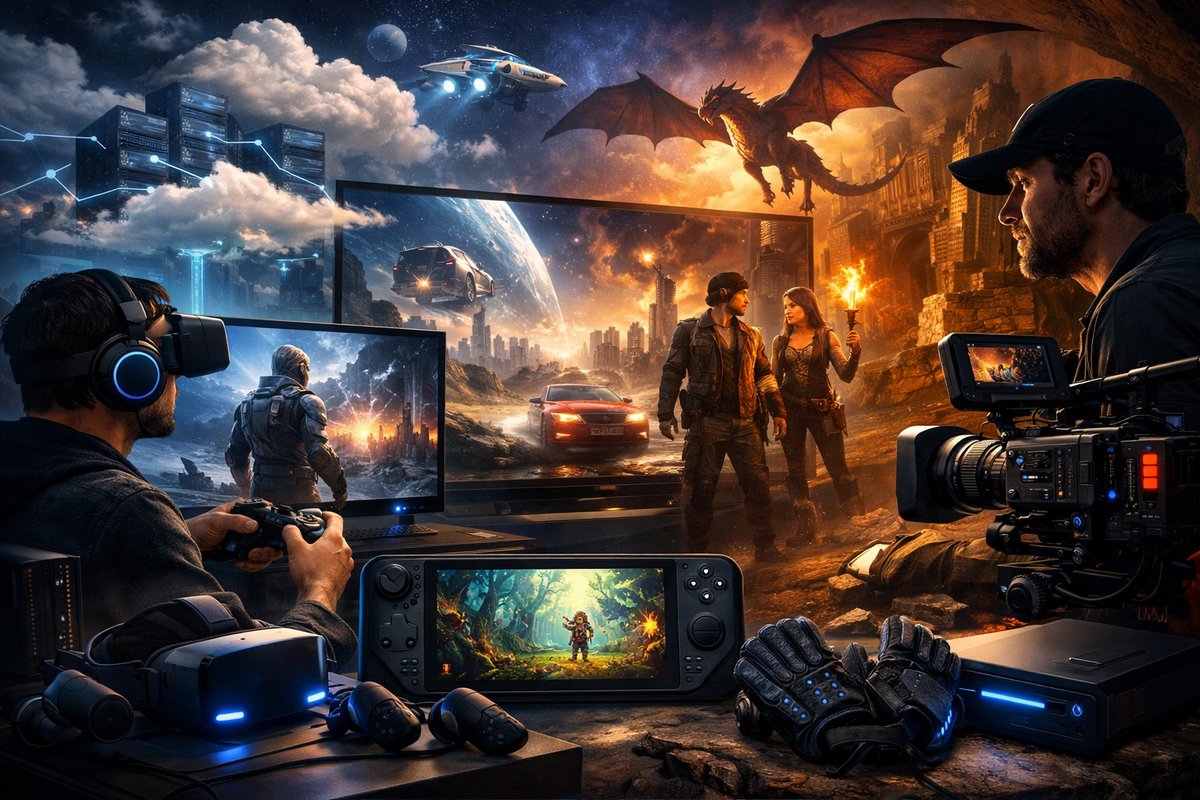

Game announcements once dominated headlines, but today’s biggest stories often arrive through unexpected channels-from modular hardware drops at global expos to surprise streaming tie-ins that capture both button mashers and binge watchers. In the span of a few months, fans around the world have witnessed the rollout of next-generation cloud gaming services, the unveiling of a VR headset that folds down to pocket size, and a scripted drama based on a beloved franchise racing toward award season buzz. Play is no longer a pastime; it’s an ever-evolving medium where every pixel and story beat feels calibrated for maximum immersion.
Cloud gaming has quietly matured from a niche experiment into a full-blown ecosystem. Earlier this year, a major service expanded its reach to dozens of new regions, promising sub-30-millisecond latency even over mobile 5G networks. The result is fluid experiences where AAA open-world titles load in seconds instead of minutes, and updates happen behind the scenes rather than during marathon download sessions. Studios are retooling pipelines to optimize for streaming, focusing on shader streaming and dynamic resolution scaling so even handheld tablets can drive sprawling environments with zero compromise.
Meanwhile, hardware makers are doubling down on portable immersion. At a recent tech expo in Berlin, a compact VR headset drew oohs and aahs by folding down into something barely larger than a slim paperback. Boasting eye-tracking and inside-out spatial awareness, its goal is to bring high-fidelity headset performance to living rooms, dorm rooms, or anywhere your Wi-Fi reaches. Developers showcased demos of physics-driven swordplay, AI-powered NPCs that react emotionally to your actions, and hand-tracking that eliminates the need for bulky controllers. It’s a reminder that virtual reality-once dismissed as gimmicky-is approaching a tipping point.
Back in more earthy territory, indie innovators continue to carve out new genres that thrive on creative constraints. In Tokyo, a weeklong showcase spotlighted small teams blending interactive fiction with abstract art direction, while a festival in São Paulo celebrated interactive music experiences that let players remaster soundtracks in real time. These projects rarely hit mainstream storefronts, but they fuel ideas that larger studios later adopt: procedural storytelling, dynamic music layering, emergent gameplay loops. Their successes underscore a broader shift: players today seek more than polished visuals and AAA budgets; they crave unique, human-scale experiments that surprise and challenge expectations.
Sustainability has emerged as a core value across both hardware and software. Against a backdrop of global energy concerns, console manufacturers are pledging carbon-neutral shipping, and PC enthusiasts are swapping power-hungry graphics chips for efficiency-tuned silicon designed with reclaimed metals. In tandem, games themselves are nudging players toward greener choices-digital farming simulators incorporate real-world climate data, and open-world adventures feature side quests that encourage wildlife preservation. When play transcends escapism to reflect pressing environmental issues, it creates a deeper resonance that can spark change beyond the screen.
Accessibility and community remain cornerstones of modern design. A growing number of titles launch alongside language packs, adaptive controller profiles, and dynamic difficulty systems that learn from each player’s pace. Lobbies brim with features like text-to-speech chat, colorblind filters, and custom cue systems that cater to neurodiverse audiences. These advancements extend social bridges, letting old friends reunite in epic raids or brand-new squads form across continents. Online tournaments, once the province of elite teams, now welcome casual participants in open-entry brackets that stream to millions of viewers worldwide.
This fusion of gaming and live entertainment has never been more evident than in the crossover successes on streaming platforms. When a show based on a breakout action-RPG premiered earlier this year, it shattered digital rental records within days. Viewers who had never picked up a game tuned in to follow its richly drawn characters and complex mythology, while die-hard players scrutinized every adaptation choice. The series’ producers recruited game writers and lore keepers to ensure fidelity, turning what could have been a marketing afterthought into an event that energized both fanbases.
The critical response has been remarkable. Episodes are dissected on social feeds, reaction videos rack up millions of views, and fan-made mods enliven the original game world with nods to the show’s plot twists. This cycle-game inspires show, show drives new players back to the source material-illustrates how storytelling has become an interconnected web. Publishers and networks alike are treating game adaptations as marquee releases, complete with companion podcasts, art books, and live watch-along events that rival major award ceremonies in scale.
Audio and visual fidelity play starring roles in this evolution. Gamers now demand spatial audio engines that pinpoint enemy shots or dialogue whispers with ear-bending precision. Meanwhile, ambient lighting systems sync LED strips to on-screen color tones, bathing entire rooms in cinematic glows during boss fights or plot reveals. Developers partner with peripheral makers to unlock fully integrated experiences, where soundscapes morph in real time and light reacts to in-game triggers. The result isn’t just a match-made-in-heaven; it’s a holistic sensory environment that blurs the border between the screen and reality.
On the control side, tactile feedback is undergoing a renaissance. Haptic triggers deliver subtle resistance when drawing a bowstring and micro-vibrations convey the crackle of energy spells. Mechanical keyboards touted for their programmable keycaps are back in vogue, boasting ultra-low actuation points for lightning-fast combos. Even controller grips are getting eco-friendly redesigns-biodegradable silicone panels that channel sweat away from palms without leaving a plastic sheen. These incremental refinements add up, turning dozens of hours of play into a seamless physical choreography.
Yet for all the digital wonder, comfort remains a timeless concern. Long sessions in high-stakes matches or story-driven marathons demand support for neck, back, and wrists. Ergonomic seating solutions have shifted from mere office chairs to sculpted gaming thrones with adjustable lumbar support, head cushions, and footrests. These designs acknowledge that focus and fun go hand in hand with posture, ensuring that even the most intense raids or speed-run attempts don’t end with stiff shoulders or sore joints.
Social features, too, are bending to new expectations. Cross-platform parties let console and PC players raid together with zero friction, while cloud-linked achievements ensure progress carries across devices. Live-drop events-timed challenges embedded in global servers-create shared moments where every participant shapes the narrative. When the final boss depletes, player-driven loot markets spring to life, fueling cottage-industry economies that rival real-world commerce. It’s a testament to how interconnected entertainment ecosystems have become.
Looking ahead, a handful of emerging trends promise to upend conventions once again. AI-driven NPC companions could adapt to your playstyle, forging memories that persist across play sessions. Procedural worlds built on neural networks may spawn unique biomes and stories for each player, making every campaign truly one-of-a-kind. Meanwhile, more shows and films will mine game lore for fresh content, creating transmedia sagas that unfold across multiple platforms. For curious players and lifelong learners, it’s a fertile ground to explore new frontiers of interactivity.
Whether you’re upgrading your rig for higher fidelity or diving into a narrative that spans continents of content, the current moment in games and entertainment feels like a cosmic reboot. Designers draw inspiration from community feedback, hardware makers chase daring form factors, and award shows acknowledge interactive experiences on par with traditional media. The synergy of technology, storytelling, and inclusivity has opened a new chapter where play is taken as seriously as cinema-and sometimes even more so. As the boundaries between platforms dissolve, the only rule that remains universal is simple: if it entertains, it belongs.
-
Razer Kraken V3 X USB Gaming Headset for PC, PS5, PS4 ...
Ultra-Light Build: Weighing just 285g, the Razer Kraken V3 X is designed for marathon gaming sessions without causing fatigue. -
Sony INZONE WH-G900N-WZ Wireless Gaming Headset🔥 ...
Sony INZONE WH-G900N-WZ Wireless Gaming Headset Brand. These Headpohones are beast on PS5 and are so comfortable to game in...T -
Wireless Gaming Headset
Check out our wireless gaming headset selection for the very best in unique or custom, handmade pieces from our electronics & accessories shops. -
Wireless Headset
Shop Wayfair for the best Wireless Headset. $89.75 was$107.99 … $141.99 FREE 3-Day Delivery. Soft padded adjustable head and lumbar pillows -
Logitech MX Mechanical Wireless Illuminated Keyboard ...
Explore Logitech MX Mechanical Wireless Keyboard in Graphite with Clicky Switches & Backlit Keys. Compatible with all OS!