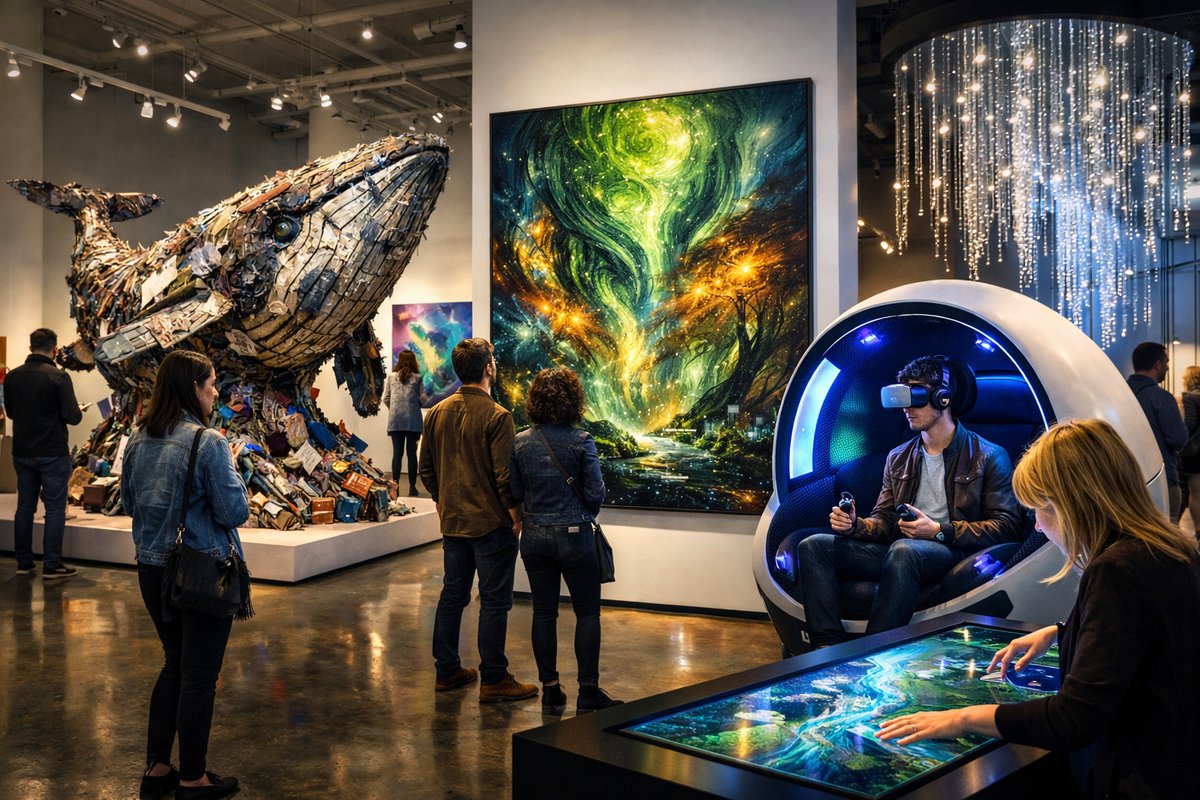

The city’s contemporary art museum has reopened its grand atrium for the latest international art biennale, and the atmosphere crackles with an electrifying blend of recycled sculpture, AI-generated imagery and immersive digital environments. This year’s edition emphasizes sustainable practice and interactive technology, inviting visitors to engage directly with works that interrogate our relationship to both the physical world and the expanding digital realm.
One of the biennale’s standout exhibits is a vast installation composed entirely of reclaimed plastic bottles woven into towering lattices that morph under shifting LED projections. Visitors step inside a pod at its center and trigger motion sensors that cast kaleidoscopic patterns across the structure’s interior surfaces. What began as an experiment in upcycled materials has become a multisensory meditation on consumption and regeneration, drawing crowds who pause to marvel at how discarded refuse can be reborn as luminous, dance-like architecture.
Around the corner, a cluster of eco-conscious painters have collaborated on a panoramic mural rendered with plant-based pigments on bio-canvas panels. The pigments-extracted from algae, beetroot, walnut husks and indigo leaves-yield a subtle, earthy palette that shifts tone as natural sunlight filters through the skylights. A touch-sensitive display nearby allows visitors to explore the chemical recipes behind each hue and even watch time-lapse footage of the pigments being distilled. This marriage of botanical science and studio practice echoes a growing desire for low-impact art materials that carry the poetry of their source.
Digital art finds its most immersive expression in a curtained alcove where wall-length VR projections envelop viewers in a virtual forest of floating geometric forms. Wearing lightweight headsets, participants navigate through clouds of color and sound, altering the visual landscape with hand gestures tracked by infrared cameras. A real-time audio-reactive engine translates movement into granular synth pulses, so every step, every wave of the arm, contributes to a personalized audiovisual composition. As critics note, this piece blurs the lines between audience and performer, turning each visitor into a co-creator of the evolving digital ecosystem.
Elsewhere, an AI-driven painter applies brushstrokes on large-scale canvases using a robotic arm guided by machine-learning algorithms. The software has been trained on centuries of art-historical imagery, from Renaissance frescoes to abstract expressionist swaths, and chooses color and form based on spectator feedback collected via touchscreen surveys. The resulting works possess an uncanny blend of familiar visual tropes and surprising quirks-hallmarks of algorithmic creativity. A live demonstration in the museum’s workshop area allows attendees to propose new styles, helping to shape the next generation of AI-generated expression.
A series of interdisciplinary workshops runs throughout the biennale, offering hands-on modules in eco-pigment extraction, projection mapping and beginner-friendly coding for interactive art. Participants gather around communal tables equipped with pipettes, glass beakers and hot plates to learn techniques for creating stable, non-toxic colorants from readily available plant matter. In parallel sessions, digital-makers experiment with pocket-sized projectors, mapping animated patterns onto sculptural forms and discovering how low-cost hardware can bring dynamic visuals to public spaces.
Curators emphasize that the biennale’s focus on sustainability and new media is not simply about novelty, but about forging resilient practices for the 21st century creative community. “Art institutions have a responsibility to model mindful production and circulation,” explains one organizer. “We’re demonstrating that ecological awareness and technological innovation aren’t opposing forces-they can propel one another forward.” The exhibition’s layout intentionally interweaves tactile, material-driven works with digital installations, prompting viewers to consider how analogue and virtual techniques can coexist rather than compete.
Despite the celebratory tone, some voices in the art world raise questions about the carbon footprint of advanced digital tools. High-powered projectors, VR headsets and server racks driving machine-learning models can consume significant energy. In response, the biennale has partnered with a local renewable-energy provider to power its digital venues with surplus wind and solar electricity. The initiative includes real-time energy-readout displays that track consumption per installation, making visible the hidden costs of immersive technologies and encouraging audiences to reflect on the broader environmental impact of digital culture.
Looking ahead, the biennale highlights emerging trends that promise to blur the boundaries between craft and code even further. Wearable light-sculpture outfits, 3D-printed ceramic tiles that respond to moisture and heat, and interactive AR murals triggered by smartphone cameras all signal a future in which the urban landscape itself becomes an open canvas. Artists envision public spaces animated by projection-mapped narratives that evolve with the seasons or community-driven data streams, fostering a more participatory model of cultural engagement.
As the biennale draws to a close, the museum’s director remarks on the event’s lasting legacy: a renewed appreciation for art as a site of experimentation, ecological stewardship and collective authorship. Visitors leave with their senses awakened by bold color, unexpected textures and the hum of electronic innovation. In this dynamic convergence of recycled materials and digital frontiers, art emerges not just as a mirror to society, but as an active force shaping how we envision-and inhabit-our shared tomorrow.
-
Standalone Drawing Tablet with No Computer Needed, 10 ...
Frunsi T11 is designed to be completely independent, allowing you to create, sketch, and design anywhere, anytime. Equipped with a stunning 10.1-inch Full HD ... -
Digital Drawing Tablet
Unleash your creativity with digital drawing tablets, perfect for artists and streamers. Explore animated assets and customizable tools for unique digital ... -
ABS Children's Educational Drawing Board Electronic ...
ABS Children's Educational Drawing Board Electronic Drawing Tablet ・ built-in battery provides up to 12 months of battery life ・ board (Set of 4) $45.99 $11. ...