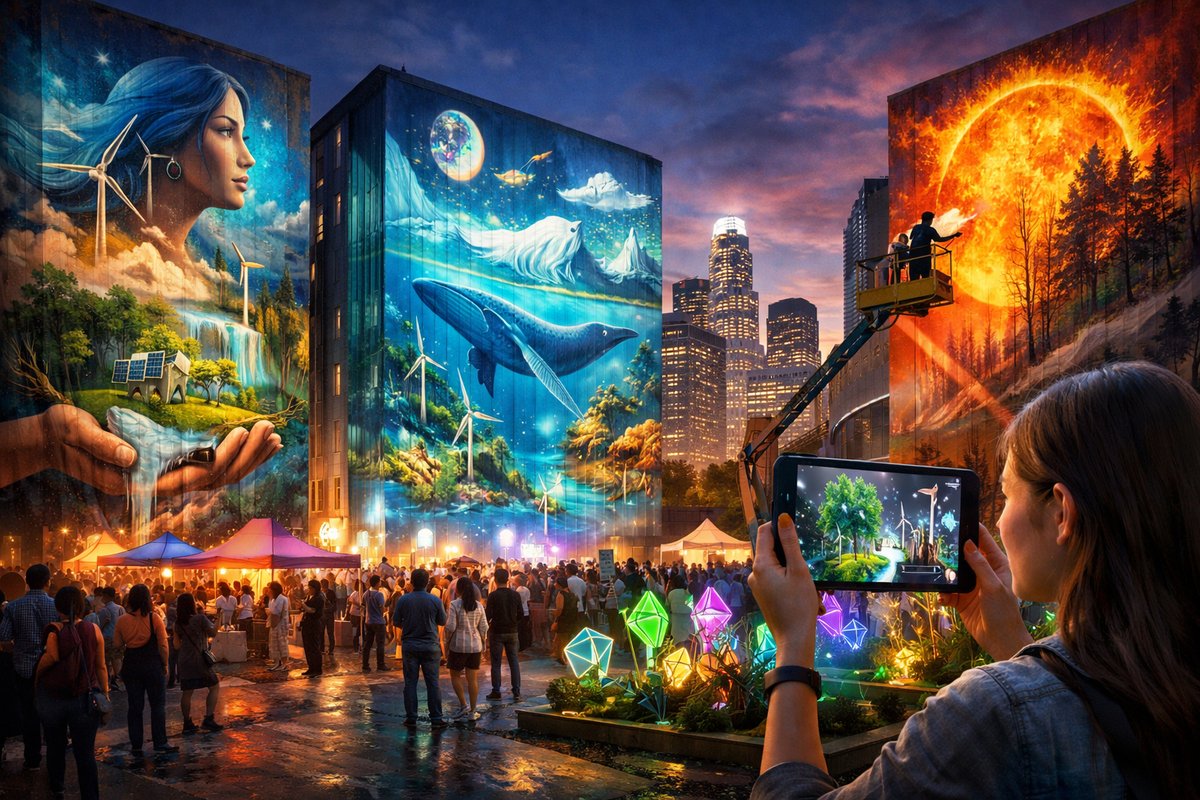

On a crisp evening beneath towering brick facades, hundreds gathered at the opening of the city’s first large-scale mural festival that fuses traditional spray-paint techniques with augmented reality and projection mapping. Neon stencils and hand-brushed lettering ripple across seven buildings in the historic arts district, while passersby scan QR codes to trigger hidden animations on their smartphones. The contagious energy feels part concert, part gallery tour-yet its beating heart is a commitment to sustainability and local collaboration.
The festival sprawls across three neighborhoods, each host to a unique thematic cluster. In one block, portraiture meets climate activism as faces carved with glazed pigments emerge from walls coated in heat-reflective primer. Just a few steps away, a pedestrian plaza transforms into a digital sandbox: visitors lace up lightweight AR glasses and watch virtual vines spiral up columns or reveal invisible narratives of past cityscapes. Organizers estimate that over forty installations will be active through late summer, complete with nightly soundscapes and guided routes.
A curator overseeing the event explains that every material was vetted for low toxicity and recyclability. “We wanted to dismantle the myth that street art is inherently wasteful,” she says. Paint suppliers were asked to submit certificates for water-based formulas, and leftover pigment gets reincorporated into community mosaic projects. Unused stencils and drop cloths have been repurposed by a local textile studio, while a pop-up repair bench mends artists’ spray cans and refillable markers.
Augmented reality anchors one of the festival’s most talked-about segments. As visitors follow a mural of twisting skyscraper silhouettes, a gray morning scene suddenly bursts into color when viewed through a compatible app. Leaves flourish on barren branches, and ghostly figures from archived news footage glide across the surface to dramatize environmental shifts. These digital layers pale gently into the painted scene, offering an ephemeral counterpoint to the static wall below.
Digital graffiti applications have drawn a younger crowd eager to tag virtual surfaces without the legal risk of trespassing. Using tablets or smartphones loaded with a custom mapping interface, amateurs and pros alike can draw in mid-air, leaving ephemeral strokes that glow against nighttime facades. Some even tap into generative AI filters that transform simple shapes into complex fractals or organic patterns. The result is a collaborative tapestry that evolves each evening, then resets at dawn to make room for fresh contributions.
A driving force behind the festival is a focus on eco-charging materials. Artists experimented with recycled canvases scavenged from shipping crates, applying paints free of volatile organic compounds and integrating plant-based binders. When an installation concludes, leftover swatches are donated to a woodworking collective that crafts them into handbags and upholstery. By closing the loop on raw materials, the festival positions itself as a blueprint for greener creative practices.
Projection mapping offers another layer of intrigue. One installation splashes dynamic geometry across a century-old bank building, its arched windows mapped with kaleidoscopic bursts of color that respond to ambient sound. A motion sensor captures footsteps below and triggers ripples in the animation, creating a playful feedback loop between spectator and façade. At night, the building becomes a living canvas, its rust-stained exterior cast aside in favor of a choreographed light ballet.
Beyond street art, the event includes a design bazaar in a repurposed warehouse once devoted to textile manufacturing. Generative furniture prototypes sit alongside biodegradable lighting fixtures and 3D-printed pottery made from clay-infused bioplastic. Designers demonstrate how parametric modeling can optimize material usage and create organically curving tables or modular shelving that snaps together without hardware. Passersby can test ergonomic seating pods or examine lamp shades printed layer by layer into translucent forms.
Workshops scattered throughout the festival aim to demystify digital tools. In one open studio, a pro digital illustrator guides participants through basic drawing techniques on a portable pen display. Attendees trace over scanned photos to learn line work, then switch to a layering feature that lets them add shadows and highlights with a digital brush set. Nearby, a VR painting booth invites curious onlookers to don headsets and sketch in three-dimensional space, watching brushstrokes swirl around them as they work.
Local maker spaces have also pitched in, offering small-batch 3D printers for melange casting demos. Clay-like filaments extrude into architectural models or sculptural forms over several hours, showcasing an alternative to handcrafted pottery. Since filaments can be soil-mapped for composting, these pieces fit neatly into the festival’s circular-economy ethos. Attendees leave with miniature keepsakes that dissolve harmlessly when buried in garden soil.
Community engagement remains a central pillar throughout the ten-day run. Each evening features pop-up food stalls helmed by neighborhood vendors, alongside live painting sessions where attendees can sketch alongside visiting muralists. Youth programs bring students to watch professional teams work, then try hands-on techniques under guided supervision. Organizers note a surge in local enrollment at after-school arts programs, attributing it to the excitement generated by public demonstrations of scale and innovation.
Economic data released by the festival’s grants office forecasts a modest tourism uptick. Hotel bookings in the arts district edged up by twenty-percent compared to the same period last year, and nearby cafés report a sustained jump in foot traffic. While exact figures vary by business, many attribute renewed interest to Instagrammable installations and word-of-mouth buzz. Planners hope that this initial surge will seed long-term partnerships between cultural institutions and local entrepreneurs.
Looking ahead, the festival’s curators envision a transdisciplinary platform that blurs boundaries between art, design, architecture and technology. Future iterations may introduce interactive street furniture equipped with environmental sensors, or host pop-up labs where neural-network experiments inform mural sketches in real time. Conversations with city planners are already underway to secure additional walls and adapt public-safety guidelines for nocturnal AR activations.
In its inaugural run, the mural festival has proven that a city’s fabric can be rewoven through imagination, tech and sustainable practice. Passersby no longer see static brick surfaces but dynamic interfaces that respond to light, sound and touch. As public art embraces its digital dimension, this event offers a vivid preview of how creativity and curiosity can converge to shape the urban experience in years to come.
-
Huion GT1562 15.6" 4K UHD Graphics Drawing Tablet ... - Walmart
XPPen Artist Ultra 16 4K OLED Touchscreen Drawing Tablet 15.6" Drawing Monitor with 99% Adobe RGB Dual 16K Pen Pressure Styli Mini Keydial 1.07 Billion ... -
Vtuber Drawing Tablet Asset | Wacom Cintiq (pack 2) - Etsy - Etsy
This Digital Drawings & Illustrations item by LemonStxDesign has 438 favorites from Etsy shoppers. Ships from United States. Listed on Aug 3, 2026. -
ABS Children's Educational Drawing Board Electronic Drawing Tablet
You'll love the Miuer ABS Children's Educational Drawing Board Electronic Drawing Tablet at Wayfair - Great Deals on all products with Free Shipping on most ...