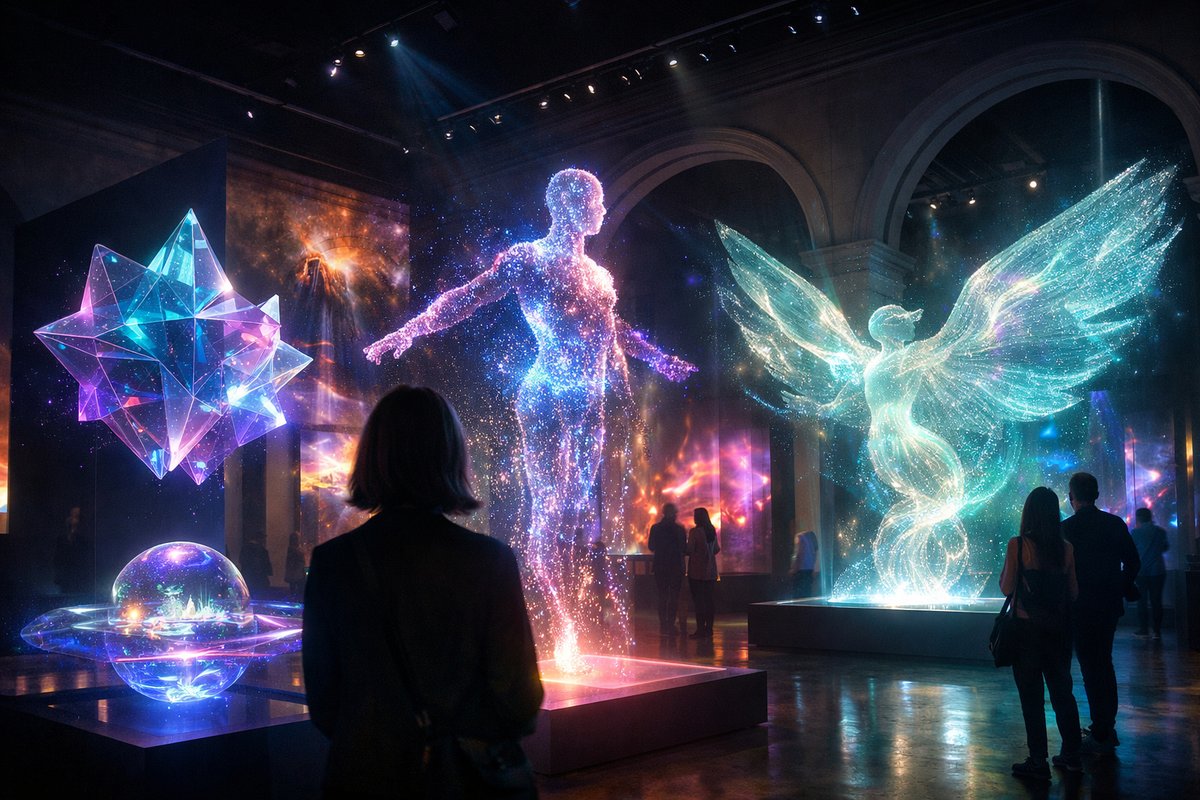

In a dimly lit gallery, viewers find themselves surrounded by floating shapes that seem to materialize out of thin air. A sequence of translucent ribbons spirals down from the ceiling. Nearby, a crystalline structure shimmers as if drenched in moonlight. These captivating apparitions are not traditional sculptures carved from marble or cast in bronze. They are holographic projections driven by arrays of LEDs, fans spinning at high speed, and complex light-field rendering engines that refract pixels into three-dimensional illusions. This emerging genre of holographic art is captivating collectors, curators, and curious passersby, and it may be the next frontier in the evolution of exhibition design.
At the heart of these installations lies the marriage of hardware and software. Holographic display fans weave blades of light in rapid motion to create volumetric images visible from a range of angles. Projection-mapping systems adapt content to architectural surfaces, wrapping stairwells and columns in shifting patterns that morph with each passing second. Light-field displays, long coveted by research labs and immersive experience designers, are finally entering public venues thanks to shrinking component sizes and plummeting costs. Together, these tools allow artists to sculpt pure luminosity, moving beyond two-dimensional canvases into spatial compositions that behave like living organisms.
One recent showing in a major European museum saw a corridor transformed into a phantasmagoria of geometric forms. Attendees reported feeling as if they could step through the walls into another realm. Interactive sensors tracked hand movements, causing delicate tendrils of light to coil around outstretched fingers. In a quiet alcove, an AI-driven hologram responded to ambient noise, aglow with color shifts that echoed the murmurs of the crowd. These developments signal a shift in exhibition philosophy: galleries are no longer static stages for framed works but dynamic environments that invite exploration and play.
Artists experimenting with holography and projection mapping are drawing from a wide range of influences. The discipline borrows from video game design, leveraging real-time rendering engines usually reserved for virtual worlds. It taps into robotics and electronics to choreograph moving parts that breathe life into each installation. And it embraces principles of theatrical stagecraft, using dramatic lighting and spatial audio to guide emotional resonance. By remixing techniques across fields, creators are forging new languages of light and motion, challenging audiences to reconsider what constitutes a sculpture or a performance.
The process of realizing a holographic sculpture often begins with a 3D scan or a photogrammetry session that captures the contours of a physical object. Artists can scan organic shapes-like a gnarled branch or a weathered stone-and then translate that geometry into digital assets. From there, they experiment with shaders that modulate opacity, texture, and color gradients. Software suites for projection mapping enable content to align precisely with irregular surfaces, correcting for keystone distortion and ensuring crisp images even on curved walls. Finally, hardware controllers synchronize LED clusters, fans, and motion sensors, weaving content into a seamless illusion that responds to human presence.
Beyond technical prowess, the allure of holographic installations rests in their ephemeral quality. Unlike a bronze statue or a painted canvas, a hologram can disappear at the click of a button, replaced by an entirely new tableau. This malleability invites an open-ended approach to curation. A single gallery space can host multiple exhibitions in rapid succession, each sculpted from the same set of light engines but configured to convey distinct narratives. For museum directors facing spatial constraints or budget pressures, this represents an efficient path to diversify programming and attract repeat visitors.
Yet the rapid integration of holographic art in public venues brings new challenges. Maintaining specialized hardware requires technical teams versed in electronics, software updates, and optical calibration. Ensuring consistent performance across multiple sessions can be tricky when ambient temperature, humidity, or power fluctuations affect delicate components. Some institutions have started collaborating with engineering firms to establish dedicated maintenance plans. Others are experimenting with portable kits that can be shipped, installed, and configured on site, reducing the need for permanent infrastructure.
Equally critical is the question of authorship and preservation. When a holographic piece lives predominantly in code and data files, who owns the rights to duplicate or modify it? How does a curator archive an installation that relies on a specific generation of LED modules or a particular firmware version? Digital artists are exploring version control systems and blockchain-based provenance tools to timestamp each configuration. Meanwhile, archival scientists are developing protocols to capture high-fidelity snapshots of holographic works, storing both the raw geometry and the dynamic code that drives interactivity.
Despite the hurdles, the creative possibilities are invigorating. In community art centers, children are using simplified projection kits to layer fantastical creatures onto playground walls. At design schools, students collaborate with computer science classes to write custom interactive scripts that trigger soundscapes as viewers approach a podium. Urban art festivals have begun to map entire city blocks with light-field canvases, repurposing vacant buildings into temporary floating murals. These experiments signal a democratization of holographic tools, moving beyond elite institutions into grassroots settings where the technology can spark fresh dialogues about public space and visual culture.
Beyond the gallery, fashion designers and product stylists are also investigating holographic visualization. Runway shows have featured models draped in digital garments only visible through projection mapping on translucent fabrics. Retail environments are testing holographic window displays that adapt promotions based on pedestrian foot traffic. Even performing arts companies are trialing holographic backdrops that can shift scenery in real time, replacing cumbersome set pieces with agile virtual environments.
As the price of hardware continues to fall and open-source mapping libraries become more robust, it seems likely that holographic art will move from novelty to mainstream. Creativity will take shape at the intersection of light, data, and interactivity. Physical galleries will transform into hybrid theaters, where audiences co-create the artwork simply by moving through the space. Designers will experiment with modular projection rigs that can be reconfigured like building blocks. And new forms of digital-physical collaboration will emerge, blurring the line between maker and spectator.
For artists and curators keen to explore this frontier, the journey begins with familiar tools from the world of digital creation. A wireless drawing tablet can serve as a sketchpad for holographic forms. A portable mini projector helps test mapping ideas on the go. A depth-sensing 3D camera captures objects and spaces for rapid prototyping. With these building blocks in hand, creators can begin to imagine sculptural light works that evolve with each viewer’s unique presence.
In reshaping how we perceive space, holographic art challenges the very definition of an object. It asks us to embrace impermanence, to delight in shifting perspectives, and to recognize that the museum of the future may be less a hall of relics than a living grid of luminous apparitions. As more artists and institutions venture into this terrain, one thing becomes clear: the boundaries between art, design, and technology are dissolving, and from that convergence comes an entirely new vocabulary of light.
The phantom galleries rising around the world invite us not just to observe but to participate. They beckon us to step into the void, where matter gives way to pixels and every reflection becomes a canvas. For those ready to cross the threshold, the next exhibition may not hang on a wall-it may ripple through the air, waiting to be shaped by a single gesture or word. In this unfolding era of holographic expression, the future of art is no longer fixed. It lives in the glow of possibility.
-
Taysing LED Spot Light Indoor Little Mini Spotlight Accent ... - eBay
【Comfortable & Bright Illumination】Each display lights has 1.5 Watt,100 lumens and 6.6ft length cord.Soft White 3000K,with a Color Rendering Index of 85RA, ... -
YG-300 LED Mini Projector Used-good Work - Etsy
A Diy Assembled 9.7inch 2K IPS Touch Portable Monitor Display Screen Modified from iPad Screen with mini HDMI & USB Type C signal input port. $119.99 ... -
Koluxhome Tech Mini Projector 1080p Portable Projector ... - Wayfair
Mini Projector 1080p Portable Projector, Compatible With Ios/android/ Windows/tv/hdmi/usb Black. ByKoluxhome Tech. 4.2. Rated 4.2 out of 5 stars. 25 Reviews.