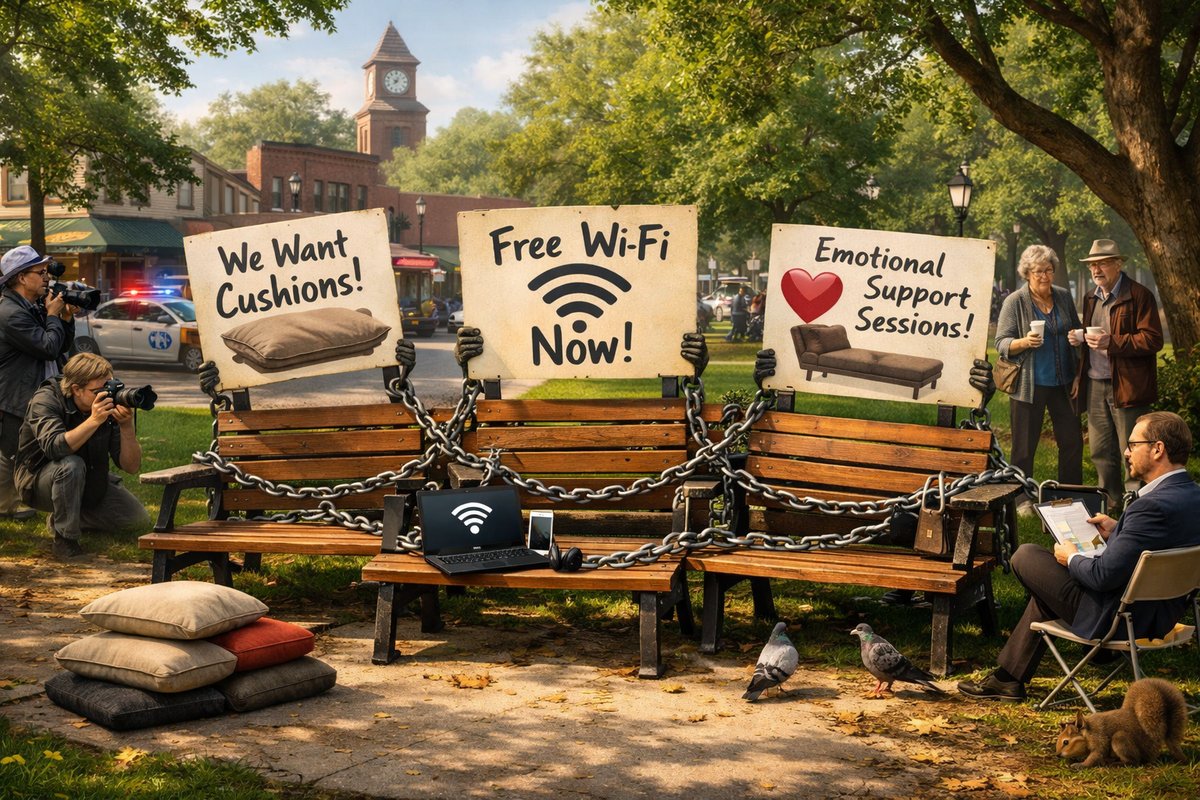

At dawn on a particularly crisp Monday, 27 park benches stationed along Pine Street mysteriously clasped metal chains around their slats and locked themselves together in a protest that has stunned the entire town. Laminated demands fluttered in the breeze: “Cushion the Situation,” “Wi-Fi Now or Forever Hold Your Peace” and “Emotional Support-Because Sitting Is Hard.” The benches, bedecked with protest banners in faded pastels, have effectively immobilized foot traffic, stroller traffic and the occasional squirrel commute.
Local residents emerged bleary-eyed to find their weekend strolls turned into a labyrinth of teak, oak and reclaimed pine. One grandmother, juggling two grocery bags and a skeptical frown, paused at the blockade. “I just wanted to feed the pigeons,” she muttered, leafing through a bench’s demand manifesto as if deciding on a new streaming series. Instead of melon-chocolate chip cookie recipes, she found bullet points outlining a call for solar-powered phone chargers and monthly jam sessions led by a touring ukulele instructor.
Town officials convened an emergency meeting in City Hall’s wood-paneled chamber, where the mayor, flanked by public works and a volunteer landscape architect, addressed the crisis with surprising gravitas. “We never imagined a bench would unionize,” she confessed, adjusting her spectacles. “But now that they have, we must negotiate in good faith.” Scraps of wax paper and leftover donut crumbs littered the lectern as she scrolled through photos of benches wearing jaunty protest bandanas-some polka-dotted, others swathed in neon stripes.
With the press pack buzzing like overcaffeinated bees, a spokesperson for the Bench Coalition-Chair Number Seven-emerged to read a prepared statement. His voice, a gravelly rasp that suggested years of holding midnight vigils for sleeping children, rasped into the microphone: “We have held our peace. Now we demand plush foam seating that conforms to the human posterior, on-demand Wi-Fi strong enough to stream three videos simultaneously, and a weekly half-hour session of communal bench-side singing. It is only fair.” He closed his eyes and swayed slightly, prompting scattered applause from the assembled journalists.
Within hours, benches across town began to tune in. A cozy elm-shaded bench in front of the library unfurled a miniature flag reading “Sofa Not Sorry.” A sleek metal bench outside the coffee shop stitched its own sign: “We Need Spa-Day Footrests.” Even the decorative curved bench by the fountain-long celebrated for its sculptural grace-posted a demand for “Artistic Recognition and Occasional Cappuccino Deliveries.”
The town’s pigeons, long accustomed to commandeering benches, found themselves at a loss. One enterprising pigeon attempted to perch on the protest chain, only to be gently nudged off by a wooden plank wearing a determined expression carved into its grain. Soon, the avian community released a hasty pigeon-gram stating that they refused to take sides, though several birds were seen drafting their own list of grievances: “Cleaner surfaces,” “Levelling the power dynamic,” and “Guaranteed landing pads.”
To broker peace, the mayor enlisted a mediator of renown: a distinguished Adirondack chair famed for resolving disputes between backyard lawn ornaments. The Adirondack chair arrived wearing a small bow tie and carrying a polished clipboard. With measured cadence, he inspected the protest line and declared, “I understand your plight. But let us remember the beauty of collaboration. We must cushion your expectations while balancing fiscal reality.” He inhaled deeply, as if readying himself to direct a Shakespearean soliloquy.
Negotiations unfolded like a slow-motion opera. Benches insisted foam cushions with water-resistant covers and built-in USB ports. Officials countered with promises to install foam-padded seats on every third bench and to pilot a solar-charging module atop the fountain. The Adirondack chair brokered smaller agreements: acoustic paneling on bus stops, occasional hot-beverage delivery drones hovering nearby, and a commitment to test a one-hour “Cushion Break” every Tuesday.
Furious locals, trapped on either side of the blockade, chimed in on community forums. One disgruntled toddler typed with sticky fingers: “I can’t slide down the slide because I can’t pass the benches.” A retiree demanded immediate bench therapy sessions, arguing that the benches needed emotional validation just as much as humans did. Comments ranged from poetic odes to casualty reports-one bicyclist described colliding head-long into a bench chain and experiencing an existential crisis.
As the drama played out, social media erupted. Hashtags like #BenchPressYourRights and #SitDownAndListen trended nationwide. Influencers live-streamed themselves attempting to negotiate with benches, only to be rebuffed by cold steel chains and impassive planks. A podcaster published a serialized audio drama called The Bench Rebellion, complete with bench-appropriate sound effects: distant wood creaks, soft sighs, and echoing metal clinks.
Meanwhile, the benches maintained strict nonviolence. One carefully lettered sign read, “No Bench Left Behind,” while another declared, “We’ll Keep Sitting Until You’re Knitting.” Yoga mats were laid out before the blockade for supporters wishing to meditate on ergonomics. A bench-sized banner quoted a philosopher (likely misattributed): “To sit well is to live well.”
On the third day of the protest, a breakthrough emerged when the LEGO club at the local community center built a miniature scale model of Pine Street. They demonstrated a prototype bench cushion infused with recyclable memory foam, complete with mock-Wi-Fi antennas made from toothpicks. The benches examined the model with silent scrutiny. After a lengthy deliberation that involved leaning back and forth, they tapped out an approval code: two light taps followed by a soft creak.
Under the glow of streetlamps, the mayor signed the Pine Street Bench Accord. Key provisions included: allocation of budget for full-length cushions on 80% of benches, installation of three solar Wi-Fi charging stations, and a twicemonthly “Bench-Side Serenade” featuring local ukulele artists. In return, the benches promised to dissolve their chains and reopen Pine Street to the public.
The morning after the accord took effect, citizens arrived to find benches gently unlocked, their protest banners replaced with soft cushions in cream and teal. A lone laminated poster announced the first Bench-Side Serenade that evening at 6 p.m. Townsfolk gathered with picnic blankets, mugs of herbal tea and small percussion instruments. As the ukulele instructor strummed the opening chord, benches seemed to hum in contentment-a chorus of wooden slats aligning in perfect harmony.
Residents lauded the accord as a triumph of empathy and collaboration. The mayor declared, “Today we prove that regardless of species-or species of wood-our community thrives when every voice is heard.” The Adirondack chair, concluding his memento mori address, reminded all to “take a seat, embrace comfort, and listen to the stories our furniture has to tell.”
Yet skeptics warned that the accord might merely be the calm before the next protest. Already, rumors swirl that the town’s picnic tables are drafting a joint statement on ergonomic injustices. Library chairs are reportedly discussing unionizing alongside the benches. And somewhere in a shadowy workshop, a group of ambitious chaise lounges is plotting a midnight sit-in demanding built-in cup holders and mood lighting.
For now, Pine Street stands adorned with cushioned benches radiating soft afternoon sunbeams. Shoppers pause to rest, parents perch while reading bedtime stories on their phones and teenagers giggle in clusters, testing the new USB ports. Somewhere a pigeon hops onto a bench, contemplates its reflection in a phone screen, then flies off in silent satisfaction.
In the end, this may go down as the day that benches taught a small town the art of sitting down and standing up for themselves-literally and figuratively. And as long as cushions hold firm and Wi-Fi routers hum, Greenhaven’s residents will have a new understanding of the humble bench: not just a place to rest, but a daring rebel demanding comfort, connectivity and a song in every seat.
-
Water Resistant Bench Cushion, 50+ Colors - Etsy
Custom Patio Cushion Set, Water Resistant Outdoor Furniture Seat Cushion. -
Outdoor Bench Cushions - Wayfair
Outdoor Chair Seat Cushions,Water-Resistant Patio Chair Cushions With Handle And Non-Slip Bottom. (Set of 2). By Latitude Run®. 19" W x 19" D, Navy. ( ... -
GENEVERSE 100 Watts SolarPower One Monocrystalline Portable ...
Buy GENEVERSE 100 Watts SolarPower One Monocrystalline Portable Solar Panel with built-in USB-C and USB-A ports at Walmart.com.