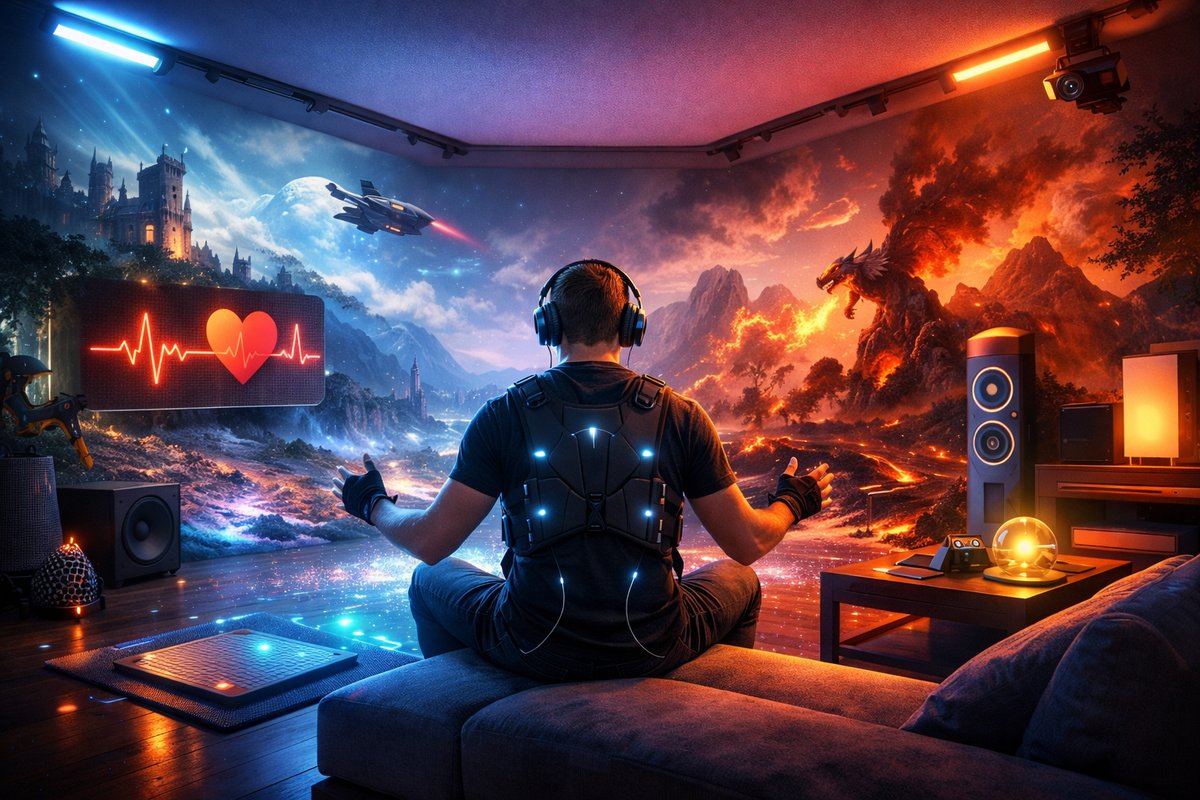

Walk into a dimmed living room as controllers hum to life and your haptic feedback vest warms across your chest. The moment you press start, sensors in the floor awaken, LED strips along the baseboards shift from cool blue to pulse in sync with your avatar’s heartbeat. This is not a sci-fi concept but the edge of modern home entertainment, where hardware and décor combine to blur the borders between player and game.
Once confined to bulky consoles and flat screens, play spaces are now arenas of full-body integration. Wearable haptic devices-vests, gloves, even headbands-translate in-game events into physical sensations. A chest-mounted vest delivers a soft pressure when your character takes cover; gloves vibrate with each spell cast; a specialized headband pulses gently to signal incoming threats. These tactile cues heighten immersion and sharpen reaction times, allowing players to navigate virtual worlds through both sight and touch.
Augmented reality walls bring digital landscapes into our homes without heavy headsets. Ultra-short-throw 4K projectors bounce life-size forests or starships onto blank surfaces, transforming a cramped apartment into a sprawling battlefield or alien outpost. Real-time room-mapping sensors detect furniture edges, recalibrating projection to avoid obstacles and maintain seamless visuals. Paired with directional speakers placed in hidden corners, audio appears to come from within the scene itself, whether it’s the crunch of gravel underfoot or the distant roar of an oncoming mech.
Lighting has become a dynamic player in its own right. Smart LED strips and panels react to soundtracks, flashing in time with gunfire or shifting hues to match a protagonist’s emotional arc. Some setups leverage overhead light banks equipped with motorized color filters, bathing the room in red when enemies swarm or bathing you in serene greens during exploration. This ambient feedback heightens emotional resonance, turning game moments into cinematic events.
Spatial audio pods deliver on-ear cues so precise you can pinpoint approaching adversaries by rustling leaves or the faintest footstep. Unlike traditional surround-sound systems, these beamforming speakers track your movement, maintaining consistent sound positioning even as you turn or duck. Paired with real-time voice modulation, multiplayer sessions feel less like chats over headsets and more like characters conversing across the dining table.
Smart microphones and AI-driven voice assistants are also joining the playfield. Whisper a command and the room responds-switch to stealth mode, lower the ambient soundtrack, or activate in-game mapping overlays projected on nearby walls. A single phrase can trigger camera drones (motion sensors repurposed as live-streaming cams), flipping from gameplay view to player reaction shots for those watching online. This live-director functionality makes every session a potential broadcast event without intrusive hardware setups.
For tabletop and roleplaying fanatics, hybrid digital boards bring hand-drawn maps to life. Magnetic tiles embedded with tiny NFC chips trigger holographic tokens or animated terrain on a companion tablet. Players place miniature figures on a wooden board, and the app translates their positions into a shared virtual map, complete with fog-of-war and dynamic weather effects. Dungeon masters can tweak encounters on the fly, tapping touchscreens to spawn new traps or alter lighting based on the narrative.
Social play is evolving beyond split-screen co-op or voice chat. Cloud-anchored lobbies let friends drop in as holographic avatars that appear on AR-ready walls, offering a presence far more personal than floating usernames. One player might be driving a virtual sports car in their garage, while another duels on a projected coliseum floor elsewhere. Yet both feel collocated, sharing gestures through hand-tracking cameras and exchanging high-fives via synchronized haptic gloves.
But this next wave of play brings challenges. The cost of modular gear can climb rapidly, and integrating multiple systems demands tech savviness. Privacy concerns surface when rooms are bristling with microphones and cameras-who owns that data, and how securely is it stored? Power consumption also spikes, prompting some enthusiasts to explore energy-efficient LED alternatives and power-management hubs that shut down idle components when not in use.
DIY solutions are rising to meet these hurdles. Hobbyists repurpose ambient lighting panels from streaming setups, retrofit old game controllers with haptic motors, or hack open-source room-mapping sensors originally designed for robotics. Online communities share wiring schematics for custom projector mounts, and local makerspaces offer workshops on soldering and voice-recognition integration. This spirit of curiosity turns every playroom into a living laboratory, where sustainability and resourcefulness matter as much as raw horsepower.
Beyond tech, emotional intelligence is carving its place in immersive setups. Some systems track facial expressions or heart rate variability to adjust difficulty or narrative tone on the fly. A horror game might dial back jump-scares if your pulse spikes too high, or a moral-choice RPG might respond to your micro-expressions, altering dialogue to keep you on edge. These feedback loops transform games into empathetic experiences, bridging the gap between algorithmic programming and human nuance.
Designers and researchers are exploring scent diffusers that release pine, ozone, or burning embers to pull players deeper into virtual forests or battlefield barracks. Temperature-controlled vents mimic a chill along a mountain summit or warm gusts in a desert wasteland. While still experimental, these environmental add-ons herald a future where every sense becomes a controller.
As playrooms grow more complex, the role of curation becomes vital. Enthusiasts recommend modular kits over monolithic all-in-ones, allowing each component to evolve independently. Swappable haptic modules, upgradeable projection lenses, and cloud-connected sound profiles ensure your setup can adapt to new titles and tech standards without a complete overhaul.
Today’s next-gen setups aren’t just about raw immersion; they’re about crafting emotional journeys, fostering social ties, and maintaining sustainable practices. Whether you’re a solo streamer, a weekend RPG party host, or a competitive gamer seeking every edge, the playroom of tomorrow weaves together wearables, AR projections, adaptive lighting, and AI-driven audio into a cohesive tapestry. The result is a personalized multisensory playground, where every corner holds a surprise and every session is a new frontier.
Get ready to leave behind the static rectangle of the television and step into a space where walls reshape themselves, controllers speak your body language, and games adapt to your emotions. The future of play is no longer confined to screens-it’s woven into the very fabric of our surroundings, inviting us to explore, connect, and feel every moment as if we’ve truly crossed the threshold of another world.