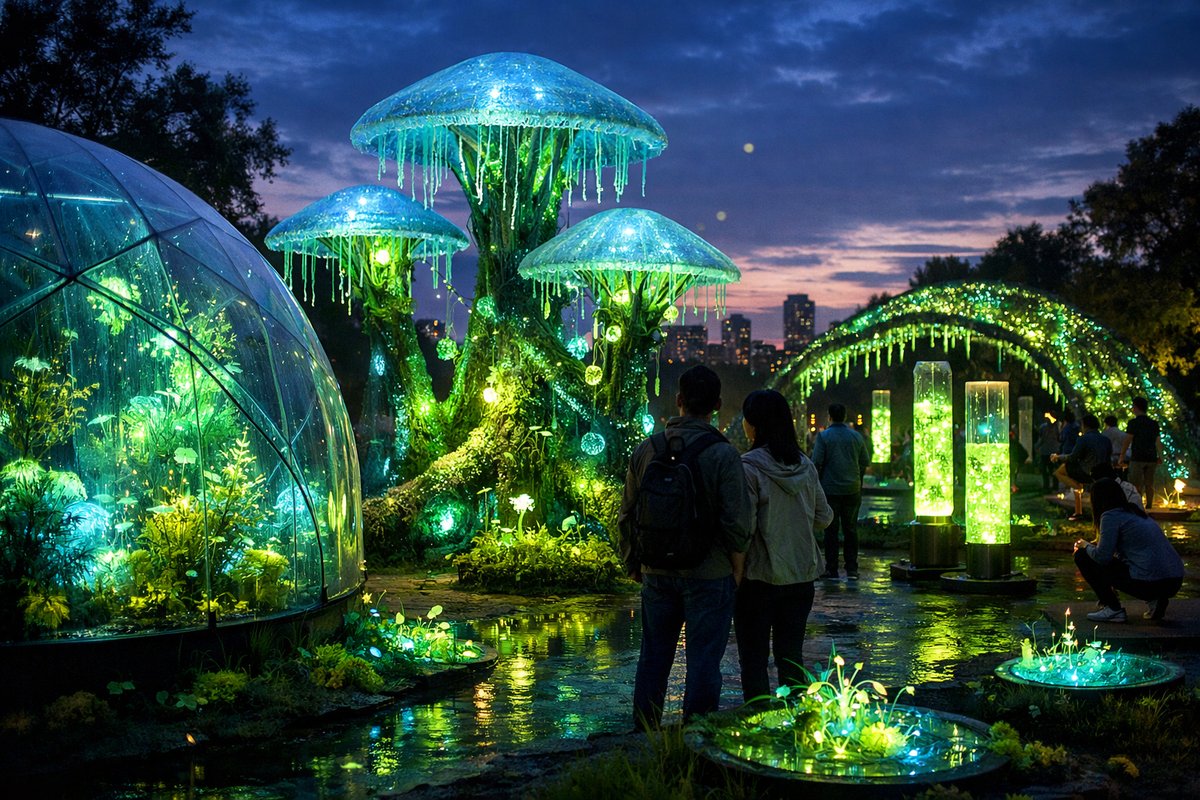

Across plazas and waterfront promenades, gentle pools of green and blue light now pulse from clusters of organic sculptures that seem alive in more ways than one. These are not LED arrays or painted fiberglass forms but living installations grown from mushrooms, algae, and genetically edited bioluminescent bacteria. As dusk falls, their glow draws curious walkers, families, and photographers into a new experience where art, ecology, and technology intersect. The phenomenon speaks to a broader shift in design thinking-where materials are not inert, but dynamic partners in telling stories about sustainability and emergence.
In a recent pilot project in a mid-sized European city, a team of designers and synthetic biologists collaborated to seed a concrete pavilion with ponds of glowing algae. Visitors are invited to dip their hands into the shallow water and watch the microbes light up in response to touch. The installation uses harmless species of dinoflagellates housed in micro-encapsulated beads. As people move through the pavilion, the collective bioluminescent patterns shift and fade, only to regenerate after a nightly rest. The effect is at once playful and poetic, reminding observers that even in urban settings, living systems can remain resilient and responsive.
The underlying technology draws on decades of research in genetic engineering and microbiology. Scientist-artists can now splice genes from firefly luciferase enzymes into common microorganisms, tuning the brightness and hue of the glow. Algae species have been optimized to thrive on minimal nutrients, capturing ambient carbon and releasing oxygen while they shine. Meanwhile, mycelium networks-fungal threads that weave through soil and substrate-are being explored for their ability to form lightweight, biodegradable structures. Once inoculated with glowing bacteria, these lattices become walk-through lanterns that pulse like heartbeats when sensors detect human presence.
For art and design communities, these living works open questions of authorship, time, and care. A static sculpture can be cast, shipped, and installed, but a living installation requires ongoing monitoring of temperature, pH levels, and nutrient balance. Bio-artists have established open labs where visitors can learn to maintain cultures, take home small vials, and experiment safely. Workshops teach participants how to plate agar, swab bioluminescent cells, and document their growth cycles. In this way, the work extends beyond gallery walls into makerspaces, where novices find themselves co-creators in a continuously evolving tableau.
Sustainability has become more than a buzzword-it’s a guiding principle. Traditional stage lighting can consume thousands of watts; bioluminescent exhibits often run on solar panels or low-energy circuits, reducing carbon footprints. After an exhibition ends, the organic scaffolding can be composted or returned to a controlled environment that seeds future projects. In addition to minimizing waste, these practices foreground the life cycles inherent in all design choices, urging viewers to consider the invisible ecosystems that support our modern lives.
Yet blending art and living materials raises ethical and regulatory challenges. Local authorities must approve permits for open-air bio-installations, ensuring that engineered organisms do not escape into sensitive habitats. Safety protocols borrowed from microbiology labs-such as sealed containers and sterilization procedures-are adapted for public interaction. Artists often design multiple containment layers: bioplastic membranes, UV-filtered enclosures, and fail-safe kill switches that trigger a chemical agent to neutralize microbes if sensors detect an anomaly.
The aesthetics of bioluminescent art also shift conventional ideas of permanence. These works peak in luminosity for days or weeks, then dim as cultures age. Some artists embrace this ephemerality, documenting each fade and regrowth as part of the narrative. Urban viewers come back night after night to see the dim spots brighten again, turning a sculpture into a communal ritual rather than a static object. The once-permanent craving for monumental bronze or marble yields to an appreciation of flux and renewal, a metaphor for how cities must adapt to climate uncertainty.
Institutional support is growing. Major museums have begun acquiring controlled bioluminescent ecosystems for their living collections, alongside snow leopards and Bonsai trees. Foundations dedicated to environmental art award residencies that pair scientists with emerging designers. Even municipal parks departments commission nightly “glow trails” that guide joggers and strollers under footbridges coated in bioluminescent paint derived from algae cultures. The result is a new nightscape where wayfinding merges with wonder, inviting deeper conversations about light pollution, urban wildlife, and community stewardship.
For designers eager to jump in, collaboration with biologists is key. Resources such as open-source gene sequences, community lab spaces, and step-by-step protocols are available online. Many start with small living sculptures in home studios-seed trays of glowing moss, petri dishes illuminated by engineered yeast. From there, they scale up to wood-framed installations with enclosed humidifiers that maintain ideal growth conditions. Portfolio builders stress comprehensive documentation: time-lapse videos of microbial blossoming, sensor logs of light intensity, and written reflections on unexpected microbial behaviors.
Public reactions range from delight to caution. Children laugh as bacterial populations ripple under their fingertips, while older visitors sometimes ask: “Is this safe?” Transparent signage, interactive video kiosks, and on-site stewards explain the science and demystify the processes. The more people understand that these organisms pose no threat-specially engineered with safety locks-they engage more deeply with the questions the art raises about coexistence and care.
Looking forward, bioluminescent art could extend beyond public squares into architecture, fashion, and even product design. Imagine façade panels of living organisms that glow in response to air quality, or clothing that lights up in step with a wearer’s heartbeat. Collaborations between textile designers and microbiologists have already produced glowing fabric prototypes, stirring visions of self-illuminating signage and wayfinding in off-grid settings.
As these living forms seed our urban landscapes, they carry deeper lessons about the interconnectedness of design, technology, and ecology. By inviting us to touch, nurture, and observe, they remind us that creativity need not be extractive or static. It can grow, breathe, and evolve alongside the living world. The next time you wander under a glowing canopy of fungal arches or peer into an aquarium of softly pulsing algae, consider: art has become a living dialogue, and light itself can grow.
Next Steps in This Garden of Light: Artists, urban planners, and curious citizens can dive deeper by visiting local bio-art residencies or attending community lab workshops. If you’re inspired to cultivate your own luminous ecosystem, start small, document every step, and build a network of mentors who can guide you through the delicate balance of life, light, and design.