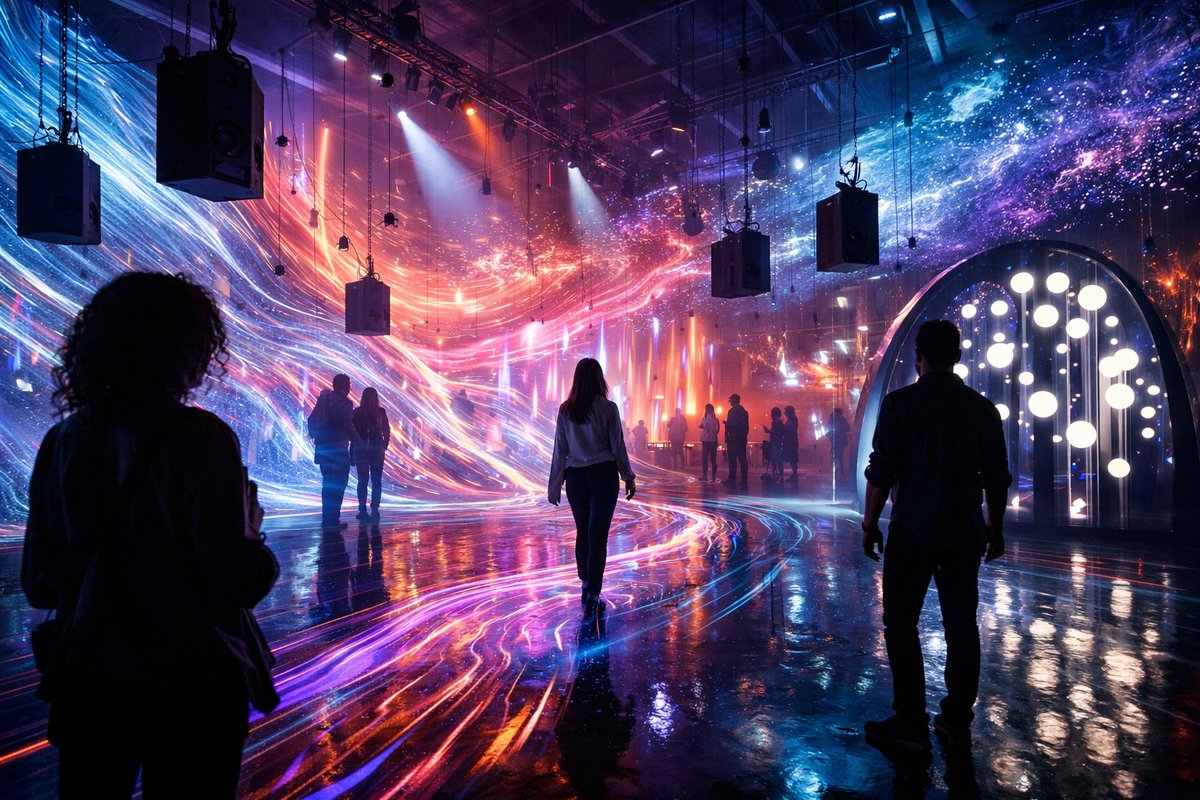

The art world is undergoing a sensory evolution as creators blend immersive audio and dynamic visuals to engineer spaces that speak to multiple senses at once. Installations no longer rely solely on static forms or linear narratives. Instead artists are building environments where sound shapes light patterns, motion triggers audio shifts and visitors step inside structures that pulse, resonate and transform in response to presence. This convergence of sight and sound is emerging across galleries, warehouses and public plazas, marking a new chapter in experiential art where boundaries between medium and message dissolve.
Last autumn in Los Angeles, a pavilion devoted to multi-sensory art drew lines around the block. Inside, floor-to-ceiling screens displayed generative graphics that swirled and fragmented according to ambient noise levels. A network of microphones and motion sensors fed data into custom software, allowing every footstep and whispered conversation to sculpt the visual tapestry. Attendees described the effect as both surreal and deeply personal, noting that the shifting forms felt like reflections of their own presence within the space.
Behind these works sits an array of technologies once reserved for high-end research labs. Depth cameras, lidar units and infrared motion trackers map visitor movement. Spatial audio arrays deliver focused sound beams that can envelop one corner without bleeding into another. On the visual side, projection mapping toolkits and high-resolution LED walls enable artists to drape complex geometry across irregular surfaces. Open-source frameworks for generative design allow real-time interaction between audio inputs and visual outputs, turning any room into a living canvas.
In Berlin, an outdoor piece known as SoundGarden transformed a disused plaza into a kinetic forest of light and noise. Dozens of directional speakers hung from scaffolding beams, each connected to a cluster of programmable LED light strips. As pedestrians moved through the space, pressure-sensitive pads underfoot triggered audio loops-from distant birdcalls to synthesized drones-while the strip lights ignited in patterns that mimicked organic growth. City officials noted a marked increase in evening foot traffic, with locals drawn by word of mouth and social media clips.
Such projects tap into growing interest in cross-modal perception-the brain’s ability to link stimuli across senses. A study published in a leading neuroscience journal in 2022 documented how pairing low-frequency sound pulses with gentle color shifts could induce a mild synesthetic response in participants, heightening emotional engagement. By leveraging these insights, installation artists craft environments that resonate on both cognitive and visceral levels, inviting audiences not just to view art but to inhabit it.
Urban planners are taking note. In Barcelona, a pilot municipal arts initiative rolled out kiosk-style soundwalk stations in parks and along promenades. Each station houses weatherproof directional speakers and modular projection panels. Visitors select a narrative track via a touch interface-guided stories that weave local history with ambient compositions-and watch as the surrounding walkway lights up in synch with the audio. Early reports indicate the program has revitalized underused green corridors, sparking conversations around civic engagement and public space design.
Artists and institutions face challenges when staging these experiences. Regulations around noise levels and public disturbance require careful calibration of speaker output. Power consumption can be substantial, prompting some teams to adopt battery banks and solar-charged modules. Environmental conditions-rain, wind and extreme temperatures-demand weatherproof housings and ruggedized electronics. Technical directors are increasingly called upon to integrate systems across lighting, audio and motion tracking, turning once artistic endeavors into full-fledged engineering projects.
In the name of sustainability, many installations now incorporate energy-efficient LED panels and recyclable materials. A touring exhibit in Tokyo used repurposed aluminum frames and eco-friendly plastic filaments for its light sculptures. Solar cells embedded along the roofline fed power into the control systems during daytime. At night, the pavilion operated off stored energy, demonstrating that large-scale immersive art can pursue both aesthetic impact and environmental stewardship.
Collaboration is at the heart of this movement. Musicians, sound designers and visual artists co-create compositions that shift between abstraction and narrative. Software developers write custom patches for generative audio engines. Architects contribute spatial layouts that guide visitor flow and optimize acoustic behavior. The result is a convergence of disciplines rarely seen in traditional galleries, fostering a new ecosystem where art, design and technology advance in concert.
Institutions are responding with new commissioning models. Several major museums have established residency programs specifically for audio-visual creators, providing access to industrial workshops, server clusters and 3D fabrication labs. Independent collectives have formed cooperative networks, sharing gear libraries and best practices for installation logistics. Digital platforms host virtual walkthroughs that allow remote audiences to experience scaled-down versions of the works, further expanding the reach of these ephemeral events.
Looking ahead, experts anticipate deeper integration with wearable and augmented reality gear. Lightweight AR glasses could overlay virtual visuals onto real-world scaffolding, reducing the need for bulky projectors. Haptic vests and gloves promise tactile feedback synchronized with audio-visual cues, opening pathways for true multi-sensory immersion. Emerging standards for networked sensor interoperability will simplify the process of designing environments that react to biometric signals like heart rate or galvanic skin response.
As immersive audio-visual installations become more prominent, their impact extends beyond novelty. They challenge artists to think of space itself as a material, inspiring designers to craft experiences that evolve over time and respond to human presence. For audiences, these works offer a rare opportunity to step outside passive observation and move into the realm of active participation. In doing so, they herald an era where art is not just seen or heard but felt, lived and shared.
This shift toward sculpted soundscapes and responsive light architectures signals a broader redefinition of creative practice. As technology becomes more accessible and ecosystems of collaboration strengthen, immersive art is poised to reshape how we perceive public space, cultural programming and personal expression. The boundaries between gallery and street, stage and studio, are blurring-and with them, our understanding of what it means to truly experience art.