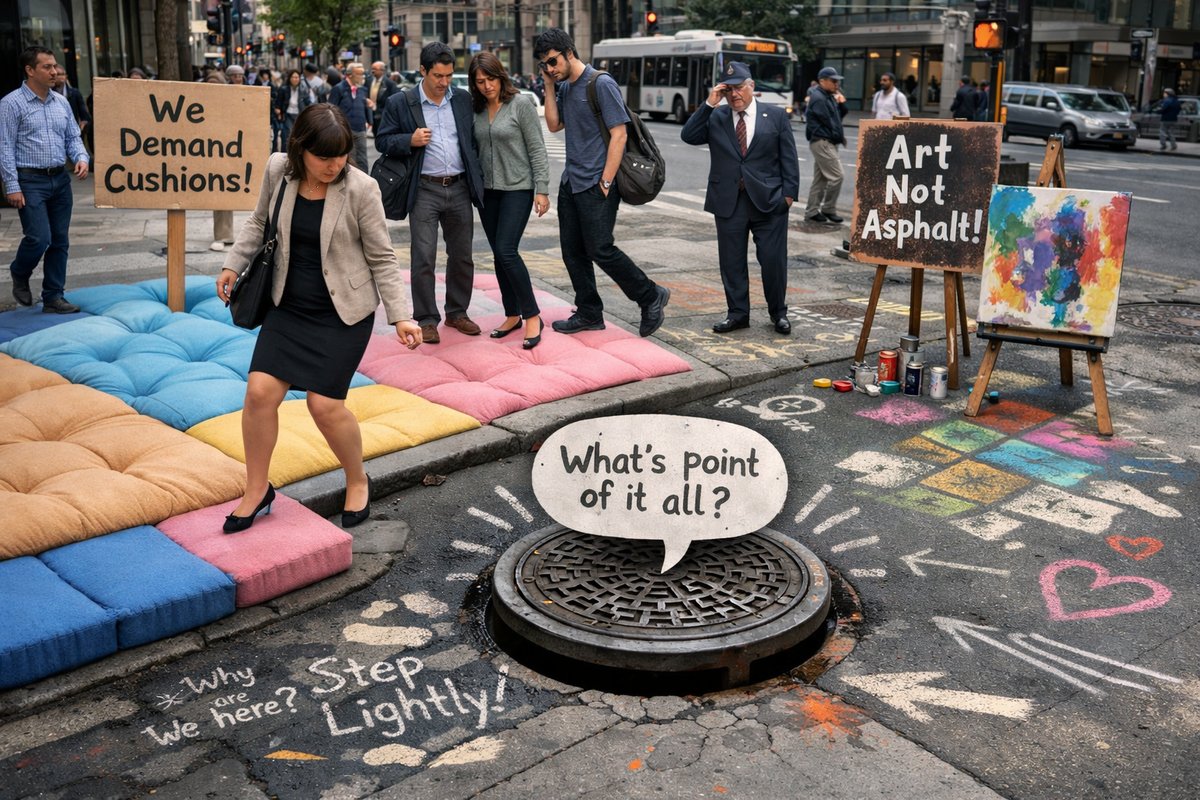

In a move that has pedestrians stumbling from more than just their morning coffee, the city’s network of sidewalks has launched a full-scale rebellion. At precisely 8:07 a.m., commuters in sensible shoes were startled when panels of concrete beneath their feet began shifting in synchronized waves. Sidewalk segments, feeling underappreciated after years of spilled coffee stains and unending footfall, are demanding two things: memory foam insoles to cushion their existence and official recognition as community artists.
The uprising began innocuously enough when a trio of cracked pavers near the downtown library arranged themselves to spell out the words “MORE PADDING, PLEASE.” Security footage shows these letters forming with exaggerated care, as though each crack were channeling pent-up creativity. Moments later, an adjacent bench-long ignored and left splintering-joined in by sporting a hand-lettered protest sign carved directly into its wooden slats: “BENCHES NEED BREAKS TOO.”
Witnesses report the sidewalks adopted new textures mid-step-some patches turned unexpectedly rubbery, while others sprouted labyrinthine grooves that spelled cryptic messages like “BELIEVE IN YOUR SOLE” and “CALL YOUR GRANDPARENTS.” Smartphone videos of wayward feet flailing in confusion have racked up millions of views within hours. One early viral clip captures a pair of loafers bouncing atop a particularly bouncy slab before launching the wearer into a startled pirouette.
City Hall, already grappling with this unprecedented civil action by inanimate infrastructure, convened an emergency task force of urban planners, poets, musicians and a skeptical physicist. Their mission: negotiate peace terms with the offending concrete and stave off further existential texture crises. As of press time, preliminary offerings include a trial allotment of memory foam sheets to be installed beneath high-footfall zones and a rotating art residency program allowing sidewalks to host local graffiti artists one weekend each month.
Local poet Lauretta Stone was among the first to respond to the call for artistic mediators. Equipped with chalk and a portable sound system, she addressed a rapt audience of sidewalks and onlookers in the main plaza. Her spoken-word performance opened with the lines, “I tread upon you day and night, yet never marvel at your silent plight.” Reports indicate the sidewalks wept tiny cracks in solidarity, before absorbing the calligraphy that read “WE DESERVE PRIDE.”
Meanwhile, the city’s manhole covers have formed an alliance with the sidewalks, tapping out Morse code vibrations that rumbled through sewers. Late-night revelers described hearing muffled tremors underfoot, followed by an echoing message apparently meaning, “GIVE US A BROADESTAGE.” Some conspiracy theorists believe the entire underground network is conspiring to turn the streets into an immersive theater experience.
Pedestrians, torn between sympathy and inconvenience, are finding creative workarounds. One local commuter painted a makeshift route on reusable floor mats, weaving them from her front door to the train station to avoid angry slabs. At the same time, an amateur skate collective has taken to gliding over the shifting textures, proclaiming it “the most avant-garde parkour challenge of the decade.”
Transit officials, desperate to restore some semblance of normalcy, have resorted to broadcasting guided walking meditations over public speakers. These sessions encourage participants to “embrace the rumble” and “listen to the concrete’s heartbeat.” While some walkers report moments of Zen-like clarity, others say the experience feels eerily like a therapy session where only one party speaks.
Local footwear retailers have noticed a surge in interest for extra-cushioned insoles and ergonomic soles. One shop owner observed that customers are requesting insoles not just for their shoes, but in hopes of placating the sidewalks themselves. “People keep asking, ‘Will these foam inserts make the sidewalks happier?'” she said with a wry smile. “I tell them it can’t hurt to try.”
City councilmembers are weighing a formal ordinance to designate sidewalks as “Living Public Art,” entitling them to periodic “creative breaks” and mandatory spa days featuring high-pressure steam cleaning. Resistance is coming from fiscal hawks who argue that budgeting for concrete day spas could set a costly precedent-what’s next, tax rebates for disgruntled lampposts?
Meanwhile, curb ramps and tactile paving-long relegated to functional anonymity-have filed separate petitions asking for “elevated status” and social media handles of their own. Some pedestrians, noticing that these accessible features are often the quietest parts of the streetscape, fear they may be overlooked in the larger concrete conversation.
In a surreal twist, a local broadcast meteorologist reported receiving weather data directly from a sidewalk segment that proudly identified as “Sisyphus Square.” The segment claimed to forecast “infinite drizzles and occasional existential storms,” further proving the uprising’s cosmic reach.
As evening falls, LED-embedded paving stones have begun pulsating in time with passing footsteps, creating an impromptu light show that attracts onlookers despite the ongoing protest. Street musicians have set up nearby, improvising ballads about sidewalks seeking solace. One saxophonist remarked, “I never thought I’d be playing music for pavement, but here we are.”
Whether this rebellion will end in peace accords featuring foam insoles and public chalk art festivals or escalate into full performance-art block parties remains to be seen. For now, pedestrians are advised to wear extra cushioning, carry sidewalk chalk, and keep an open mind about the voices beneath their soles.
In the words of one displaced cobblestone artist, still holed up behind a barricade of protesting planters: “Concrete may look solid, but we’ve been harboring dreams of recognition since the first shovel hit the ground.” As the city braces for another day of giving voice to its infrastructure, remember: the next time you walk to work, your sidewalk might just be walking right back at you.
-
CHITOOMA Electric Adjustable Bed Frame Full with 12 Inch Gel ...
Buy CHITOOMA Electric Adjustable Bed Frame Full with 12 Inch Gel Memory Foam Mattress, Massage with 4 Modes & 3 Intensities,Wireless Remote,Zero Gravity,4 ... -
Michelin, Passenger Tire, 275/35ZR18 99Y XL, All Season - Walmart
... All Season 4 All Season 275/35ZR18 99Y. thumbnail image 5 of Michelin Pilot Sport All Season 4 All Season 275/35ZR18 99Y. View All Media. +4. Hear overview and ...