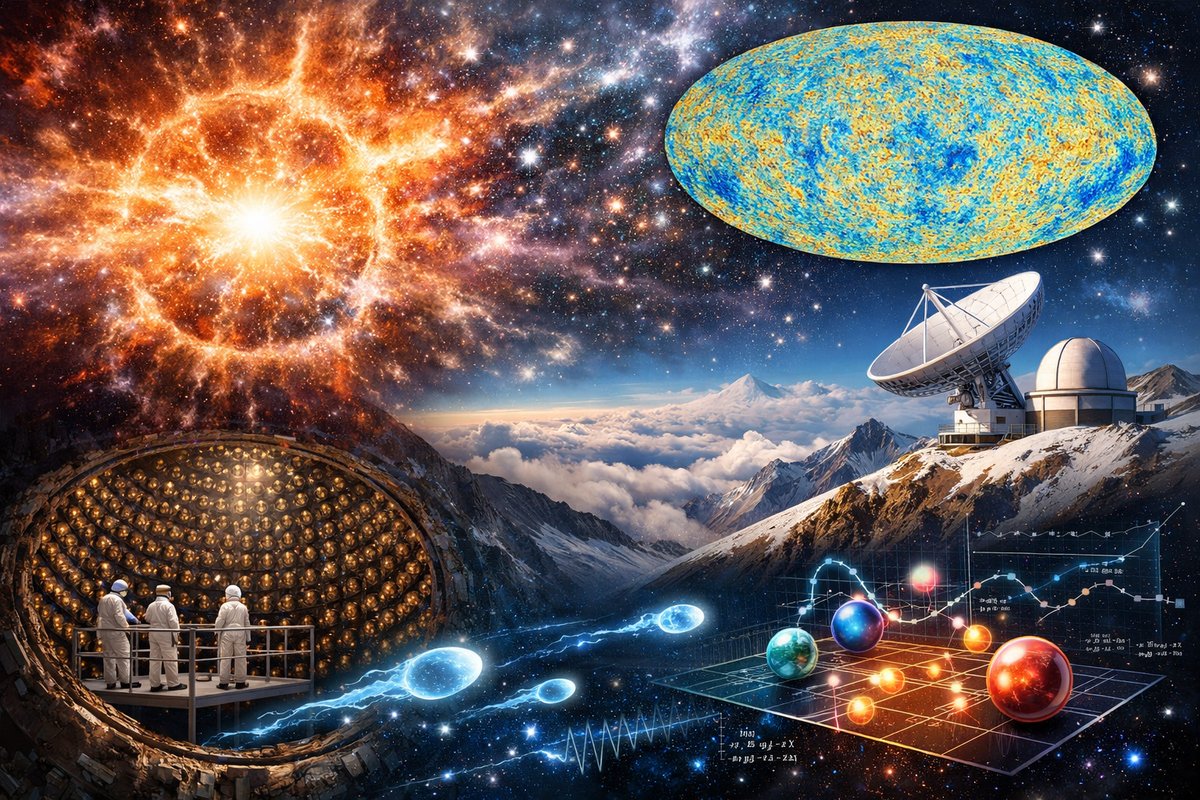

A wave of excitement is rippling through the cosmology community as new neutrino observations and high-precision cosmic microwave background (CMB) studies converge to probe times earlier than ever before. Deep beneath the Earth’s surface, an underground neutrino observatory has reported the first statistically significant detection of cosmological neutrinos-ghostlike particles that decoupled mere seconds after the universe sprang into being. Simultaneously, ground-based telescopes at high-altitude plateaus are delivering sharper CMB maps, revealing subtle anisotropies that hint at surprises in the infant cosmos.
The subterranean facility, shielded by more than two kilometers of rock, uses ultra-pure water tanks surrounded by light sensors to catch fleeting flashes from neutrino interactions. By isolating signals at energy ranges consistent with relic neutrinos, researchers have glimpsed a sea of particles that streamed freely when the universe was scarcely one second old. Though these detections remain at the edge of statistical significance, follow-up campaigns aim to confirm whether fluctuations in arrival rates reflect ancient quantum ripples or environmental noise.
Above ground, the Simons Observatory array and a complementary satellite mission have refined measurements of the CMB’s temperature and polarization down to arcminute scales. These maps expose minute temperature differences-mere millionths of a degree-across the sky. Unexpected cold and hot spots have emerged, deviating slightly from predictions of a perfectly smooth inflationary expansion. If confirmed, these anomalies could point to physics beyond the simplest inflation models, perhaps revealing interactions among quantum fields or hints of exotic particles in the primordial plasma.
One puzzle revolves around so-called B-mode polarization patterns in the microwave sky. Generated by primordial gravitational waves, these swirling imprints have proven elusive. A recent reanalysis of combined ground and satellite data suggests a faint B-mode signal at large angular scales. While dust in our galaxy can mimic such patterns, teams are applying advanced component-separation algorithms to disentangle cosmic signals from local contaminants. Confirmation of primordial B-modes would represent a direct signature of inflation’s most extreme energy scales.
These observations feed into a longstanding paradox in cosmology: the horizon problem. Regions of space separated by billions of light-years appear to share the same temperature, even though light could not travel between them before decoupling. Inflation offers a solution by stretching tiny, causally connected patches to cosmic size. Yet the detailed shape of the CMB anomalies hints that inflationary dynamics might be more complex, perhaps involving multiple interacting fields or steps in the inflaton potential.
In response, theorists are refining multi-field inflation models that predict distinct patterns of non-Gaussianity-deviations from the simple random fluctuations usually assumed. By comparing these models against the observed distribution of hot and cold spots, researchers hope to identify signatures of field couplings or phase transitions within the first fraction of a second. Such a discovery would open a new window onto high-energy physics otherwise inaccessible to particle colliders.
Another cosmic riddle is the matter-antimatter asymmetry. The universe is overwhelmingly composed of matter, despite theories that the Big Bang should have produced equal parts matter and antimatter. Experiments using particle accelerators and rare decay studies have tightened constraints on CP-violation processes, but they fall short of explaining the observed asymmetry. Some physicists now propose that interactions among hypothetical heavy neutrinos in the early universe could tip the balance, a mechanism known as leptogenesis. Neutrino-detector upgrades and precision measurements of neutrino mass hierarchy are critical to testing these ideas.
At the other extreme of cosmic formation lies dark matter, which outnumbers ordinary matter by roughly five to one. Yet its identity remains a mystery. New cosmological surveys have mapped dark-matter distributions with unprecedented precision, revealing small-scale clumps that challenge simple cold-dark-matter models. To reconcile observations, some theorists have introduced self-interacting dark matter or warm dark matter scenarios. Upcoming galaxy surveys and 21-centimeter line experiments will probe the dark sector’s role in structure formation at high redshift.
Beyond photons and neutrinos, gravitational waves offer a third messenger. The next generation of CMB polarization experiments aims to isolate B-mode patterns from primordial gravitational waves generated during inflation. At the same time, space-based detectors under design will hunt for a stochastic gravitational-wave background across a broad frequency range. Detecting this relic hum would provide a direct probe of quantum fluctuations in spacetime itself.
Closer to home, proton-decay experiments in deep mines are pushing detection thresholds to unprecedented lifetimes. If protons decay, as predicted by certain grand-unified theories, it would signal a unification of fundamental forces at energies far beyond current colliders. Null results thus far have eliminated many theoretical models, narrowing the path toward a consistent description of all forces.
Cosmologists and particle physicists are also contemplating more speculative scenarios involving a multiverse. Some inflationary models naturally spawn “bubble universes” with varying physical constants. Though direct tests seem implausible, researchers are exploring whether bubble collisions could leave imprints on the CMB or gravitational-wave spectrum. Such signatures would revolutionize our understanding of reality’s scope.
A critical ingredient in all these efforts is computational power. From handling petabytes of telescope data to simulating quantum field dynamics during inflation, advanced algorithms and machine-learning tools are transforming analysis. AI-driven anomaly detection can flag subtle deviations in terabyte-scale sky maps, guiding scientists to potential discoveries.
Public engagement is thriving as well. Citizen-science platforms now invite enthusiasts to classify galaxy shapes, scan radio-telescope data for fast radio bursts, and even search for CMB anomalies. Open data policies ensure that raw cosmological observations are accessible to researchers worldwide, fostering collaboration across disciplines.
Taken together, these threads weave a rich tapestry. Each neutrino detection, each refined microwave map, each theoretical refinement brings us closer to reconstructing conditions in the universe’s first heartbeat. While many questions remain-about inflation’s nature, the origin of matter’s dominance, the essence of dark matter-the pace of discovery has rarely been this brisk.
The coming decade promises further breakthroughs. New observatories on the ground and in space will delve deeper into the cosmic microwave background, high-precision neutrino and proton-decay detectors will push experimental frontiers, and next-generation gravitational-wave observatories will open yet another channel. Whether the ultimate theory lies in elegant simplicity or a tapestry of competing fields and forces, the hunt for the universe’s origin story remains one of humanity’s grandest scientific adventures.
As detectors hum, telescopes scan, and theorists refine their equations, our cosmic origin saga enters its most thrilling chapter yet. Each advance illuminates the forces and particles that shaped all we know-and hints at phenomena we have yet to imagine.