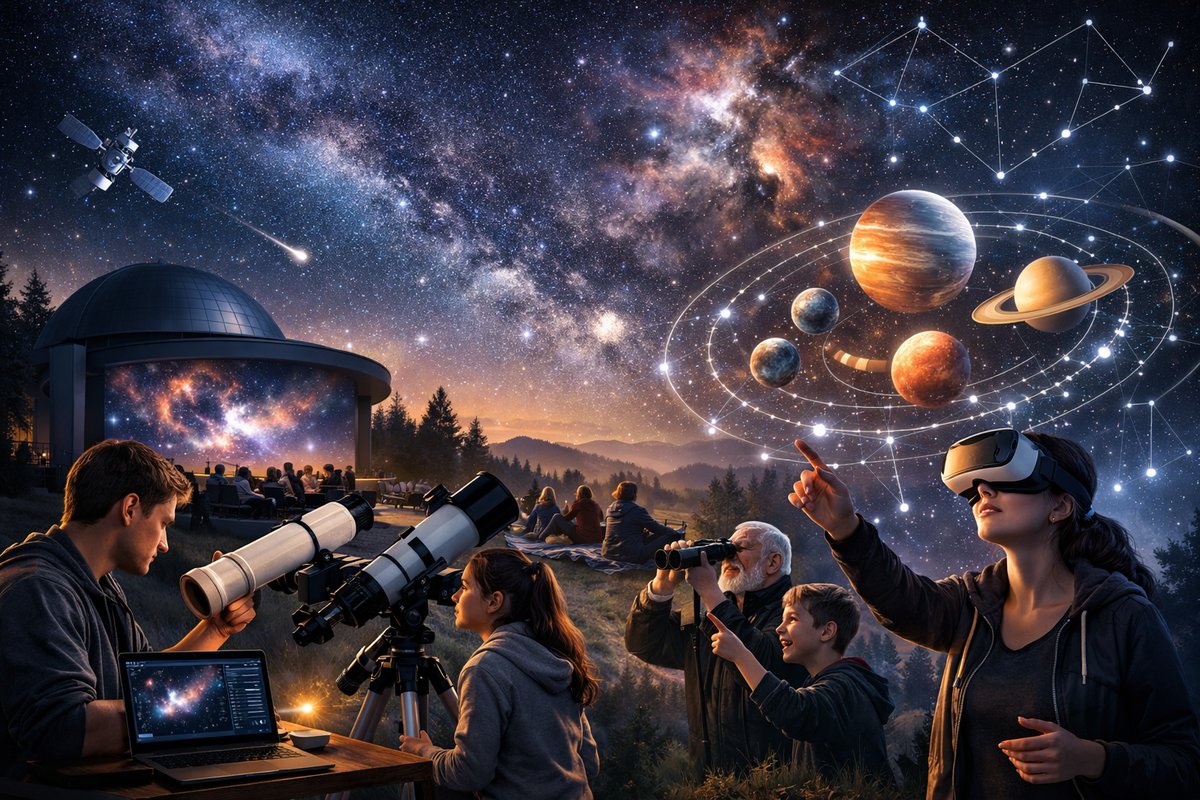

When the first hints of twilight blend into a curtain of stars, an invitation unfolds. It’s not just a view; it’s a call to wonder. In the last year, community dark-sky reserves have doubled in number across several continents, while smartphone stargazing apps have recorded millions of new downloads. This groundswell of interest suggests something more profound than a passing interest in constellations. It marks a new chapter in how we encounter-and engage with-the cosmos.
At the heart of this movement is accessibility. High-quality telescopes once reserved for university observatories now come in portable, plug-and-play models that fit in a backpack. Citizen-science platforms let enthusiasts log meteor sightings, track variable stars, and even spot new exoplanets. Far from sitting on the sidelines, these everyday explorers are adding real data to professional research, creating a bridge between backyard curiosity and scientific discovery.
Consider the story of a group of high school students who recently tracked a rare planetary conjunction from a suburban backyard. Armed with a mid-range telescope and an open-source star-chart app, they not only captured time-lapse images but also submitted brightness readings to an international database. Their observations helped refine the orbital path of one of Jupiter’s lesser-known moons-proof that cosmic exploration isn’t bound by age or professional training.
Still, the night sky can feel intimidating. Light pollution washes out faint nebulae, while weather patterns keep cloud cover in constant flux. In response, a wave of urban stargazing initiatives has emerged. Pop-up observatories in city parks offer guided tours through telescopes, paired with projected star maps on portable domes. These mobile planetariums bring the Milky Way to neighborhoods where skylines usually block the view, rekindling a sense of connection to the wider universe.
Technology is a key enabler. Augmented-reality headsets overlay digital star guides onto real skies, making it easier to identify constellations and track satellites in motion. Virtual tours of deep-space objects invite users to “fly” through the Pillars of Creation or spiral around distant galaxies. These immersive experiences neutralize skill barriers, empowering newcomers to feel at home among the stars.
Yet the revival of cosmic curiosity isn’t just about gadgets. It’s rooted in a deeper longing for perspective. During times of global turbulence-economic uncertainty, political polarization, environmental stress-the infinite backdrop of space can be both humbling and hopeful. Astronomers and philosophers alike note that contemplating vast cosmic scales helps reduce anxiety by reframing personal challenges within a grander context. In this sense, stargazing becomes a form of collective therapy.
Environmental stewardship is a parallel theme. Dark-sky advocates emphasize sustainable lighting solutions that reduce glare and preserve nocturnal habitats. By installing shielded fixtures and using warmer lighting temperatures, communities are learning that protecting the night sky goes hand in hand with energy conservation. These initiatives create a ripple effect: fewer city lights, clearer skies, and renewed opportunities for everyone to look up.
Digital connectivity amplifies these efforts. Online forums, livestreamed telescope feeds, and real-time meteor trackers transform solitary stargazing into a shared adventure. A single meteor shower can draw thousands of participants tuning into the same camera feed, each one adding commentary, photos, and data points. The result is a living tapestry of human curiosity woven into the fabric of the cosmos.
Astrophotography remains one of the most popular portals into skywatching. Mirrorless cameras paired with star-tracking mounts produce crisp images of galaxies millions of light-years away. New machine-learning tools help process raw data, enhancing faint details and reducing noise. These innovations have democratized what was once a specialized craft, enabling hobbyists to achieve near-professional results from their patios or local parks.
Beyond still images, time-lapse movies of the night sky are capturing imaginations on social media. Long exposures reveal the rivers of the Milky Way arcing overhead, while star-trail loops trace Earth’s rotation in hypnotic spirals. When shared online, these sequences spark conversations about our place in the universe-reminding viewers that every point of light is a sun, potentially hosting worlds of its own.
Cultural institutions are also embracing cosmic curiosity. Museum exhibits featuring interactive simulations, telescope demonstrations, and live Q&A sessions with astronomers draw enthusiastic crowds. Planetary-science lectures transition into stargazing nights on museum rooftops. The interplay between formal education and hands-on exploration nurtures a generation that sees curiosity not as a solitary pursuit but as a communal act of discovery.
The forward momentum is palpable. Private organizations are funding new ground-based observatories in under-served regions, while universities open remote telescope networks to public use. Even space agencies are inviting public participation in mapping surface features on Mars or classifying asteroids. These projects blend professional expertise with grassroots enthusiasm, illustrating that the frontier of exploration extends well beyond institutional walls.
So what comes next? As optics, sensors, and AI continue to advance, we can expect ever-richer windows into the cosmos. Portable spectroscopes may allow backyard astronomers to analyze starlight composition in real time. Holographic star charts could project constellations onto tabletops. Citizen-research missions might crowdsource signals from new moons and minor planets in the outer solar system.
Ultimately, this resurgence of cosmic curiosity is more than a pastime-it’s a social evolution. It forges connections across age, geography, and background, uniting people in shared wonder. Under the same sky, urban neighborhoods and remote villages alike can feel the pull of something greater than ourselves. And in that collective stargazing, we find not just data or images, but a renewed sense of belonging to the universe we inhabit.
As night falls and earthbound concerns fade, an endless panorama unfolds above. Every flicker of starlight carries a story waiting to be told-and with each observation, we become authors in an ever-expanding chronicle of cosmic discovery.