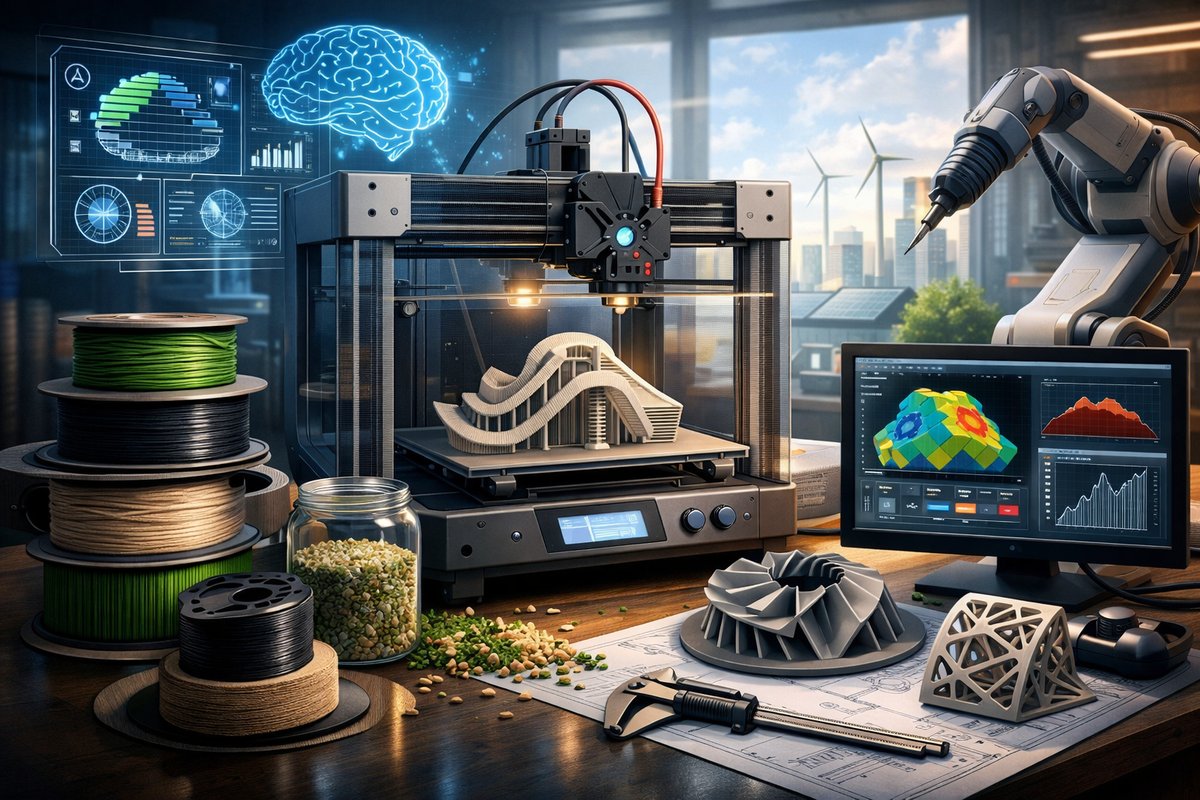

From hobbyist workbenches to professional makerspaces, the landscape of 3D printing is undergoing a profound transformation. The rise of modular approaches-where printers, materials, and post-processing tools can be swapped and upgraded like building blocks-has opened doors to unprecedented flexibility and rapid iteration. No longer confined to a single machine or filament type, today’s enthusiasts can mix and match components to suit specific projects, whether that means crafting intricate architectural models with fine-detail resin or producing functional prototypes in durable thermoplastics. This shift toward modularity not only accelerates production cycles but also invites a broader community of learners to engage with additive manufacturing without the fear of obsolescence.
At the heart of this revolution are novel materials designed for sustainability, performance, and aesthetic flair. Biodegradable PLA remains an entry point for many, prized for its ease of use and vibrant color options. Beyond standard polymers, composite filaments infused with wood fibers, metal powders, or carbon additives enable finishes that mimic real-world surfaces and add structural reinforcement. High-temperature engineering plastics such as PETG, ABS, and nylon now boast improved layer adhesion and impact resistance, expanding the arena of functional parts from automotive components to patient-specific medical models. Meanwhile, water-washable resins and bio-derived photopolymers are lowering environmental impact and easing safety concerns in home studios.
Yet materials alone tell only half the story. Precision hardware and auxiliary tools are instrumental in harnessing the full potential of printable substrates. Digital calipers and micrometer gauges verify critical dimensions before and after printing, ensuring designs meet tight tolerances. Filament dryers and sealed storage boxes control humidity to prevent brittle, bubbly extrusions. Upgraded nozzles in hardened steel or ruby tips stand up to abrasive compounds, preserving fine detail when printing with composite blends. Even modest investments in a temperature-controlled enclosure stabilize ambient conditions, reducing warping on large ABS parts or preventing cracking in resin cures. Each accessory contributes to consistent outcomes, turning occasional successes into reliable workflows.
Advances in multi-material and multi-color printing are redefining what additive manufacturing can achieve in a single build. Dual-extrusion heads allow simultaneous deposition of rigid and flexible materials, opening up applications like living hinges or overmolded electronics housings in a single pass. Hybrid machines that combine filament deposition with resin vats or powder beds bring high-resolution features and varied mechanical properties into a unified platform. On the software side, AI-driven slicing engines analyze geometry to optimize support placement, toolpaths, and cooling schedules in real time. This intelligent automation reduces user guesswork, accelerating the leap from design file to finished part while minimizing material waste and print failures.
Design strategies have adapted to this dynamic toolkit, spawning techniques that blur the line between analog craftsmanship and digital fabrication. Conformal lattice structures, generated through topology optimization tools, reduce weight while maintaining strength-an approach once reserved for aerospace engineers that is now accessible on desktop platforms. Embedded fasteners and cable channels can be printed directly into housings, eliminating drilling and glue-ups during assembly. Post-processing workflows leverage simple jigs that hold complex parts for uniform sanding, priming, or electroplating. Even hand-applied treatments such as solvent smoothing or light spray-on sealants can impart polished, professional finishes to prints destined for product showcases or end-use prototypes.
Sustainability is no longer an afterthought but a guiding principle in material selection and waste reduction. Closed-loop recycling systems for PLA scrap enable repeated reuse in secondary prints or support structures. Researchers and indie developers are experimenting with agricultural byproducts-like rice husk and corn waste-as filler materials, diverting organic refuse into functional composites. On the software front, print-oriented nesting algorithms maximize bed usage and generate interlocking support networks that collapse neatly, simplifying removal and recycling. This green-minded approach not only lowers the barrier to entry for makers on a budget but also resonates with designers committed to responsible production practices.
The integration of IoT sensors and cloud-based dashboards is transforming even standalone printers into networked collaborators. Remote monitoring cameras, real-time temperature feeds, and automated alerts keep users informed of print progress and environmental anomalies. Coupled with cloud slicing platforms, these capabilities allow teams distributed across geographies to iterate on designs without the need for local expertise or hardware. In collaborative maker hubs, administrators can allocate print farm resources dynamically, ensuring high-priority jobs receive dedicated nozzles, optimal bed time, and post-processing attention. This democratization of access mirrors trends in distributed manufacturing, where small-scale workshops contribute to larger supply chains without centralized mass-production facilities.
Beyond technical prowess, the modular ethos fosters resilience and continuous learning. Novice makers can start with a basic resin or filament model and upgrade to dual-extrusion heads, automated leveling modules, or laser engraver attachments as confidence grows. Online communities share step-by-step guides for retrofitting machines with custom toolheads-transforming a printer into a CNC mill or a pencil plotter with minimal hardware tweaks. These open-source projects encourage experimentation and empower people to troubleshoot issues, adapt designs, and innovate on top of existing platforms. The result is a culture of perpetual improvement where failures become instructive milestones rather than discouraging setbacks.
Looking ahead, the fusion of robotics and additive workflows hints at factory-floor automation that maintains the agility of a desktop system. Mobile print arms could traverse large structures, depositing concrete or polymer layers for rapid construction. Smart tool changers might swap extruders mid-print, embedding electronics, sensors, or conductive inks within structural parts. As machine learning models evolve, slicing engines will anticipate mechanical stresses, recommending design tweaks or infill patterns to reinforce critical zones. In education, kids will assemble modular printer kits that teach coding, electronics, and materials science in parallel. The boundaries between design, engineering, and manufacturing are dissolving, creating a participatory ecosystem where anyone with curiosity and a small workspace can shape tangible change.
-
Polymaker PETG Black 3D Printer Filament 1.75mm ... - Amazon.com
Amazon.com: Polymaker PETG Black 3D Printer Filament 1.75mm 1kg, High Speed PETG up to 300mm/s, High Strength New Formula, Excellent Layer Adhesion, ... -
YOUSU Carbon Fiber Filament 1.75mm - Reinforced ... - Amazon.com
... Filament Etc. Carbon fiber filaments are composite materials formed by infusing fragments of carbon fiber in a polymer base, similar to metal-infused ... -
3D Printer Enclosure with LED Lighting, Fireproof ... - Amazon.com
Buy 3D Printer Enclosure with LED Lighting, Fireproof Dustproof Tent Constant Temperature Protective Cover for Creality Ender 3 V3 SE/KE/Ender 3/Ender 3 ... -
KETOTEK Digital Caliper Measuring Tool, IP54 Waterproof Stainless ...
KETOTEK Digital Caliper Measuring Tool, IP54 Waterproof Stainless Steel Electronic Vernier Caliper 6 Inch/150mm Digital Micrometer with Large LCD Screen: ... -
【2025 Special Bundle】 SUNLU Official Filament ... - Amazon.com
Amazon.com: 【2025 Special Bundle】 SUNLU Official Filament Dryer Box S4,Four-Spool 3D Printer Dehydrator with Rapid Heating, Auto Humidity Control, ... -
Creality Upgraded 3D Printer Tool Wrap Kit Pro ... - Amazon.com
... Finishing : Industrial & Scientific. ... ➤Post-processing Tools for Perfecting Models: Chamfer knife with 360° rotatable blade, for precisely refining ...