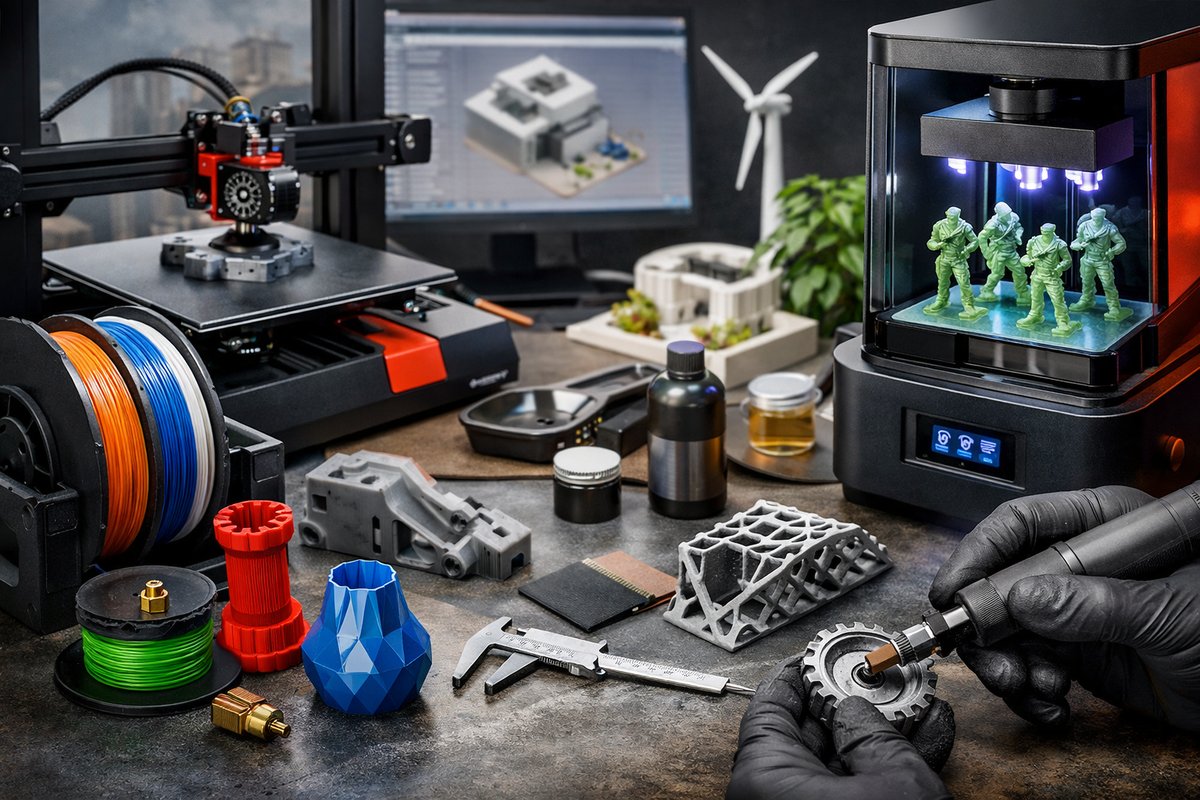

Three decades ago, 3D printing felt like science fiction. Now a compact FDM machine can sit on a kitchen table while a desktop resin printer can produce fine jewelry prototypes or dental models with microscopic detail. The essence of 3D printing lies in turning digital blueprints into physical objects, weaving together materials science, mechanical precision, and creative problem-solving. Whether you’re a novice setting up your first build plate or an experienced tinkerer exploring multi-material assemblies, understanding the full ecosystem of materials, technologies, and techniques is essential for achieving consistent success and pushing the boundaries of what’s possible.
At the heart of any extrusion-based setup are thermoplastic filaments. Polylactic Acid (PLA) remains the go-to for beginners: it’s biodegradable, easy to heat, and warps less than many alternatives. ABS offers greater impact resistance and higher heat tolerance but requires an enclosed chamber to minimize cracking. PETG blends toughness with slight flexibility, while specialized blends infused with carbon fiber or wood particles deliver enhanced stiffness or aesthetic textures. Beyond thermoplastics, flexible TPU filaments open doors to functional parts like gaskets or wearables. Powder-based technologies in Selective Laser Sintering (SLS) let you print nylon parts with intricate lattices, eliminating support structures and unlocking new mechanical properties. Resin systems used in Stereolithography (SLA) and Digital Light Processing (DLP) shine when extreme resolution and smooth surface finish matter most, though they demand proper ventilation, safety gloves, and post-cure UV exposure for full strength.
The machines themselves come in many flavors. Fused Deposition Modeling printers range from cost-effectively simple open-frame kits to industrial dual-extruder workhorses capable of printing soluble supports. Resin printers use LED arrays or laser diodes to solidify liquid photopolymers in fine layers, delivering detail down to tens of microns. On the high end, powder-bed fusion systems handle sintering of metal or ceramic powders for aerospace and medical components, though they’re still out of reach for most hobbyists. Each technology carries its own temperature requirements, safety considerations, and maintenance routines. Enclosed chambers with HEPA or activated carbon filters reduce fumes from ABS and resin machines, while heated build plates aid layer adhesion. Removable build surfaces-flexible magnetic spring steel sheets, textured PEI sheets, or glass plates-simplify part removal and minimize risk of damage to the printer’s mechanics.
Precision is the name of the game. Achieving crisp corners, accurate dimensions, and repeatable results often depends on dialing in calibration. Digital calipers become indispensable for measuring test cubes, checking nozzle-to-bed distances, or verifying filament diameters. A reliable bed-leveling probe-inductive, capacitive, or mechanical-coupled with mesh bed-level compensation can compensate for slight warps across the platform. Upgraded all-metal hot ends enable higher temperature range for exotic filaments, while hardened steel nozzles resist wear from abrasive blends. Direct-drive extruders excel at flexible filaments by minimizing bowden-tube distance, whereas geared extruders offer extra torque for consistent feed rates. Even simple accessories like a filament guide tube or a filament tensioner can make the difference between smooth prints and snarled extrusions.
Design and slicing form the digital backbone of any project. Beginner-friendly CAD programs allow intuitive model creation with drag-and-drop shapes, while advanced parametric tools support complex assemblies and generative design. When exporting STL files, attention to manifold geometry and wall thickness prevents slicing errors. Slicer software transforms 3D models into machine instructions: layer height, print speed, wall count, and infill pattern all play roles in strength and print time. Conformal supports, tree supports, and custom skirts or brims keep overhangs stable. Progressive slicer features like variable layer heights optimize surface finish on curved features without sacrificing speed on flat sections. For multi-material setups, tool-change scripts and color-swap pauses let you embed rigid cores inside flexible exteriors or create two-tone prototypes seamlessly.
No print is truly finished until it’s cleaned up and treated for its end use. FDM parts often require a few minutes of manual sanding to erase layer lines, especially around stair-stepping on sloped surfaces. Chemical smoothing-such as an acetone vapor bath for ABS-yields glossy results but demands airtight chambers and strict safety precautions. Resin prints emerge tacky and need an isopropyl alcohol bath to rinse uncured resin before a final UV cure stage. Dedicated resin curing stations with rotating turntables and timed LED arrays ensure uniform exposure. For functional parts, epoxy coatings or cyanoacrylate fillers enhance water resistance and mechanical strength. Painting protocols begin with primer sprays, followed by airbrushing or hand-brushing with acrylics, and conclude with clear coats for UV protection and scratch resistance.
Sustainability is increasingly woven into the 3D printing narrative. Biodegradable filaments reduce reliance on petroleum-based plastics, while users recycle failed prints and purge chunks into compact filament extruders to feed back into the pipeline. Powder-based systems reclaim and reuse unsintered powders, minimizing waste. Energy-efficient LED curing systems and low-temperature extruders lower the overall carbon footprint. Open-source microcontrollers and 3D-printed upgrade parts empower repair-over-replace philosophies, extending the lifespan of hardware. Community-driven repositories host millions of freely shared models, from functional tool holders to custom prosthetics, fostering collaboration and reducing redundant manufacturing.
Looking ahead, the frontiers of 3D printing beckon with embedded electronics, multi-material composites, and bioprinting. Conductive filaments and microcontrollers inside printed housings blur the lines between electronics and structure. Shape-memory polymers and hydrogels hint at 4D-printed objects that change shape over time or in response to stimuli. Bioprinters layer living cells with gels to research tissue regeneration, while large-format gantry systems fabricate full-scale building components in sustainable construction. Continuous glass fiber reinforcement on desktop FDM machines promises parts rivaling aerospace-grade composites in strength-to-weight ratio. New slicing algorithms leveraging artificial intelligence optimize support placement and path planning, shaving hours off complex prints.
Whether you’re creating cosplay props, prototyping mechanical assemblies, crafting custom orthodontic trays, or producing replacement parts for vintage equipment, modern 3D printing underscores the marriage of imagination and engineering. Each filament, each calibration tweak, each post-processing step shapes the final result. By exploring diverse materials, mastering precise tool setups, and adopting mindful finishing techniques, makers transform abstract concepts into functional reality. Embrace experimentation, lean on the community’s wealth of collective knowledge, and keep an eye on emerging technologies. The next breakthrough may come from a novel bio-ink, an open-source hardware upgrade, or a slicer feature that redefines speed and quality. In this ever-shifting landscape, curiosity and adaptability remain your most valuable tools.
-
Kynup Digital Calipers, Caliper Measuring Tools IP54 ... - Amazon.com
Buy Kynup Digital Calipers, Caliper Measuring Tools IP54 Waterproof Protection Design, Stainless Steel Measuring Tools Easy Switch from Inch Metric Fraction ... -
KETOTEK Digital Caliper Measuring Tool, IP54 Waterproof Stainless ...
KETOTEK Digital Caliper Measuring Tool, IP54 Waterproof Stainless Steel Electronic Vernier Caliper 6 Inch/150mm Digital Micrometer with Large LCD Screen: ... -
Battery Cover Lid Fit for Digital Calipers, Compatible ... - Amazon.com
Amazon.com: Battery Cover Lid Fit for Digital Calipers, Compatible with Model Series Up to 50018230 : Industrial & Scientific. -
Amazon.com: Creality Filament Dryer Box 2.0 Dehydrator ...
The Creality 3D Printer Filament Dry Box combines a 24-hour timer function, allowing for customizable heating times, with real-time monitoring and a countdown ... -
【2025 Special Bundle】 SUNLU Official Filament Dryer Box ...
Four-spool 3D printer dehydrator with rapid heating, auto humidity control, and advanced triple fan upgrade, fits PLA,PETG,ABS,TPU,PA,etc. -
3d Printer Filament Dryer Box
Caydo Filament Dryer, 3D Printer Filament Dry Box with Auto Humidity Control for Anti-Moisture Filament Storage, 350W PTC Heater, 35-70℃ Temperature & 99H Timer ...